
Rabbit Hole · Who Decides · 12 min
The BIP Process
How an idea becomes a Bitcoin Improvement Proposal, what the editors actually control, why most proposals die, and how the ones that matter get activated - including the covenant activation fight underway in 2026.
Where you're going: Bitcoin has no product team and no roadmap, yet it ships upgrades. The unit of change is the BIP, the Bitcoin Improvement Proposal - a numbered text file in a public repository. This chapter covers where BIPs came from, what the editors who run the repository actually control (much less than people assume), the lifecycle a proposal moves through, how the important ones get activated on the network, and why the covenant proposals everyone argues about today have been sitting at Draft for years. If you read our block size war chapter, this is the same governance machine viewed from the inside.
A text file with a number
Every deliberate change to Bitcoin you have ever heard of - SegWit, Taproot, the block size increases people fought over - started life as a text file. A Bitcoin Improvement Proposal is a design document with a number, a specification, and a motivation section, kept in a public repository that anyone can read.
The convention is borrowed. In 2011 a developer named Amir Taaki adapted Python's PEP process for Bitcoin and wrote the result up as BIP-1, in places simply copying the Python text and swapping the names. The governance instrument for a monetary network was cribbed from a programming language's paperwork, and it worked, because the problem is the same. How does a project with no boss agree on changes? You write proposals down, number them, and argue about them in public.
BIP-1 established three kinds of proposal, and the categories survive in updated form today: consensus and standards changes (the ones that alter what software must do), informational documents, and process documents - proposals about how proposals work. Keep that last category in mind; it comes back.
What the editors actually do
The repository is maintained by BIP editors, and the single most misunderstood thing about Bitcoin governance is what those editors control.
They assign numbers. They check that a submission is on topic, properly formatted, coherent, and licensed acceptably. Under the current process document they are explicitly barred from judging whether a proposal is a good idea or likely to be adopted. An author cannot self-assign a number; drafts circulate under working names until an editor assigns one in public. But once a proposal meets the formal bar, the editors are not supposed to stand in its way, however much they may personally dislike it.
From January 2016 the editor was Luke Dashjr, joined by Kalle Alm in 2021, and a team that small made the role a recurring flashpoint: every delayed number assignment looked like gatekeeping, whatever the reason. In April 2024 the list was rewritten. Alm came off it, and Bryan Bishop, Jon Atack, Mark "Murch" Erhardt, Olaoluwa Osuntokun and Ruben Somsen joined Dashjr. Dashjr was removed in August 2026, which left five editors.
The cleanest illustration of what a BIP number means is the OP_CAT episode. Its supporters campaigned for the meme number 420. The editors assigned 347, the next sensible slot, in April 2024. The press covered the number assignment either way, and none of it moved the proposal an inch closer to activation, because a BIP number is a filing label. It is not an endorsement, and it is not a prediction.
The lifecycle
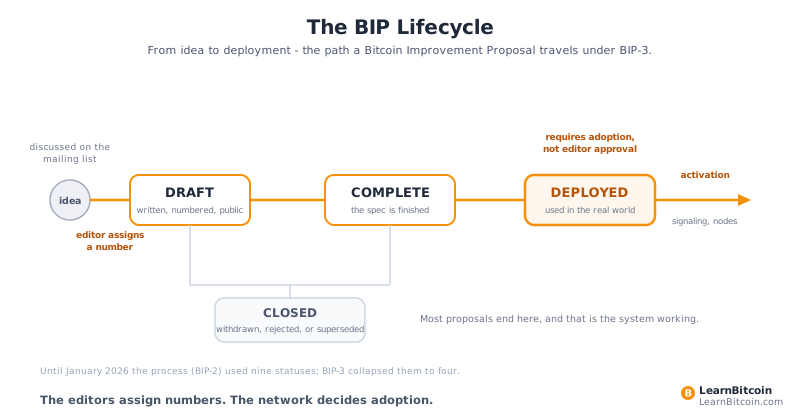
For most of Bitcoin's history the lifecycle came from BIP-2, a 2016 process document by Luke Dashjr. It defined nine statuses - Draft, Deferred, Proposed, Rejected, Withdrawn, Final, Active, Replaced, Obsolete - and some mechanical rules for moving between them: authors could park or withdraw their own proposals, anyone could request a stale proposal be marked Rejected after three years without progress, and reaching Final required objective evidence of adoption.
In January 2026 a new process document took over. BIP-3, authored by the Bitcoin Core contributor known as Murch, collapsed the nine statuses to four: Draft, Complete (the specification is finished), Deployed (it is in real-world use), and Closed (withdrawn, rejected, or superseded - the terminal bucket). It also tightened the editor role described above and made process documents living documents that can be amended in place.
A proposal to change the proposal process was itself drafted, numbered, argued over in public for more than a year, and adopted through the very process it replaced. The system amended its own constitution using its own rules, twice now (BIP-2 replaced BIP-1 the same way). Nothing about that required anyone's permission, and nothing about it was enforceable until the people using the repository simply started following the new document.
Reaching Deployed
Deployed is the status that matters, and no committee can grant it. A proposal gets there when the network actually runs it.
The bar depends on what kind of change it is. A soft fork has to actually activate on the network, which is the hardest test Bitcoin has. Under the old BIP-2 rules, a wallet-level standard needed at least two independent, compatible implementations before it could be called Final, and a change to how nodes talk to each other needed real nodes speaking it in the wild. The details have evolved, but the principle has never changed: adoption comes first, and the paperwork catches up. There are BIPs that half the wallets on earth implement, and there are BIPs with beautiful specifications that nothing has ever run. The repository just records which is which.
This is the answer to a question newcomers reasonably ask: who approves Bitcoin upgrades? Nobody approves them. Authors propose, editors file, and then the proposal goes out into the world to win adoption or fail to. For consensus changes, that contest has a formal arena.
How a consensus change actually activates
A consensus change is special because every node has to agree on the rules or the network splits. So Bitcoin developed machinery for coordinating the switch-on, and the machinery has its own BIPs.
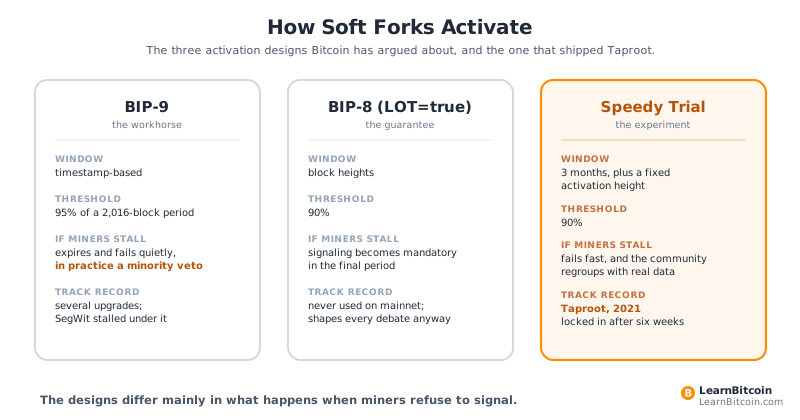
The workhorse is BIP-9, version bits. Miners set a bit in the blocks they mine to signal readiness for a named change. If enough blocks in a difficulty period signal - a stretch of 2,016 blocks, roughly two weeks, and BIP-9 asked for 95 percent of them - the change locks in and activates on schedule. Miner signaling is a readiness check, not a vote: it exists so the network can see that the people building blocks will enforce the new rules, not to give them a veto over whether the rules are wanted.
It became a veto anyway, exactly once. During the block size war, most blocks did not signal for SegWit. Signaling opened in November 2016, and in May and early June 2017 only about 30 percent of blocks signaled for it, far short of the 95 percent it needed. BIP-148, a user-activated soft fork, set a flag day: from August 1, 2017, its nodes would reject blocks that did not signal. The miners behind the SegWit2x agreement took a different route, BIP-91, a separate deployment with an 80 percent threshold that was built to be compatible with BIP-148. Signaling for it took off on July 17 and it locked in on July 21. From July 23, about nine days before the flag day, every block signaled for SegWit until it locked in on August 9. SegWit activated on August 24. UASF supporters credit the flag day for that outcome, and the SegWit2x organizers credit their agreement. The whole fight took two of the ugliest years in Bitcoin's history.
The scar tissue from that fight shaped everything since. BIP-8 generalized the UASF idea into a reusable mechanism: deployment windows measured in block heights, and a flag called lockinontimeout, LOT for short, which when set to true makes signaling mandatory in the final period so the fork cannot be stalled to death. When Taproot came up for activation in early 2021, the community agreed on nearly everything except that flag, and the LOT=true versus LOT=false argument threatened to become its own small war.
What ended the standoff was a deliberate change of question. Speedy Trial, proposed by Russell O'Connor and written up by David Harding in March 2021, said: stop arguing about the guarantee and run a short experiment. Three months of signaling at a 90 percent threshold. Succeed fast or fail fast, and if it fails, debate the stronger mechanisms with data in hand. Miners reached the threshold in June 2021, about six weeks in, and Taproot activated that November at block 709,632. The five-month gap between lock-in and activation was deliberate: a fixed activation height gave node operators time to upgrade no matter how quickly miners signaled.
Taproot remains, as of 2026, the last soft fork to activate on Bitcoin. One protocol upgrade in the better part of a decade is the pace, and nobody who built this system considers that a failure. A monetary network is supposed to be this hard to change.
Most BIPs die, and that is fine
Walk the repository and you find the graveyard. BIP-62, a 2014 attempt to fix transaction malleability by patching its symptoms one by one, was withdrawn by its own author when the whole-cloth fix (SegWit) proved better. BIP-101, the 8 MB block size increase that shipped in Bitcoin XT, is filed as Closed - the most consequential dead BIP in the repository, and the one that opened the war. Dozens of others sit where their momentum ran out: numbered, specified, argued over, and never adopted.
None of that is dysfunction. The process is a filter, and dead proposals are what a working filter leaves behind. Getting a number is easy by design - it costs the editors nothing and it puts the idea on the public record with a citable name. Getting the network to run your idea is hard by design, because the network is a monetary system holding other people's savings, and the burden of proof belongs on the change, not on the status quo. The repository's dead proposals are the receipts of ideas that got their hearing and did not clear the bar. The system worked on them too.
The covenant debate
The covenant debate is the best place to watch the machine run in real time.
Covenants are proposed script capabilities that would let a coin constrain how it can be spent next - the building block for vaults, congestion control, and a family of layer-two designs. Three proposals anchor the discussion. BIP-119, OP_CHECKTEMPLATEVERIFY or CTV, has been sitting at Draft since January 2020. BIP-347, OP_CAT, has a finished specification - status Complete - and, as you would now expect, that alone has moved it no closer to deployment. BIP-348, OP_CHECKSIGFROMSTACK, is a Draft that often travels in a bundle with CTV.
The history already includes one cautionary tale. In April 2022, CTV's author announced a Speedy Trial-style activation attempt through a standalone client, and withdrew it within about ten days under heavy developer pushback. The consistent objection, then and since, has been about process rather than merit: an activation attempt without broad consensus is the block size war's playbook, and everyone remembers how that went. A 2025 open letter asking Bitcoin Core to prioritize CTV and CSFS review within six months drew the same response from several senior contributors - pressure campaigns, they argued, set proposals back.
As we publish this, the question is genuinely open. In early 2026 an independent activation client for CTV appeared with a year-long signaling window that opened in March 2026, echoing the UASF pattern of putting a deadline on the table without Bitcoin Core's involvement. Through the first three months of that window, miner signaling stayed at essentially zero. Whether meaningful signaling materializes, whether Core review moves, whether the whole attempt fades like 2022's did - none of that is knowable from here, and we will not pretend otherwise. What we can tell you is how to read it: watch whether the economic majority of nodes and businesses moves, because as the war chapter showed, that is where activation is actually decided.
What this buys us
The BIP process looks bureaucratic from the outside and anarchic from the inside, and both impressions miss what it does.
- It makes change legible. Every serious proposal gets a number, a specification, and a public paper trail. When you hear that some upgrade is coming to Bitcoin, there is a document to check and a status to read, and now you know how to read it.
- It separates filing from approving. The editors run a filing system rather than a gate. Nobody in the process holds the power people keep assuming someone must hold, and that is on purpose.
- Deployed status is evidence, not authority. A BIP advances when the world adopts it. The repository is a map of what happened, which is why it can be trusted in a way a roadmap never could be.
- The graveyard is the guarantee. Most proposals die, including well-crafted ones with passionate backers. A system where changing Bitcoin is this hard is the same system that makes the 21 million cap worth believing.
The block size war settled who controls Bitcoin's rules. The BIP process is what that settlement looks like as paperwork: ideas in, numbers assigned, arguments in public, and the network, rather than any editor or letter-writing campaign, deciding what becomes Bitcoin.
More in Who Decides
Corrected
-
Was: The chapter said a minority of miners held SegWit back by declining to signal, and that miners began signaling weeks before BIP-148's August 1, 2017 deadline.
Now: Most blocks did not signal. Signaling had been open since November 2016, and in May and early June 2017 only about 30 percent of blocks signaled for SegWit, against the 95 percent it needed. Every block signaled from July 23, about nine days before the deadline, once the BIP-91 deployment took effect. Details
-
Was: The chapter said Luke Dashjr was the only BIP editor for roughly a decade and that the role became a team in February 2024. Its count of six editors went out of date in August 2026.
Now: Dashjr became editor in January 2016 and Kalle Alm joined in 2021. The list was rewritten in April 2024, adding five editors and dropping Alm, and Dashjr was removed in August 2026, leaving five. Details
Sources
- BIP-1 - BIP Purpose and Guidelines (2011)
- BIP-2 - BIP process, revised (2016)
- BIP-3 - Updated BIP Process (deployed 2026)
- bitcoin-dev mailing list - David Harding, Taproot activation proposal Speedy Trial (2021)
- Bitcoin Optech - Soft fork activation
- Bitcoin Optech Newsletter #388 - BIP-3 reaches Deployed (2026)
- Bitcoin Optech Newsletter - the CTV/CSFS open letter and responses (2025)
- Delving Bitcoin - BIP-119 CTV activation client (2026)
- bitcoin/bips commit 1c5c149 - BIP 0001: Change BIP editor to Luke Dashjr (6 January 2016)
- bitcoin/bips commit 4e53b6e - Add Kalle Alm as BIP editor (6 May 2021)
- bitcoin/bips PR #1573 - BIP2: update BIP editors (merged 23 April 2024)
- bitcoin/bips PR #2248 - process: Remove Luke from BIP Editors (merged 10 August 2026)
- BIP 141 - Segregated Witness, deployment (BIP 9 bit 1, signaling from November 15, 2016)
- BIP 9 - Version bits (threshold 1,916 of 2,016 blocks, 95%)
- Bitcoin Magazine - BIP91: The SegWit Activation Kludge That Should Keep Bitcoin Whole (Aaron van Wirdum, June 16, 2017): only some 30 percent of hash power signals for SegWit; the SegWit2x team plans to implement BIP91, designed to prevent a coin split by making SegWit2x and BIP148 compatible
- Mike Belshe - Segwit2x Final Steps (bitcoin-segwit2x list, November 8, 2017, archived): SegWit had only 30% support among miners in May; the Segwit2x organizers write that it broke the deadlock and led to SegWit's activation
- BIP 148 - Mandatory activation of segwit deployment, by Shaolin Fry (from midnight August 1, 2017, by median time past, blocks that do not signal for SegWit on bit 1 are rejected, until SegWit locks in)
- BIP 91 - Reduced threshold Segwit MASF, by James Hilliard (its own deployment on bit 4: activates once 269 of 336 blocks, 80%, signal; while active, blocks that do not signal for SegWit on bit 1 are rejected)
- mempool.space - block 476,448 (23:22 UTC, July 18, 2017): 173 of the previous 336 blocks (mined July 16 to 18) signaled for BIP 91 on bit 4, the first of them at 02:11 UTC on July 17, after 1 of the 336 before them
- mempool.space - block 476,784 (02:53 UTC, July 21, 2017), first block of BIP 91's locked-in period; 284 of the previous 336 blocks signaled bit 4
- mempool.space - block 477,120 (04:46 UTC, July 23, 2017), first block with BIP 91 active; it and every block after it up to SegWit's lock-in signal bit 1
- mempool.space - block 479,808 (12:36 UTC, August 9, 2017), first block of SegWit's locked-in period; all 2,016 blocks of the previous period signaled bit 1
- mempool.space - block 481,824 (01:57 UTC, August 24, 2017), the first block under SegWit rules
- Braiins - Anniversary of the BIP148 UASF (August 1, 2020), a retrospective that celebrates it: SegWit signaling had plateaued at about 30%; it says the UASF put Bitcoin's future in the hands of users, not miners
Published . Revised . Two corrections logged for this page.
Edit this page on GitHub