
Rabbit Hole · How It Works · 13 min
Lightning Routing
The Lightning Network is a graph. Sending a payment is finding a path through it. Here is how routing actually works.
Where you're going: Lightning is often described as a "second layer" or a "scaling solution." Both are true and both miss what it actually is: a graph of channels through which routed payments hop, using onion encryption that keeps each hop blind to the full path. You will learn how nodes find routes, why payments fail, what privacy guarantees you actually get, and why none of this looks like the base layer.
1. The Shape of the Problem
Bitcoin's base layer is a chain. Every transaction is appended sequentially, broadcast globally, validated by every node, and stored forever.
Lightning is not a chain. It is a graph. Nodes have channels to other nodes. Channels can route payments. A payment from Alice to Carol can hop Alice -> Bob -> Carol if Alice and Bob share a channel, and Bob and Carol share another channel.
This is the entire premise. Off the chain, in a separate network, with payments that route through intermediaries who do not need to trust each other.
The hard problems are:
- How does Alice find a path to Carol?
- What does each intermediary node learn?
- What happens when the path does not work?
- What does Alice pay for the privilege?
This rabbit hole walks through each.
2. Channels Are Edges in a Graph
A Lightning channel is a 2-of-2 multisig output on the Bitcoin base layer with two parties (the channel partners) holding the keys. The channel has a fixed capacity (the amount of bitcoin locked in the multisig) and a balance (how much is on each side at any moment).
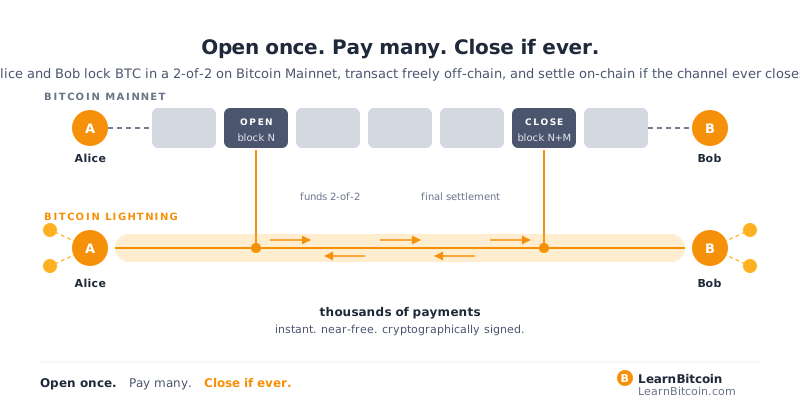
When Alice opens a channel with Bob and funds it with 0.1 BTC, the channel starts with balance 0.1 BTC on Alice's side, 0 BTC on Bob's. Alice can route nearly 0.1 BTC outbound through Bob (a small reserve and the commitment fee stay behind). Bob, until he receives some funds from Alice, can route 0 outbound through Alice.
Capacity is symmetric (the channel has 0.1 BTC total). Balance is asymmetric (it shifts as payments flow). This asymmetry is the source of nearly every Lightning routing failure. The closer to a balanced channel - capacity split roughly 50/50 between both sides - the more reliable that channel is for routing in either direction.
3. Gossip: How Nodes Learn the Graph
BOLT 7 defines how Lightning nodes broadcast information about themselves and their channels. The protocol has three gossip messages. The two that describe channels:
channel_announcement- "I have a channel with node X, funded by this on-chain output." Broadcast once the funding transaction has six confirmations.channel_update- "My current routing fee is Z, my minimum HTLC is M, here is my CLTV expiry delta." Broadcast whenever a node updates its policy.
Every node receives these messages and builds a local view of the entire public graph. A node's "channel graph" is its understanding of who has channels with whom and at what fees.
Two important caveats:
Capacity is public; balance is private. You can see Alice and Bob share a channel of capacity 0.1 BTC. You cannot see whether the balance is 0.1 / 0 or 0.05 / 0.05 or 0 / 0.1. This is why probing for routes can fail repeatedly: the graph says "this channel exists," but the actual balance at that moment may make the payment impossible.
Not all channels are public. A node can open a private channel (or "unannounced" channel) that does not broadcast to the gossip layer. Private channels are useful for end users who do not want to route for others; they can still receive payments via route hints in the BOLT 11 invoice.
4. Onion Routing (Sphinx)
Lightning uses onion routing - specifically a construction called Sphinx - so each hop in the route learns only what it needs to forward the payment, nothing more.
When Alice wants to pay Carol via Bob, her node:
- Constructs the route: Alice -> Bob -> Carol.
- Builds an "onion" with layered encryption: outermost layer for Bob, inner layer for Carol.
- Sends the onion to Bob.
- Bob decrypts his layer. He sees: "forward this onion to Carol, with this amount, this fee, this expiry."
- Bob forwards. Carol decrypts the innermost layer. She sees: "this payment is for you." She already holds the preimage (she made the invoice) and claims the payment by revealing it back along the route.
Crucially:
- Bob does not know Carol is the final destination. He only knows the next hop.
- Bob does not know Alice is the original source. He only knows the previous hop (which gave him the onion).
- Bob does not know the full route length. Padding is added to keep onions a constant size regardless of hops.
Tor uses the same layered idea, but a different construction: Tor builds a circuit one hop at a time, while Sphinx packs the whole route into one fixed-size packet. The privacy guarantees are real but bounded: with enough hops along the path observed, traffic analysis can sometimes correlate.
5. Source Routing vs. Trampoline
In standard Lightning, the sender computes the entire route. Alice's node looks at the gossip graph, runs a pathfinding algorithm (typically Dijkstra-style with weighted edges), and produces the complete onion before sending.
This is called source routing. It puts the burden on the sender to maintain an accurate, complete graph. For a mobile wallet on a phone, this can be expensive: the public Lightning graph has tens of thousands of channels.
Trampoline routing delegates the routing decision to an intermediary. Alice sends a partially-routed onion to a "trampoline node," which figures out the rest of the path and forwards it. Alice's node does not need the full graph.
Tradeoff: trampoline simplifies the sender but introduces some trust in the trampoline node. The trampoline knows more than a standard hop would: with a single trampoline, it learns the final destination. As of 2026, trampoline is supported by some implementations (notably Eclair) and unevenly adopted.
6. Why Payments Fail
Lightning payments fail more often than base-layer payments, and they fail for reasons that surprise newcomers. The common failure modes:
Insufficient liquidity. A hop in the chosen route does not have enough balance on the outbound side. The graph said the channel had 0.5 BTC capacity; in reality, only 0.001 BTC was on the right side.
Channel offline. A node on the route is offline. The HTLC cannot be forwarded. The payment fails and the sender retries with a different route.
Fee too low. A hop's routing policy requires higher fees than the sender offered. The sender retries.
HTLC limit. Nodes set maximum-HTLC sizes for protection. A large payment may not fit through narrow channels.
Timeout. HTLCs have CLTV expiry deltas. If a payment cannot complete before the relevant timeout, it fails and the sender's funds are returned.
The user-visible result: the wallet says "trying route 1, trying route 2, trying route 3, succeeded." Modern wallets try dozens of routes transparently. Most failures are invisible to the user.
This is fundamentally different from base-layer Bitcoin, where a transaction either gets included in a block or does not. On Lightning, payment success is a property of the network state, not just the transaction.
7. Multi-Part Payments
When no single route has enough liquidity, the sender can split the payment across multiple routes simultaneously. This is Multi-Part Payments (MPP) or its more flexible variant, Atomic Multi-Path Payments (AMP).
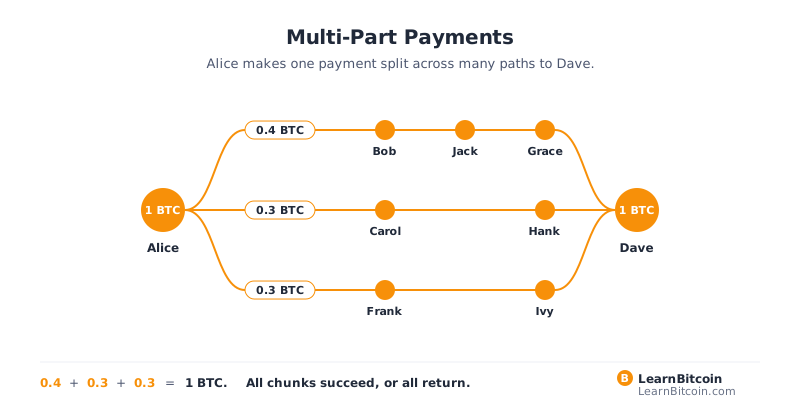
A 1 BTC payment can be split into ten 0.1 BTC chunks, each routed through a different path. The recipient collects all ten and reveals the preimage to claim the full payment. If a chunk fails, the sender retries it on another path. If the full amount never arrives, every chunk is returned.
MPP dramatically expands what Lightning can route. In 2018, a 1 BTC Lightning payment was impossible (the protocol capped a single payment at about 0.043 BTC). In 2026, with MPP and larger channels, it is doable.
Tradeoffs:
- More overhead. Each chunk pays its own fee. Total fees can be higher than a single-path payment.
- More failure modes. Each chunk can fail on its own, and every failed chunk has to be retried on another path.
- Privacy. Every chunk carries the same payment hash, so a node that sees two chunks can tell they are one payment. AMP avoids this by giving each chunk its own hash.
8. What Each Hop Knows (Privacy)
The privacy story on Lightning is "much better than the base layer, with caveats." The matrix below summarizes who knows what along the route. Each row is a fact about the payment; each column is a position on the route. An orange dot means the position knows the fact; a dash means it does not.

The top three rows are the privacy. The matrix shows two important asymmetries:
- The middle hops are completely blind to the endpoints. They know their immediate neighbors and the amount they are forwarding, and that is it. They cannot tell whether they are the second hop or the fifth, the start of the route or near the end.
- The endpoints leak. The first hop received the onion via a direct channel from the sender, so it can often infer who the sender is, especially if that sender does not also run a routing node. The last hop delivers the payment over a direct channel to the receiver, so it can often guess the recipient too, especially when the receiver is a private node with no other channels. Sphinx hides the path; it cannot hide who is sitting next to you.
The bottom three rows are the floor: every hop must know its immediate neighbors and the forwarded amount, or no payment moves. Sphinx privacy is everything beyond that minimum that the protocol refuses to reveal.
Anyone watching multiple hops in sequence can correlate timing, amount, and the payment hash (the same at every hop) to trace a payment. This is a real risk for large or unusual payments, especially if the adversary runs many nodes.
Compared to the base layer, where every transaction is fully public and pseudonymous addresses cluster easily (see UTXOs), Lightning is a substantial privacy improvement. Compared to ideal privacy, it has gaps.
9. The Fee Market for Routing
Lightning routing is not free. Each hop charges a fee for forwarding, expressed as fee_base_msat + (amount_to_forward * fee_proportional_millionths / 1000000).
A typical routing node might charge 1,000 msat base + 100 ppm. Routing 0.01 BTC (1,000,000 sats = 1,000,000,000 msat) costs: 1,000 + (100 x 1,000) = 101,000 msat, or roughly 101 sats total fee.
For a multi-hop payment, fees from each hop sum.
The fee market dynamics:
- Well-connected nodes can charge higher fees. Liquidity in central hubs is more valuable.
- Newer routing nodes undercut. A node trying to attract routing traffic offers lower fees.
- Fees are extremely competitive. Lightning routing fees on most payments are negligible compared to base-layer fees.
There is no equivalent of mempool fee competition. Each hop sets its own price; the sender picks routes that minimize cost subject to liquidity and reliability constraints.
10. What This Buys Us
Lightning routing solves a problem the base layer can not: high-volume, low-latency Bitcoin payments at micro-fee scale.
Trade the base layer's guarantees (global verification, persistent recording) for Lightning's properties (instant settlement, fractions of a satoshi in fees, off-chain capacity). For the right use cases - tipping, point-of-sale, microtransactions, machine-to-machine payments - this trade is enormous.
Routing is what makes the whole thing work. Without it, Lightning would be a network of disconnected payment channels, useful only between direct counterparties. With it, Lightning is an actual network: a graph through which value flows, with no central operator, no permissioned ledger, no payment processor.
The privacy story is genuine but partial. The reliability story is dramatically improved since 2018. The fee story is tiny fees for typical payments, though never quite zero. The capacity story is about consolidation. Public capacity hit a record in late 2025, then fell back in 2026. Public channels have fallen by more than half since their 2022 peak, and public node counts are flat or down, depending on the tracker. Liquidity is concentrating in a small number of large nodes.
It is, like Bitcoin itself, not theoretically perfect. It is, like Bitcoin itself, the best thing of its kind that has ever existed in production.
Pro tip: If you want to understand Lightning at a deeper level than this rabbit hole goes, run your own routing node for a month. The dashboards alone - liquidity in vs. out, channel utilization, fee earnings, failure logs - teach more about the network's actual shape than any document.
More in How It Works
Corrected
-
Was: The chapter's closing summary said the number of public nodes and channels had been shrinking since 2022.
Now: Public channels have fallen by more than half since their 2022 peak. Public node counts are flat or down depending on the tracker: about level with 2022 on mempool.space, well below it on Bitcoin Visuals. Details
-
Was: The chapter's closing summary said Lightning fees are essentially free and that capacity "keeps growing as more nodes open more channels".
Now: Fees are tiny but never quite zero. Public capacity hit a record in late 2025 and then fell back in 2026, while the number of public nodes and channels had been shrinking since 2022, a claim that was itself corrected on 9 October 2026. Details
-
Was: The onion routing animation on this page, and its text description, showed the payment preimage at the center of the onion.
Now: The innermost layer carries the receiver's payment instructions, the amount and a payment secret. The receiver already holds the preimage and reveals it to get paid, and the animation was re-rendered to show that. Details
-
Was: The chapter said Sphinx is the same construction Tor uses, that the onion carries the payment preimage to the receiver, and that the public graph has hundreds of thousands of channels. It also said one failed chunk sends a whole multipath payment back, and that the last hop knows the receiver for certain.
Now: Tor builds its circuits one hop at a time while Sphinx packs the whole route into one packet, the receiver already holds the preimage and reveals it to get paid, and the public graph has tens of thousands of channels. Failed chunks are retried on other paths, the last hop can often guess the receiver but cannot be sure, and the BOLT 7 fee formula and gossip details were also corrected. Details
Sources
- BOLT 4 - Onion Routing
- BOLT 2 - Peer Protocol for Channel Management
- Sphinx: A Compact and Provably Secure Mix Format (Danezis and Goldberg, 2009)
- Tor Protocol Specification - Creating circuits
- mempool.space - Lightning nodes and channels
- mempool.space - Lightning network capacity
- Bitcoin Visuals - daily Lightning data as a CSV file (nodes with channels, channels, capacity)
- River - Bitcoin Adoption Report 2026, Lightning section (River runs a Lightning business)
- Bitcoin Optech - Trampoline payments
- Bitcoin Optech - Multipath payments
- Bitcoin Optech - Atomic multipath payments (AMP)
- Bitcoin Optech - Large channels
- Bitcoin Optech - PTLCs
- BOLT 7 - P2P Node and Channel Discovery
- BOLT 11 - Invoice Protocol for Lightning Payments
- Lightning Routing glossary entry
Published . Revised . Four corrections logged for this page.
Edit this page on GitHub