
Rabbit Hole · 12 min
Mt. Gox to FTX: The Custody Graveyard
A decade of crypto custodians that lost their customers' coins, from Mt. Gox to FTX, and the honest case for holding your own keys instead.
Where you're going: Over about a decade, most of the biggest names in crypto custody collapsed: Mt. Gox, QuadrigaCX, Celsius, Voyager, BlockFi, Genesis, FTX. Their customers lost money every time. This chapter goes through what happened in each one and what they had in common. The short version is that holding your own keys would have prevented all of them. Self-custody has its own costs, though, and we cover those too.
Everyone repeats it, almost nobody acts on it
Every Bitcoiner has heard "not your keys, not your coins." Most of us repeat it. Far fewer act on it, and the reason is simple: a balance on an exchange feels exactly like owning bitcoin. You can see the number in the app and move it around whenever you want. It looks like yours, right up until the day you go to withdraw and the button doesn't work.
That day has come around a lot. What follows is just a list of what actually happened to people who left their coins with a custodian, with the dates and the dollar amounts attached.
The graveyard at a glance
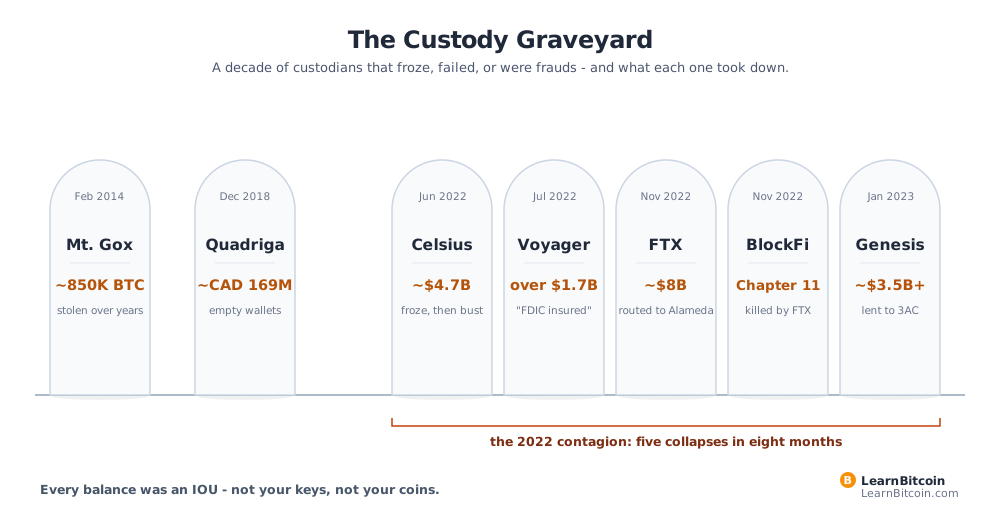
Seven collapses across nine years. The details differ each time, but the underlying failure is the same one, which is easier to see once you have the individual cases in front of you. Here they are.
2014: Mt. Gox
Mt. Gox handled around 70 percent of all Bitcoin trading by 2013. It halted withdrawals on 7 February 2014 and filed for bankruptcy in Tokyo three weeks later, on 28 February, with roughly 850,000 BTC missing. About 750,000 of those were customer coins. It wasn't one dramatic hack. The coins had been leaking out for years through bad controls and theft nobody caught, hidden behind balance figures that were simply faked. Creditors didn't start getting repaid until July 2024, more than ten years after the collapse.
At the time most people read this as one badly run company. The more durable lesson is about what an exchange balance actually is. It's an IOU, and an IOU is only worth as much as the company behind it is solvent and honest. You usually can't tell whether that's true until the moment it isn't.
2019: QuadrigaCX
QuadrigaCX was the largest exchange in Canada. In December 2018 its founder and CEO, Gerald Cotten, died while travelling in India. The company said Cotten was the only person who could access its cold wallets, so roughly CAD 169 million of customer money was now locked away for good. That was the story, anyway.
When the court-appointed monitor, Ernst & Young, went looking at those wallets, they were empty. They had been empty since April 2018, eight months before Cotten died. In 2020 the Ontario Securities Commission concluded that Quadriga had "operated like a Ponzi scheme." Cotten had been faking trades under aliases, paying real withdrawals out of new deposits, and spending customer money on houses and a private jet.
So Quadriga added something to the Mt. Gox lesson. With Mt. Gox you could at least imagine outside thieves. With Quadriga there was nothing left for thieves to take, because the custody had never really existed. A company telling you its funds are safe in cold storage is making a claim, not showing you proof, and the people making the claim had every reason to stop you from checking it.
2022: the lenders
Mt. Gox and Quadriga still looked like one-off disasters. 2022 showed they were a type. Over a few months a whole chain of lenders and exchanges went down one after another, and the wreckage made it obvious what had been happening to money people thought they had simply deposited. It had been getting lent out and re-lent, often several times over.
It started with a hedge fund. Three Arrows Capital made huge leveraged bets, including a big position in the Terra/LUNA token that went to nearly zero in May 2022. It funded those bets by borrowing from almost every lender in the industry. When the bets failed, 3AC couldn't repay, and a court ordered it into liquidation in late June 2022. Creditors claimed more than $3 billion.
The default tore through the firms that had lent 3AC their customers' money. Celsius advertised interest on deposits the way a bank advertises a savings account. It froze every withdrawal on 12 June 2022 and filed for bankruptcy owing about $4.7 billion to more than 600,000 users. Voyager had lent 3AC more than $650 million; it froze in July and filed owing customers over $1.7 billion. Genesis, the lending desk owned by Digital Currency Group, had lent 3AC about $2.36 billion. When that money evaporated it was left with a roughly $1.1 billion hole, which its parent company covered on paper with a promissory note that doesn't come due until the 2030s. Around 340,000 Gemini Earn depositors were told the whole time that Genesis was solvent. BlockFi, already hurt by 3AC, got rescued mid-year by FTX, and then went down when FTX did.
Voyager's "FDIC insured" marketing is worth pausing on, because it shows how the reassurance was built. The insurance was real. It covered the US dollars Voyager kept at a partner bank, and it only applied if that bank failed. It did not cover crypto, and it did not cover Voyager itself going bankrupt, which is what actually happened. Every word of it was technically accurate. What customers took away from it was not.
November 2022: FTX
Then the biggest one. By the autumn of 2022 FTX was one of the most respected exchanges anywhere. It had stadium naming rights, Super Bowl ads, and a founder who testified in front of Congress and got photographed with world leaders. None of that had anything to do with whether the customer coins were actually there.
When CoinDesk reported that the balance sheet of FTX's sister hedge fund, Alameda Research, was propped up by FTX's own FTT token, confidence broke. A competitor said it would sell its FTT, customers rushed to pull their money out (around $5 billion of withdrawal requests in a few days), and the money wasn't there to give them. FTX had been quietly sending customer deposits to Alameda through a credit line with effectively no limit. On 11 November 2022, FTX, Alameda, and roughly 130 related companies filed for bankruptcy. The customer shortfall was about $8 billion. Sam Bankman-Fried was convicted on all seven fraud counts in 2023 and sentenced to 25 years in 2024.
The repayment is the part worth sitting with. FTX creditors are actually being made more than whole, but in dollars, valued as of 11 November 2022, when bitcoin was around $16,000. Bitcoin later traded well above $90,000. So if you held bitcoin on FTX, you're getting back its dollar value from the worst week of that year, and you no longer own the coins or get their later price. What you held on FTX was a claim that happened to be measured in bitcoin, which is not the same thing as the bitcoin.
The pattern
Put the seven side by side and the same few things show up in almost all of them.
Your deposit was never just sitting there. "Earn interest on your crypto" and "your funds are safe with us" are two descriptions of the same thing: your coins got lent out into somebody else's leveraged trade. At Celsius, Voyager, BlockFi, and Genesis, counterparty risk wasn't a side effect of the product. It was the business model.
You couldn't check the custody yourself. "Cold storage," "fully reserved," "FDIC insured" were words on a website, not anything you could verify. Quadriga's wallets were empty. Voyager's insurance covered the wrong thing. FTX's "reserves" were a loan to a hedge fund.
The bigger the reputation, the bigger the failure. Mt. Gox basically was the market. FTX was about as respectable as a crypto exchange could get, right up to the week it imploded. A trusted brand tells you nothing about whether the coins are there.
When it broke, you were just a creditor. Not someone who owned coins, but a line in a bankruptcy filing, paid back part of what you were owed, often years later, at whatever value the court settled on. Even the cases that ended relatively well ended that way.
Why holding your own keys fixes this
This is where Bitcoin works differently from the dollars and stocks those same companies held. Bitcoin is a bearer asset. Whoever holds the private keys controls the coins, completely, and without needing anyone's permission. Holding your own keys isn't an advanced trick you bolt on afterward. It's the normal way Bitcoin was meant to be held. When the keys are yours, there's no company that can go insolvent out from under you, no balance that's secretly a loan, and nobody on the other end who can switch your withdrawals off.
Every failure in this chapter happened on a layer that people added on top of Bitcoin: the exchange, the lender, the interest account. None of it happened to Bitcoin itself, which kept producing blocks the entire time. In every case the coins were lost because someone other than the owner was holding the keys.
The honest counterargument
It would be easy, and a little dishonest, to stop there. All of this is a strong argument against keeping your savings on a custodian. It is not an argument that custodians are evil, or that everyone should hold all of their own keys all of the time. An honest version has to deal with the other side.
You still need exchanges. Getting dollars into bitcoin almost always means going through a centralized exchange. The point isn't to avoid them, it's to not treat one as a place to store anything. Buy your bitcoin and move it to a wallet you control, then do the same thing next time.
Self-custody moves the risk, it doesn't erase it. Once you hold your own keys, you also hold every way of losing them. Lose your seed phrase and the coins are gone for good, with none of the partial recovery the Mt. Gox creditors eventually got. A bad backup, a house fire, a passphrase you forget, an heir who has no idea what a hardware wallet is, a thief who knows you keep keys at home: those are all your problem now instead of an exchange's. For a lot of people that's still the better deal. It's a real trade, though, not a free upgrade, and our seed backup strategies chapter exists because getting this part right is genuinely hard.
Some custody is fine. A custodian that's actually regulated, audited, and insured can be a reasonable choice for an institution, for someone holding more than they can safely secure on their own, or for a beginner who isn't ready to manage keys yet. The companies in this chapter weren't dangerous because custody is inherently evil. They were dangerous because they were unregulated, unaudited, or lying, while telling everyone they were safe.
Proof of reserves helps, a little. After FTX, exchanges started publishing "proof of reserves," a cryptographic way of showing they control a given set of coins. It's a genuine improvement. It also isn't proof that the exchange is solvent: a company can demonstrate the assets it holds while saying nothing about what it owes, and it can arrange to look fully funded on the one day it knows it's being checked. Useful information, not a guarantee.
What to actually do
You don't have to pick between trusting everyone and burying steel plates in the backyard. There's a reasonable middle, and a sensible default.
- Treat an exchange like a cash register, not a vault. Keep only what you're actively trading there, and only an amount you could stand to lose if withdrawals stopped tomorrow.
- Move anything you're holding for the long term into a wallet you control. The one skill it takes is backing up a seed phrase properly, and you can learn that in an afternoon.
- Match the setup to the amount. A single hardware wallet is already a big step up from an exchange balance. Multisig is worth the extra effort once the sum is large enough that losing it would change your life.
- If you do leave some with a custodian, use one that's regulated, audited, and insured, and stay aware that you're still trusting a promise.
None of this means everyone running a custodian is a crook. It means a balance with a custodian is a promise, and Bitcoin is the rare case where you don't have to rely on the promise at all. Every company in this chapter asked you to trust that your coins were really there. With Bitcoin you can just hold them yourself. That is the whole point of holding your own keys, and the people in this chapter learned it the expensive way.
Sources
- Mt. Gox Rehabilitation Trustee - repayment commencement announcement (2024)
- Ontario Securities Commission - QuadrigaCX investigation report (2020)
- US DOJ - Samuel Bankman-Fried sentenced to 25 years (2024)
- SEC - charges against Sam Bankman-Fried and FTX (2022)
- US DOJ - founder of Celsius sentenced to 12 years (2025)
- NY Attorney General - $2B settlement with Genesis (2024)
- SEC - BlockFi to pay $100M over its unregistered lending product (2022)
- FTC - settlement with Voyager Digital over false FDIC-insurance claims (2023)