
Rabbit Hole · Who Decides · 9 min
Decentralization
What 'decentralized' actually means, where Bitcoin sits on the spectrum, and how the network has defeated takeover attempts without anyone in charge.
Where you're going: A clear-eyed look at what "decentralized" actually means, where Bitcoin lands on the spectrum, and why a network with no one in charge can still defend itself against takeover.
1. Three Network Shapes
In the early 1960s, an engineer at RAND named Paul Baran was trying to design a communications network that could survive a nuclear strike. He sketched three shapes:
- Centralized. One hub. Every node talks to the hub. Lose the hub, lose the network. The most efficient design, and the most fragile.
- Decentralized. Several hubs, each with their own clusters of nodes. Lose one hub and one cluster goes dark, but the rest survive. Still has hubs, just more of them.
- Distributed. No hubs. Every node connects to several neighbors directly. The network can lose huge swaths of itself and the survivors keep talking.
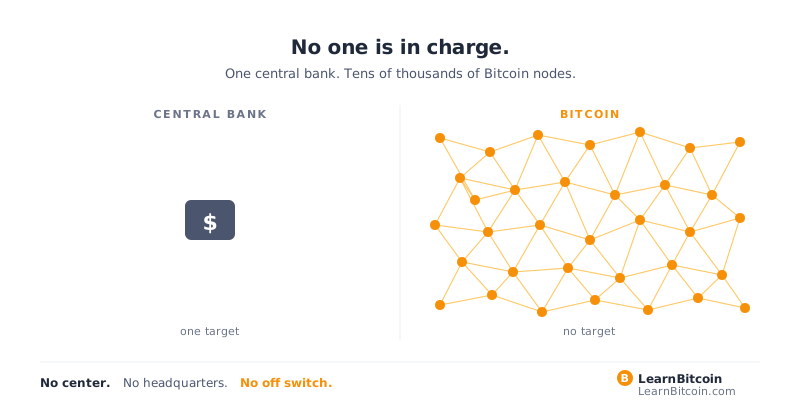
Most things we casually call "decentralized" are actually the middle option, a federation. Real distribution is rarer than the word suggests. Bitcoin's claim is the third shape: distributed, in the strong sense.
2. What "Decentralized" Doesn't Mean
The word has been abused. Some examples of things called "decentralized" that are not:
- "It's on a blockchain, so it's decentralized." Most blockchains have a small number of validators, sometimes literally a handful. Putting a database on a blockchain doesn't decentralize the database. It just makes it slower.
- "Multiple companies run it." Federation isn't distribution. Visa, Mastercard, and SWIFT are all "federated" with many member institutions, but if a few of them coordinate, they control the network. That's not what Bitcoin offers.
- "It's open source." Open code is necessary for decentralization but doesn't produce it. Plenty of open-source projects are controlled by one company or one foundation.
- "It's governed by token holders." Voting weighted by holdings is just plutocracy with extra steps. A handful of large holders effectively decide outcomes.
What decentralization actually means, in the Bitcoin sense: no single party - or coordinated small group of parties - can force changes, censor users, or shut the network down. The test isn't who's on the cap table. It's who can be coerced.
3. Where Bitcoin Sits
Bitcoin is the most decentralized monetary system humans have ever built. Three categories of participant, each plays a different role, each constrains the others.
Node operators. bitnodes.io counted about 25,500 reachable Bitcoin nodes on October 9, 2026, a figure that includes about 1,800 Knots nodes that no longer follow Bitcoin's main chain. Many more run without accepting incoming connections, which keeps them out of that count. A counter run by Luke Dashjr adds an estimate for those and put the total at about 104,000 on October 10, 2026. Dashjr maintains Bitcoin Knots, and his total includes several thousand Knots nodes running versions that no longer follow Bitcoin's main chain. A node operator is anyone running Bitcoin software that validates every transaction and block. The rules each node enforces define what Bitcoin is on that node's copy of the chain.
If you don't like a proposed change, you don't run the new software, and your node continues operating on the old rules. A node runs on a laptop, a Raspberry Pi, or any cheap computer with disk space. No permission required. Live count: bitnodes.io.
Miners. Specialized hardware competing to add blocks for the reward. Mining is spread across many countries, though unevenly. In a 2025 University of Cambridge survey, 49 mining firms that together accounted for about 48% of global mining reported operations in 23 countries, with 75.4% of their activity in the US and 7.1% in Canada. They produce blocks, but they don't make the rules. If miners produce a block that violates consensus, every node rejects it and the miner's electricity is wasted. Miners follow nodes, not the other way around.
Developers. People who write the software. Bitcoin Core is the dominant implementation. btcd (written in Go) and Libbitcoin are separately written implementations of the same protocol. Bitcoin Knots began as a modified version of Core, merging in Core's code for each release. Knots releases from May 9, 2026 on enforce BIP-110, a temporary limit on data in transactions. Nodes running them stopped following Bitcoin's main chain on August 8, 2026, when they began rejecting blocks that did not signal support for it. In September 2026 Knots shipped a hard fork that gave that split-off chain a different proof of work, BLAKE2b. Developers can propose changes; they can't impose them. A pull request to Bitcoin Core has to convince thousands of node operators to actually run the new code. Since 2009, Bitcoin Core has had over a thousand contributors.
Concentration concerns, and the structural answer.
Mining pool concentration: the top few pools control the majority of global hashrate. That sounds alarming until you realize pools don't own the hashrate. Individual miners (often thousands per pool) point their hardware at whichever pool gives them the best terms. If a pool tried to attack the network, the miners would leave within days. We saw exactly this in June 2014, when GHash.io briefly held 51% of the hash rate for a few hours and miners moved their hash power to other pools within days.
Implementation concentration: Bitcoin Core dominates by node count. This is a real risk if Core developers were ever captured. The mitigation is the existence of alternative implementations (which can be promoted quickly if needed) and the fact that Core's review process involves dozens of independent contributors with the power to refuse merges.
These aren't perfect protections. They're better than every other system humans have tried to use as money.
4. The 2017 Takeover Attempt
The clearest stress test of Bitcoin's decentralization happened in 2017.
A coalition of large mining pools, exchanges, and Bitcoin companies signed the New York Agreement (NYA). The plan: activate SegWit plus hard-fork the chain to double the block size, in a package called SegWit2x or simply "2x." The signers represented something like 80% of mining hashrate and most major businesses in the space.
This looked like an overwhelming consensus. It wasn't.
A grassroots movement called UASF (User-Activated Soft Fork, organized around BIP 148) ran in parallel. Node operators who backed it planned to enforce SegWit from August 1, 2017 regardless of miner approval, rejecting blocks from miners who didn't signal SegWit support.
What actually happened:
- BIP 148 set an August 1 flag day. Nine days before it, miners made SegWit signaling mandatory among themselves through BIP 91, every block from then on signaled, and the split never came. SegWit activated on August 24, 2017, at block 481,824. Who forced whose hand is still argued: UASF supporters say the flag day did; the SegWit2x organizers credited their own agreement.
- The 2x hard fork was scheduled for November 2017, and was cancelled nine days before the planned fork. Once node operators made it clear they would not run the new software, the agreement collapsed. The signers had hashrate; they had money; their nodes still ran old rules. They couldn't actually force the change.
- Earlier in 2017, on August 1, a different group had forked off and created Bitcoin Cash with bigger blocks. It became a separate network with its own coin.
The lesson is in the mechanics. Miners had hashrate. Businesses had money. Developers had attention. None of those groups were the deciders. The deciders were the thousands of node operators who chose what software to run. The same people who run a node on a laptop are the same people whose collective choices determine what Bitcoin is.
That's what "no one is in charge" looks like in practice. Not no rules. The rules are extremely strict. Just no central party who can change them.
5. How to Measure It
Decentralization is hard to quantify. Several imperfect metrics, taken together, paint a picture:
| Metric | Bitcoin | What it tells you |
|---|---|---|
| Reachable nodes | about 25,500 (October 9, 2026) | Lower bound on participants enforcing rules |
| Estimated total nodes | about 104,000 (one estimate, October 10, 2026) | Real population including non-reachable |
| Mining hash rate, top pool | 25.5% of blocks (month to October 10, 2026) | Largest single coordinator of block production |
| Mining hash rate, top 5 pools | 78.6% of blocks (same month) | Concentration vulnerability (mitigated by miner mobility) |
| Geographic mining distribution | 23 countries among firms surveyed in 2025; US 75.4% of their activity | Jurisdictional spread |
| Full-node implementations | Core, plus separately written btcd and Libbitcoin | Diversity at the code layer |
| Bitcoin Core contributors | 1,000+ since 2009 | No single point of failure in dev |
These metrics aren't dispositive. Together, they paint a picture: Bitcoin is the most distributed monetary system that has ever existed, by a wide margin, with real concentration risks at specific layers that the community actively works to manage.
6. Decentralization Theater
A lot of projects claim "decentralization" while running on something between a database and an oligarchy. The critique is fair, and important to apply consistently, including to Bitcoin.
Some common patterns of decentralization theater:
- "It's permissionless." Anyone can join, but a small group writes all the upgrades.
- "It's governed by token holders." A small set of large holders effectively control governance votes.
- "The validator set is open." It's open if you stake $X million and run specific hardware in a specific data center.
- "The code is on GitHub." Yes, but pull requests are reviewed and merged exclusively by one foundation's employees.
- "It's L2 on Bitcoin." Sometimes true, sometimes a federation calling itself Bitcoin-adjacent.
These can all be features of useful systems. They're not what Bitcoin's design is aiming at, and they don't survive the "who can be coerced" test.
Bitcoin's claim is testable: any node operator on any device can verify the chain themselves, run their own software, and refuse to accept changes they disagree with. The bar is "no permission required, no coordination required, just the math and the software you choose to run."
That's the standard. It's the right one for sound money. Anything weaker is not a substitute. It's just a different product.
7. Why It's Hard to Replace
Decentralization is expensive. It costs throughput, it costs energy, it costs developer convenience, it costs UX. Most blockchains compromise on it to gain speed and features.
That's a defensible trade-off for many use cases. It's a fatal trade-off for sound money, because sound money's whole job is to be a monetary store that no one can devalue, freeze, seize, or unilaterally upgrade. The moment a single party can change the rules, the money is no longer sound.
If you accept that money is uniquely worth defending against capture, you accept the cost of decentralization to defend it. Bitcoin is the implementation of that choice.
The price is real, and the price is the product.
Pro tip: When someone tells you a project is decentralized, ask: "If ten specific people coordinated, could they change the rules, freeze funds, or shut it down?" For most things called blockchains, the honest answer is yes. For Bitcoin, after every stress test since 2009, the answer is still no. That's the entire product.
More in Who Decides
Corrected
-
Was: The chapter said the mining majority "caved when faced with the potential chain split UASF threatened", stating one side's account of why SegWit activated in 2017 as fact.
Now: BIP 148 set an August 1, 2017 flag day. Nine days before it, miners made SegWit signaling mandatory among themselves through BIP 91, every block from July 23 on signaled, and the split never came; SegWit activated at block 481,824 on August 24. Whether the flag day forced the miners' hand is disputed: UASF supporters say it did, and the SegWit2x organizers credited their own agreement. Details
-
Was: The chapter called Bitcoin Knots an independent implementation of Bitcoin, alongside btcd and Libbitcoin, and its metrics table counted Knots among "4+" independent clients.
Now: Knots began as a modified version of Bitcoin Core, merging in Core's code for each release. Its releases from May 9, 2026 on enforce BIP-110, a temporary limit on data in transactions, and nodes running them left Bitcoin's main chain on August 8, 2026. A September 2026 release moved that chain to a different proof of work. btcd and Libbitcoin are the separately written implementations. Details
-
Was: The chapter said no single contributor's commits made up more than a few percent of Bitcoin Core's code.
Now: One developer has written more than a tenth of Bitcoin Core's commits, even with merge commits left out. The chapter now says only that Bitcoin Core has had over a thousand contributors since 2009. Details
-
Was: The chapter said the mining pool GHash.io "approached 51%" of the hash rate in 2014 and that miners left it "within weeks".
Now: GHash.io held 51 percent of the hash rate for a few hours on 13 June 2014, and miners moved their hash power to other pools within days. Details
-
Was: The chapter said the SegWit2x hard fork was cancelled three days before its planned activation, and its source was a Bitcoin Magazine URL that does not exist.
Now: Mike Belshe's cancellation email went out on November 8, 2017, nine days before block 494,784, where the fork was set to happen. The chapter cites an archived copy of that email. Details
Sources
- Paul Baran - On Distributed Communications (RAND, 1964)
- bitnodes.io - independent rebuild of the Bitnodes crawler, run by Rodrigo Martinez and not affiliated with the original project (25,514 reachable nodes on October 9, 2026)
- BTC Nodes API - bitnodes.io snapshot of October 9, 2026, 19:28 UTC (25,514 nodes, main chain at height 970,671; 1,829 nodes with Knots user agents report heights off the main chain: 656 stuck at 961,639 and 1,173 near 976,430, ahead of the main chain)
- Luke Dashjr - Bitcoin node software chart, listening nodes plus his estimate of non-listening ones (about 106,000 at 15:00 UTC on October 10, 2026: Bitcoin Core 87%, Bitcoin Knots 13%; its per-version list puts about 7,900 nodes on Knots builds that enforce BIP-110, about 5,000 of them on 29.4.1 or 29.4.2)
- Luke Dashjr - Bitcoin node count history chart (listening plus estimated non-listening nodes: 104,388 at 00:00 UTC on October 10, 2026)
- mempool.space - mining pool ranking by blocks found over one month (to October 10, 2026: Foundry USA 1,124 of 4,407 blocks, 25.5%; top five pools 78.6%)
- Cambridge Judge Business School - Cambridge study: sustainable energy rising in Bitcoin mining (April 28, 2025): 49 mining firms surveyed, covering 48% of global mining activity, with operations in 23 countries; the US had 75.4% of the activity they reported and Canada 7.1%
- The Guardian - Bitcoin currency could have been destroyed by '51%' attack (June 16, 2014): GHash.io held 51% of the hash rate for a few hours on Friday, June 13, and some members then pulled their computing power from the pool
- Bitcoin Knots README (development generally happens in Bitcoin Core and is merged into Knots for each release)
- Bitcoin Knots v29.3.knots20260508 release notes (May 9, 2026) - this version applies BIP-110 (RDTS) after the user confirms
- BIP-110 - Reduced Data Temporary Softfork (temporarily limits data fields; blocks 961,632 to 963,647 that do not signal bit 4 are rejected)
- bitcoin/bips PR #2245 - BIP 110 status changed to Closed (opened August 9, 2026); notes Knots released it on mainnet and on August 8 its nodes began rejecting non-signaling blocks, split to a new chain and stalled
- Bitcoin Knots v29.4.1 release notes, published by Luke Dashjr (September 2, 2026) - dates the split to August 8 and ships a backward-incompatible protocol change that switches Knots to a BLAKE2b proof of work
- bitcoin-blake2b.org, the page Knots' v29.4.1 release notes link for more information (nodes enforcing BIP-110 stopped accepting non-signaling blocks on August 8, 2026; proof of work later changed to BLAKE2b, first BLAKE2b block 961,640 on August 30, 2026)
- btcd README (an alternative full node Bitcoin implementation written in Go)
- Libbitcoin Node on GitHub (Bitcoin full node, a separate codebase)
- BIP 148 - mandatory SegWit activation (from August 1, 2017, blocks that do not signal for SegWit are rejected)
- BIP 91 - Reduced threshold Segwit MASF, by James Hilliard (activates once 269 of 336 blocks, 80%, signal on bit 4; while active, blocks that do not signal for SegWit on bit 1 are rejected; ends when SegWit locks in)
- mempool.space - block 477,120 (04:46 UTC, July 23, 2017), first block with BIP 91 active; it and every block after it up to SegWit's lock-in signal bit 1
- Braiins - Anniversary of the BIP148 UASF (August 1, 2020), a retrospective that celebrates it: says the pressure from the UASF was enough to force miners to adopt SegWit without SegWit2x
- Bitcoin Core 31 - chainparams.cpp (mainnet SegwitHeight 481824)
- mempool.space - block 481,824, the first block under SegWit rules (mined 01:57 UTC, August 24, 2017)
- UAHF technical specification, the Bitcoin Cash fork rules (activation August 1, 2017, 12:20 UTC; blocks over 1 MB allowed, 8 MB minimum setting)
- Digital Currency Group - Bitcoin Scaling Agreement at Consensus 2017, the New York Agreement (archived): as of May 25, 2017 the signers represented 58 companies and 83.28% of hashing power
- Segwit2x Final Steps, the cancellation email from Mike Belshe (bitcoin-segwit2x list, November 8, 2017, archived): says Segwit2x broke the deadlock in August and quickly led to SegWit's activation; calls off the 2MB increase for lack of sufficient consensus
- Decentralization glossary entry
- GitHub - Bitcoin Core contributors (the GitHub API lists 1,368 distinct commit authors, anonymous ones included, as of October 2026)
Published . Revised . Five corrections logged for this page.
Edit this page on GitHub