
LearnThe Journey · Chapter 3 of 7 · 8 min
Fair Questions
Is it a scam? Who runs it? Can it be shut down? Straight answers, with sources you can check.
Where you're going: These are the questions a careful person might ask before going further, each with a straight answer. You do not have to read them all: pick the ones that are yours. At the end you read the oldest entry in Bitcoin's record with your own eyes.
The questions:
- Is it a scam?
- Why is it worth anything, and why does the price fall?
- Who really runs it?
- Could a government shut it down?
- Is it legal? Is it taxed? Is it private?
- Should I buy some?
A guess first. In 2021 China banned bitcoin mining, the work of making Bitcoin's blocks. More of that work was done in China than in any other country. How long did Bitcoin stop for: a day, a month, or not at all?
Is it a scam?
Bitcoin itself is a network, not a company collecting your money or promising you a return. But scammers use Bitcoin, just as they use other forms of money. Once a Bitcoin transaction is confirmed, you generally can't reverse it if you sent money to the wrong person.
Watch out for a few common tricks:
- The "too good to be true" investment. Someone promises you a guaranteed profit if you send them bitcoin. They may show you a website with impressive gains, then demand more money before you can withdraw.
- The urgent call. Someone pretending to be your bank, the government, or a company says your money is in danger and tells you to send bitcoin or use a Bitcoin ATM. Hang up and contact the organization using a number you find yourself.
- The request for your recovery words. Someone posing as a wallet company or offering to help asks for your 12 or 24 words. Those words give them control of your wallet. Never share them.
If someone pressures you to act quickly, stop. Don't send money or share your recovery words. Talk it through with someone you trust.
Why is it worth anything, and why does the price fall?
Bitcoin has value because people want it. Some use it to send money without a bank's approval. Others value being able to hold it themselves or prefer its predictable supply. Some buy it hoping its price will rise.
Bitcoin's rules limit its supply to roughly 21 million coins. New bitcoin is still being created, but at a decreasing rate. No single person can change the limit for everyone.
Scarcity alone doesn't guarantee value, though. People also have to want what's scarce. Critics question whether Bitcoin's uses justify its price; supporters believe those uses and its limited supply give it lasting value.
Bitcoin's price changes as buyers and sellers decide what they're willing to pay. News, expectations and speculation can move it sharply. Since 2011, it has fallen by more than half seven times. It has recovered from previous falls, but there's no guarantee it will recover from the next one.
Unlike a savings account, bitcoin pays no interest on its own. And the amount of dollars you can exchange it for can change dramatically, even over a short time.
Who really runs it?
Bitcoin has no owner or central operator. Two groups do different jobs to keep it running.
Miners compete to add blocks of transactions to the record. The miner that adds a valid block receives newly created bitcoin, along with transaction fees. Mining uses a great deal of electricity.
Nodes independently check transactions and blocks against Bitcoin's rules. Anyone can run one, and thousands of people and organizations do.
If a miner creates a block that breaks the rules, full nodes reject it, no matter how large the miner is. Miners cannot simply create extra bitcoin or spend yours without your keys.
But mining power matters too. A few large mining pools produce much of Bitcoin's blocks. If enough mining power acted together, it could delay transactions or reorganize recent blocks to reverse its own payments. It could not make full nodes accept coins created outside their rules.
A dispute in 2017 showed the limits of miners' influence. Many major companies and miners supported a proposal, which included increasing the block size limit. But the proposed increase faced significant opposition, and its organizers called it off, saying they had not built enough consensus.
Bitcoin's rules can change, and other changes did go through around that time. But being big, or controlling a lot of mining power, does not give anyone the power to change the rules for everyone.
Could a government shut it down?
None has, and there is no switch to turn off. The nodes and miners are spread over many countries.
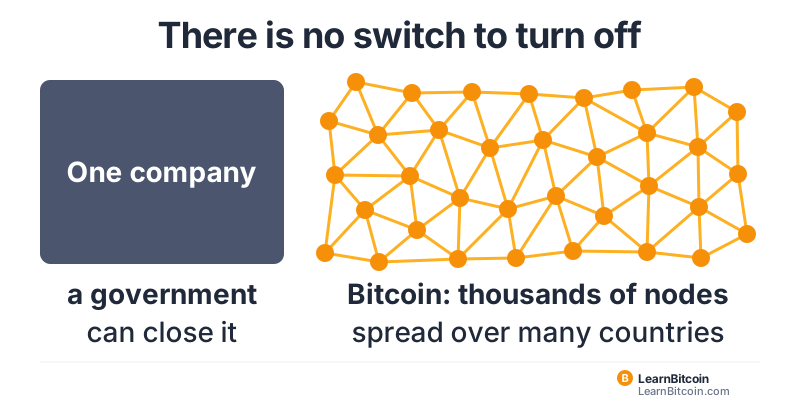
The hardest test came in 2021, when China banned mining. For some weeks blocks came more slowly, in the worst week about every seventeen minutes instead of ten. They never stopped. Within eight months more mining was going on than before the ban.
What a government can control is the companies around Bitcoin. Most people buy and sell through an exchange: a company that trades bitcoin for ordinary money, and usually holds its customers' coins. A government can license an exchange, order it to freeze a customer's account, or close it.
It can also take coins when it gets hold of the keys, because whoever has the keys can move the coins. In 2022 US agents found the keys to more than 94,000 stolen bitcoin in an online account, and took the coins.
Is it legal? Is it taxed? Is it private?
In the United States it is legal to own, buy and sell. There, buying it and holding it is not taxed. Selling it, or paying for something with it, has to be reported, and a profit can be taxed. Rules differ by country: a few ban it outright, and more bar their banks from handling it. Your own tax office's website is the place to look.
It is less private than people think. Every payment stays on a public record forever. The record shows addresses, not names, but investigators have followed it to arrests and to recovered money.
Criminals do use it, as they use every kind of money, and ransom demands often ask for it. The US Treasury said in 2026 that they move much less through digital coins than through ordinary money, and that they are using the coins more.
Should I buy some?
This Journey does not say. Three things are true either way.
Nobody can promise you a profit. No government insures what you buy, the way US bank deposits are insured. And you can lose all of it: the price can fall, a company holding your coins can fail, or you can be tricked into sending them away. One government watchdog puts it plainly: be prepared to lose all the money you put in.
Most people own none. About one American adult in ten holds or uses any cryptocurrency, a Federal Reserve survey finds, and about one in fifty paid for something with it.
Do it
Bitcoin's transaction history is public. A block explorer is a website that lets you look through it, a bit like browsing the pages of a public ledger.
Let's visit Bitcoin's very first block, called the genesis block. It was created in January 2009, and its creator left a newspaper headline inside it. You don't have to take our word for it: you can find it yourself on an independent explorer.
- Open the first Bitcoin block, block zero at mempool.space, a website that shows the record to anyone. It asks for nothing: no name, no password, no words, no money. If a page ever does, close it.
- Find the line marked Timestamp. It shows when this block was made: January 2009.
- Scroll down to the words "Coinbase (Newly Generated Coins)". Under them you will see "The Times 03/Jan/2009": a popular London newspaper's name and date, then the headline "Chancellor on brink of second bailout for banks". Just below are the first 50 bitcoin ever made.
A fair objection
"This is a site about Bitcoin. Of course it has an answer for everything."
It does not. Three questions have no settled answer. Nobody knows whether a fixed supply will hold its value over decades. Whether all that electricity is worth it depends on what you think Bitcoin is worth: supporters say the cost is what makes the record so hard to rewrite, and critics say other designs use a tiny fraction of it.
And the new coins that pay the miners are cut in half about every four years. Whether the fees can take their place is an open question, and researchers disagree.
For the rest, check us. More than half of the sources at the bottom of this page are governments and central banks, and some of them are Bitcoin's sharpest critics.
Check yourself
What is the difference between a miner and a node?
A miner makes new blocks. A node keeps a copy of the record and checks every block against the rules. It ignores a block that breaks them. Reread "Who really runs it?"
Someone you met online shows you a site where your bitcoin has doubled. You ask to take some out, and there is a fee to pay first. What is happening?
A scam. The balance on the screen is not real, and the fee will be lost too. Reread "Is it a scam?"
Your guess at the start: how long did Bitcoin stop when China banned mining?
It did not stop. For some weeks blocks came more slowly, and within eight months more mining was going on than before. Reread "Could a government shut it down?"
Words you now know
- Miner. A person or company whose machines race to make the next block. The winner is paid in new coins and fees.
- Node. A computer that keeps a copy of the record and checks every block and payment against the rules.
- Exchange. A company where people buy and sell bitcoin for ordinary money. It usually holds its customers' coins.
If you stop here, you know what Bitcoin is, why it was made, and what the hard questions are. If you go on, nothing ahead needs money: the next chapter has you send a payment yourself, with practice coins.
Go deeper
- The Block Size War The 2015-2017 fight over Bitcoin's block size limit, from Bitcoin XT to the UASF to the forks that split away, and how it settled who actually controls the rules.
- Bitcoin and Energy How much electricity Bitcoin uses, where it comes from, what the critics get right, and which common comparisons don't hold up.
- Rat Poison, Tulips and a Pet Rock: Everything Bitcoin's Been Called (so far) Bitcoin is dead, they said, and a Ponzi scheme, a tulip bubble, rat poison and money for drug dealers and terrorists. Every label, who said it and when, which ones can actually be scored, and what happened next, including the calls that held up and the ones our own side got wrong.
Sources
- FBI Internet Crime Complaint Center - 2025 report: $11.37 billion lost in complaints involving cryptocurrency, about $7.2 billion of it to investment fraud; the figures are what people reported, for every cryptocurrency
- US Federal Trade Commission - What To Know About Cryptocurrency and Scams: only scammers demand payment in cryptocurrency, and only scammers guarantee profits; payments typically cannot be reversed
- FBI Internet Crime Complaint Center - Investment fraud: a platform shows large returns, then asks for taxes or fees before money can be taken out
- FBI - public service announcement of May 15, 2026: criminals direct people to cryptocurrency kiosks; no real official demands payment through one
- US Federal Trade Commission - Bitcoin ATMs: A payment portal for scammers (September 3, 2024): callers say there is fraud on your account or that your money is at risk, and send people to a Bitcoin ATM in a shop; slow down, and talk with someone you trust
- US Federal Trade Commission - How to handle unexpected calls that claim your money is at risk (January 30, 2026): hang up, call the number on a recent statement or the back of your card, and talk to a trusted friend or family member
- US Federal Trade Commission - Reports show scammers cashing in on crypto craze (June 3, 2022): crypto is attractive to scammers because transfers cannot be reversed
- US Federal Trade Commission - Refund and recovery scams: someone who asks for a fee up front to get your money back is a scammer
- Federal Reserve - Is U.S. currency still backed by gold? Federal Reserve notes are not redeemable in gold, silver or any other commodity
- US Internal Revenue Service - Foreign currency and currency exchange rates: US tax must be paid in US dollars
- Federal Reserve Act, section 2A - the Federal Reserve is to promote maximum employment, stable prices and moderate long-term interest rates
- Satoshi Nakamoto - Bitcoin v0.1 released, the Cryptography Mailing List (January 8, 2009): 21,000,000 coins in total, the same total the program enforces today
- Bitcoin Core, validation.cpp - the schedule of new coins: 50 a block at first, halved every 210,000 blocks until it reaches zero
- Executive Order 14233 (March 6, 2025) - bitcoin that the government has taken in forfeitures shall not be sold and is kept as a reserve; the order notes that Bitcoin is often referred to as digital gold
- Ulrich Bindseil and Juergen Schaaf - ETF approval for bitcoin: the naked emperor's new clothes, The ECB Blog (February 22, 2024): the fair value of Bitcoin is still zero; the views are the authors' own
- Agustin Carstens, General Manager of the Bank for International Settlements - Money in the digital age: what role for central banks? (lecture of February 6, 2018): the case that Bitcoin is a bubble
- Bank for International Settlements - Annual Economic Report 2018, chapter V: with a supply set in advance, any change in demand becomes a change in price
- Coin Metrics - BTC daily reference price since 2010: seven falls of more than half from a record high since 2011; six were followed by a new record after 189 to 1,177 days; the fall that began on October 6, 2025 was not over on November 15, 2026
- Satoshi Nakamoto - Bitcoin: A Peer-to-Peer Electronic Cash System, section 6 (fees are added to the reward for a block), section 10 (the record is public) and section 11 (an attacker with most of the mining power cannot create coins or take coins that were never theirs, and can only try to take back money they recently spent)
- Cambridge Centre for Alternative Finance - Cambridge Digital Mining Industry Report (April 2025): about 0.54% of the world's electricity in mid-2024; on the same base the index's 2025 average is about three quarters of one percent, which is this site's sum
- Cambridge Bitcoin Electricity Consumption Index - daily estimate, with its lower and upper bounds (147.5 TWh a year on November 15, 2026; 189 on average in 2025)
- Bitcoin Wiki - Clearing Up Misconceptions About Full Nodes: a full node checks that every rule is being followed
- BTC Nodes - computers that accept connections from others: about 19,000 in November 2026
- mempool.space API - who made the last month's blocks (when checked on November 16, 2026, three pools had made 62% of them)
- Cambridge Centre for Alternative Finance - Funding Bitcoin's Future: Paying for Security as the Block Subsidy Fades (October 2026): miners can switch pools freely; a majority of mining power can rewrite recent history; whether fees can replace new coins is an open question
- Digital Currency Group - Bitcoin Scaling Agreement at Consensus 2017 (May 23, 2017, archived): 58 companies with 83.28% of hashing power agree to a plan in two parts
- Bitcoin Core 0.13.1 release notes (October 27, 2016) - the change that the plan's first part switched on had been released by Bitcoin's developers the year before
- Bitcoin Core, chainparams.cpp - that change took effect at block 481,824
- Bitcoin Core (August 18, 2017) - its program does not include the plan's second part, the larger block size limit
- Bitnodes (snapshot of November 14, 2017, archived) - most reachable nodes were running Bitcoin Core
- Mike Belshe - Segwit2x Final Steps (November 8, 2017, archived): the second part, a doubling of the block size limit, is suspended for lack of consensus
- US Internal Revenue Service - Chief Counsel Advice 202114020: the Bitcoin Cash record split from Bitcoin's after block 478,558 on August 1, 2017
- State Council of China (May 21, 2021) - the committee chaired by Vice Premier Liu He calls for a crackdown on bitcoin mining and trading
- National Development and Reform Commission of China and ten other bodies (notice of September 3, 2021) - new mining projects are forbidden and existing ones are to be wound down
- Cambridge Centre for Alternative Finance (July 15, 2021) - China's share of Bitcoin mining was 46% in April 2021, the largest of any country
- Cambridge Centre for Alternative Finance (May 17, 2022) - where the mining went after the ban: the United States, Kazakhstan and other countries, and back into China
- mempool.space API - difficulty adjustments: mining difficulty fell 45% from May 13 to July 17, 2021, and passed its old record on January 21, 2022
- Coin Metrics - blocks per day and hash rate in 2021: the slowest day was June 27, 2021 with 58 blocks; in the slowest seven days blocks came about 17 minutes apart; hash rate passed its May level on December 9, 2021
- UK Financial Conduct Authority - Cryptoassets consumer research 2025: 73% of people who own crypto bought it through an exchange, and 74% keep it at the exchange where they bought it
- New York State Department of Financial Services - virtual currency businesses: a state license for companies that trade or hold virtual currency
- US Federal Trade Commission - Protecting Older Consumers 2025-2026 (October 2026): an FBI team has an exchange freeze more than $51,000
- US Department of Justice (March 7, 2025) - an exchange's websites and servers are seized
- US Department of Justice (February 8, 2022) - agents found the private keys in an online account and seized more than 94,000 bitcoin stolen in 2016
- Executive Order 14178 (January 23, 2025) - lawful use of digital assets, and keeping them in one's own custody, are protected
- US Internal Revenue Service - Digital assets: treated as property; buying and holding is not reported, selling them or paying for goods with them is
- Law Library of Congress - Regulation of Cryptocurrency Around the World: November 2021 Update: nine jurisdictions with an absolute ban and 42 with an implicit one, as of November 2021
- US Department of Justice (June 7, 2021) - investigators followed a ransom on the public record and recovered 63.7 bitcoin
- US Treasury - 2026 National Money Laundering Risk Assessment: money laundering through digital assets remains well below that through ordinary money; criminals use digital assets increasingly, and ransom demands are often made in them
- FDIC - Financial products that are not insured by the FDIC: crypto assets are on the list
- UK Financial Conduct Authority - Crypto: The basics: be prepared to lose all your money
- Board of Governors of the Federal Reserve System - Economic Well-Being of U.S. Households in 2025 (May 2026), table 33: 10% of adults used or held any cryptocurrency, and 2% used it to buy something or make a payment
- White House Office of Science and Technology Policy (September 2022) - Climate and Energy Implications of Crypto-Assets in the United States: crypto-assets use more electricity than many whole countries; another design uses a tiny fraction of it
- mempool.space - block 0, the first block, with the text of that day's headline from The Times
Published . Revised . Fact-checked . No corrections logged for this page.
Edit this page on GitHub