
Rabbit Hole · 40 min
Rat Poison, Tulips and a Pet Rock: Everything Bitcoin's Been Called (so far)
Bitcoin is dead, they said, and a Ponzi scheme, a tulip bubble, rat poison and money for drug dealers and terrorists. Every label, who said it and when, which ones can actually be scored, and what happened next, including the calls that held up and the ones our own side got wrong.
Where you're going: Since 2010, people with large audiences have called Bitcoin a Ponzi scheme, a tulip bubble, rat poison, a fraud, money for drug dealers and terrorists, an environmental disaster and, hundreds of times, dead. This chapter starts with four of the best-known critics and then takes the labels one at a time: who said it, when, what the price was, and what happened next. Each label is sorted by the kind of claim it makes, which decides whether it can be checked at all. Then it follows the claim that each new crisis was the one Bitcoin could not survive, from a 2010 software bug to the 2021 mining ban and the collapse of FTX. It ends with the critics' calls that held up, the critics and firms that changed course, and the things Bitcoin's own side said that turned out wrong.
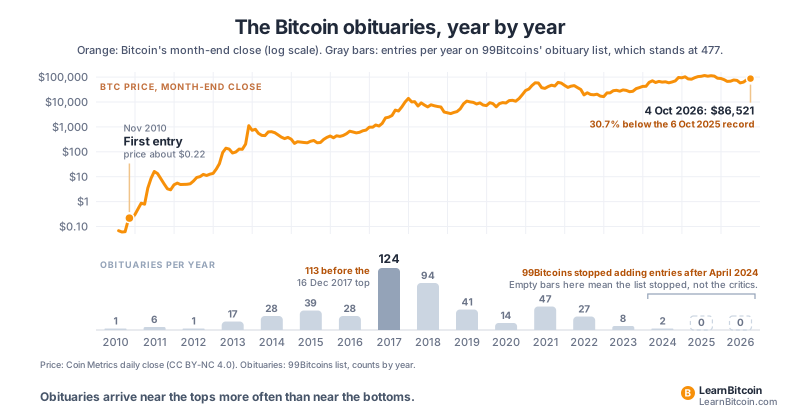
The first Bitcoin obituary went up on 9 November 2010, when a bitcoin cost about 22 cents. It was a post on a small economics blog, The Underground Economist, titled "Why Bitcoin can't be a currency." By June 2011 its author, Sean Lynch, had added an update saying he now thought bitcoin's exchange value was "probably enough by itself to prevent a deflationary spiral to zero." The site 99Bitcoins put his post first on its list of Bitcoin obituaries, a collection of times someone with a platform declared Bitcoin dead or worthless, which has 477 entries.
Bitcoin has been called many specific things, by central bankers, Nobel laureates, the best-known investors of their generation and the chief executive of the largest bank in the United States, and most of those claims can be checked against what happened afterward, which is what this chapter does, claim by claim. Many of the people who made them are very good at their jobs, and several of them were right about something.
For a prediction with no date, "wrong" can only ever mean wrong so far. A claim that bitcoin will go to zero can fail every year for a century and still come true in the next one, and 477 failed obituaries do not prove that the 478th will fail.
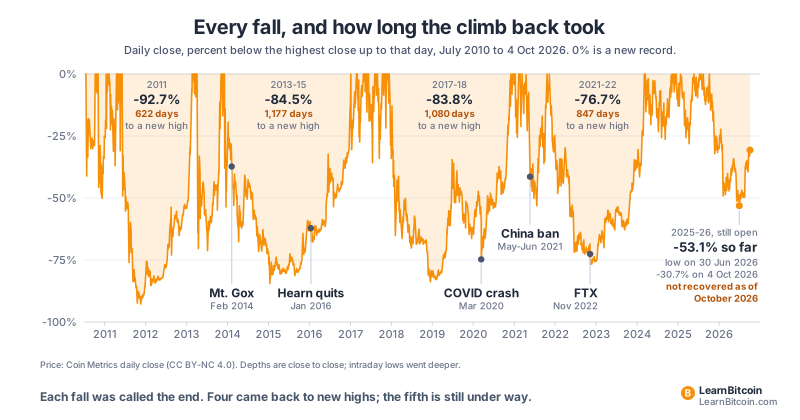
This chapter was written in October 2026, during a fall. The daily close peaked at $124,824 on 6 October 2025, fell 53 percent to $58,525 on 30 June 2026, and was $86,521 on 4 October 2026, about 31 percent below the high, with no new high since. Some of the critics below were right about the following twelve months more often than Bitcoiners like to remember, and the chapter keeps count of those too.
How to read a Bitcoin obituary
99Bitcoins' list starts with that 2010 post. From at least 2021 to 2024 the page carried a stated rule: the piece itself had to say plainly that Bitcoin is or will be worthless, the author or outlet had to have a real audience, and it had to be in English. In practice the list is looser than the rule. About one headline in ten is a question or a "could," and a few entries are not in English. It also stopped growing after its last entry, dated 17 April 2024, and when articles in August 2025 celebrated a full year without a Bitcoin death declaration, they were measuring a list that had stopped adding entries. A rival tracker, bitcoindeaths.com, which uses a broader rule, counts 34 for 2025 and 24 more in 2026 through late September.
The peak year is 2017, with 124 entries, and the busiest month is December 2017, with 34, the month bitcoin topped out at $19,641. There were 113 entries in 2017's run-up to that top and 100 in the twelve months after it, so the obituaries arrive at the top, as bubble calls, and keep coming on the way down. Searches for the phrase "bitcoin is dead" behave differently. On Google Trends they peak in crash weeks: February 2018, June 2022, the FTX collapse in November 2022, and the slide to $63,495 in early February 2026.
The events that could actually have broken Bitcoin drew almost no obituaries. The March 2013 chain split, which lasted nearly eight hours, drew none, and no entry mentions CVE-2018-17144, a 2018 bug that could have let a miner create coins out of nothing. GHash.io's few hours with 51 percent of the mining power in June 2014 drew none in the following month, and the March 2020 crash, when the price fell 38 percent in a day, drew none for more than three months. The events with the most entries around them were price falls: 12 in the month either side of Mt. Gox halting withdrawals in February 2014, and 14 in the month either side of China's crackdown in May 2021.
How the labels are scored
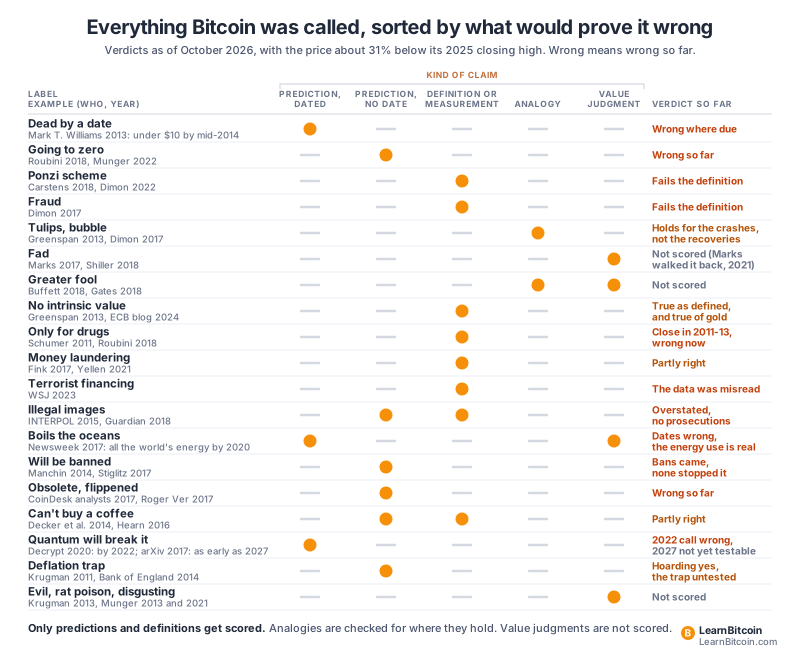
Not every label is a prediction, and treating them all the same way is how both sides end up talking past each other. A reader on r/Bitcoin, robinsonrichard_3, suggested sorting each one by what would prove it wrong, and the chapter does that throughout.
- A prediction with a date can be checked on the date. "All of the world's energy by 2020" had one.
- A prediction without a date, such as "it is going to zero," can only ever be wrong so far.
- A definition or a measurement can be checked against the definition or the data. "Ponzi scheme" has a legal definition, and "only used for drugs" can be measured.
- An analogy, such as tulips, is neither true nor false. The useful question is where it holds and where it breaks.
- A value judgment, such as "evil" or "disgusting," cannot be scored at all.
Only the first three kinds get marked wrong. Prices are the Coin Metrics daily close, the price at midnight UTC (Greenwich time) each day.
Here is every label in the chapter in one chart, sorted the same way.
Warren Buffett and Charlie Munger: rat poison
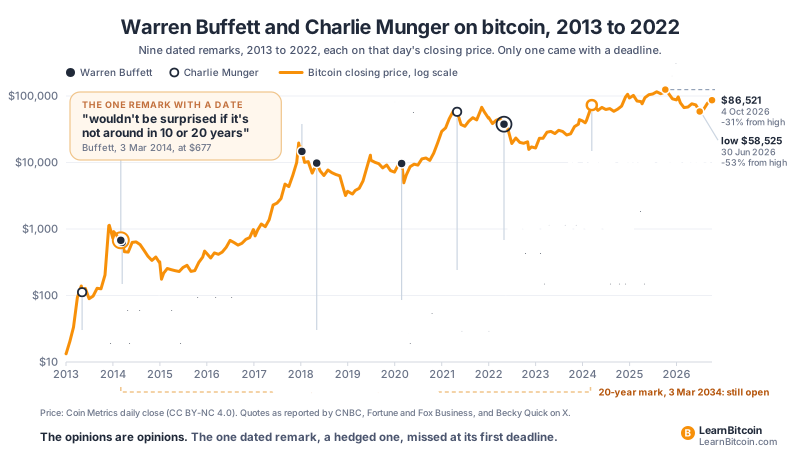
"Rat poison" started with Munger. In a joint interview with Warren Buffett and Bill Gates on the Berkshire Hathaway weekend in May 2013, with bitcoin at about $112, he told Fox Business's Liz Claman, "I think it's rat poison," and Buffett told her to put him down as undecided. At the annual meeting that weekend Buffett had noted that none of Berkshire's $49 billion was in bitcoin.
Buffett's one remark about bitcoin with a deadline in it came on CNBC on 3 March 2014, at $677: "I wouldn't be surprised if it's not around in 10 or 20 years." Eleven days later he called it a mirage and told viewers to stay away. The ten-year mark arrived in March 2024, two months after the United States approved spot bitcoin exchange-traded funds, which hold actual bitcoin and trade like shares, and on 13 March 2024 bitcoin closed at a record $73,082. The twenty-year mark is March 2034. Since he only said he would not be surprised, the ten-year mark is a miss with a hedge on it.
On 10 January 2018, at $14,669, he said cryptocurrencies would come to "a bad ending," almost certainly, and that he would happily buy a five-year put on every one of them. A put is a bet that a price will fall, so that one can be tested. A five-year put on bitcoin at that day's price would have been worth cashing in at any point from January 2018 to early November 2020, a stretch in which the price closed as low as $3,185, but held to the end it would have paid nothing on 10 January 2023, when bitcoin was $17,434, higher than when he spoke. The bet would have lost if held to its end. The warning behind it was partly right, because the bad ending came for many people who bought near the 2017 and 2021 tops, though not for bitcoin itself inside his five years.
The line everyone remembers came on the morning of the 2018 annual meeting, 5 May, when Claman reminded Buffett of Munger's 2013 answer. He said it was "probably rat poison squared," with bitcoin at $9,796. CNBC's Becky Quick posted it on Twitter at 6:56 a.m. Omaha time, and CNBC's own archive notes that neither man used the words on stage. Munger, on stage that day, said cryptocurrencies were "just dementia." Buffett went on to call bitcoin "a delusion, basically" in February 2019 ($3,822) and to say cryptocurrencies basically had no value in February 2020 ($9,648). At the 2022 meeting, on 30 April, at $37,714, he said he would not pay $25 for all the bitcoin in the world, because it does not produce anything.
Munger, who died on 28 November 2023 at 99, stayed harsher than his partner. He called bitcoin "noxious poison" in February 2018, and in May 2021 he called the whole development "disgusting and contrary to the interests of civilization." In April 2022 he said it was stupid "because it's still likely to go to zero" (the often-quoted "very likely" is not what CNBC or Fortune printed). In February 2023 he wrote in the Wall Street Journal that America should ban crypto, as China had, on the grounds that a cryptocurrency "is not a currency, not a commodity, and not a security." The commodity part had been settled the other way in September 2015, when the Commodity Futures Trading Commission held that bitcoin is a commodity. In March 2025, instead of a ban, a US executive order set up a Strategic Bitcoin Reserve.
Berkshire itself ended up closer to bitcoin than either man. In June 2021 it put $500 million into Nubank, the Brazilian digital bank. On 11 May 2022, eleven days after the $25 remark, Nubank launched bitcoin trading for its customers, and its parent company put about 1 percent of its cash into bitcoin. Berkshire had sold its Nu shares by the spring of 2025. The fund manager Bill Miller, who owned bitcoin, answered the original remark in his letter for the last quarter of 2020: "Bitcoin could be rat poison, and the rat could be cash."
Most of what the two men said was a value judgment, which is not scored. Of the rest, Buffett's dated remark missed at its ten-year mark, his five-year put would have lost while the warning behind it was partly right, Munger's "not a commodity" was wrong when he wrote it, "still likely to go to zero" is wrong so far, and the ban he called for went the other way.
Jamie Dimon: fraud, tulip bulbs and a pet rock
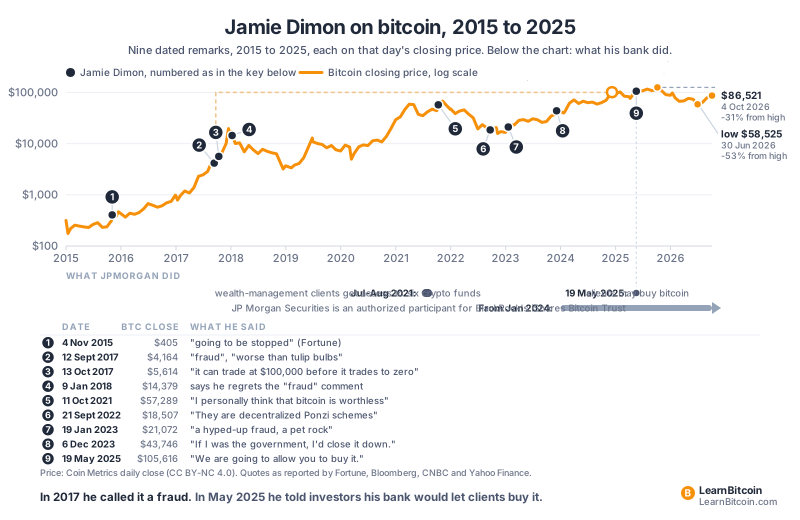
At the Fortune Global Forum on 4 November 2015, at $405, JPMorgan's chief executive said of bitcoin, "There is no government that's going to put up with it for long." At Davos in January 2016 he said governments would stop it if it got big, and added, "I may be dead wrong."
His best-known day was 12 September 2017. At a Barclays investor conference in New York that morning he called bitcoin a fraud and "worse than tulip bulbs," said it would blow up, and said he would fire any JPMorgan trader caught trading it, for breaking the rules and for being stupid. That afternoon, at another conference, he said it would eventually be closed. The price that day was $4,164. A month later, on 13 October 2017, he said it "can trade at $100,000 before it trades to zero." The first half of that sentence came true on 8 December 2024, when bitcoin closed at $100,799, and the second half has not. Bitcoin closed at or above $100,000 on 218 days, the last of them on 13 November 2025.
On 9 January 2018 he told Fox Business he regretted calling it a fraud. His view of it did not change much. He called it worthless in October 2021, told a House committee in September 2022 that crypto tokens like bitcoin "are decentralized Ponzi schemes," called it "a hyped-up fraud, a pet rock" at Davos in January 2023, and told the Senate Banking Committee in December 2023, "If I was the government, I'd close it down."
His bank kept moving in the other direction. In July and August 2021 JPMorgan gave its wealth-management clients access to six crypto funds. J.P. Morgan Securities is listed in the prospectus of BlackRock's bitcoin fund, the iShares Bitcoin Trust, as an authorized participant, one of four firms allowed to hand the fund actual bitcoin for new shares, or hand back shares for bitcoin. On 19 May 2025, at JPMorgan's investor day, Dimon said, "We are going to allow you to buy it." The bank would not hold the coins for its clients, he said, and he would defend their right to buy bitcoin the way he defends their right to smoke.
"Fraud" and "Ponzi" are definitions, and both fail for the same reason, which the Ponzi section below explains. "Closed" and the claim that governments would stop it are predictions without dates, wrong so far, more than ten years after the first one. The $100,000 waypoint came true.
Peter Schiff: put a fork in it
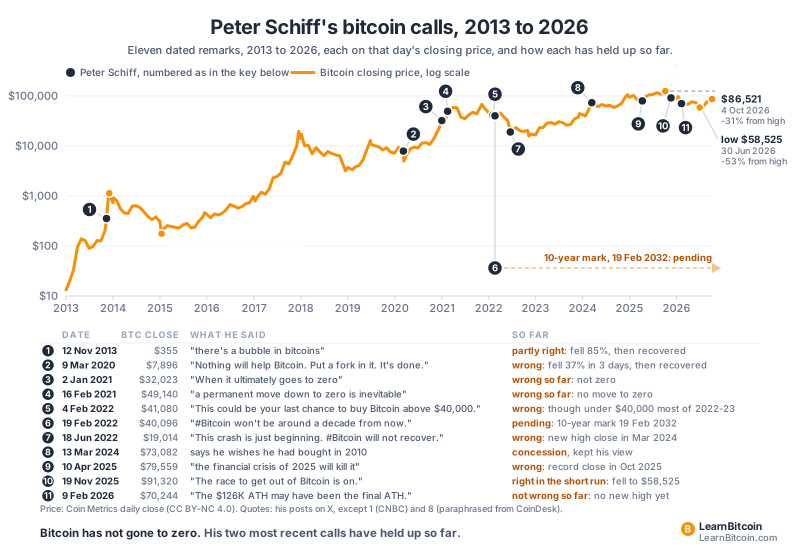
The gold investor Peter Schiff called bitcoin a bubble as early as 12 November 2013, at $355, when he told CNBC it was a modern-day tulip mania. About three weeks later it reached $1,135, and then the bubble burst, as he had said it would, in the 85 percent fall described under tulips below.
The later calls came on Twitter, and most of them can be scored.
- 9 March 2020, at $7,896: "Nothing will help Bitcoin. Put a fork in it. It's done." Three days later bitcoin closed at $4,959, down 38 percent in a single day. A year after the tweet it was $54,739.
- 2 January 2021 ($32,023) and 16 February 2021 ($49,140): "When it ultimately goes to zero," and then "a permanent move down to zero is inevitable." The February tweet allowed for a temporary run to $100,000 first, and that part came true in December 2024.
- 4 February 2022, at $41,080: "This could be your last chance to buy Bitcoin above $40,000." It was not the last chance, since it rose as high as $47,464 on 29 March, but after 25 April 2022 it did not close above $40,000 again until 4 December 2023.
- 19 February 2022: "#Bitcoin won't be around a decade from now." That one is due on 19 February 2032.
- 18 June 2022, at $19,014: "This crash is just beginning. #Bitcoin will not recover." It passed its 2021 high on 4 March 2024.
- 10 April 2025, at $79,559: "Ironically, the financial crisis of 2025 will kill it." Six months later it set its record close, and it ended 2025 at $87,517.
- 19 November 2025, at $91,320: "The race to get out of Bitcoin is on." The close fell to $58,525 by 30 June 2026, so that one was right in the short run.
- 9 February 2026, at $70,244: "The $126K ATH may have been the final ATH." His $126,000 is the intraday high; the record close was $124,824. As of early October 2026 there had been no new high, so the call has held so far.
In March 2024, on a podcast, Schiff said he had looked at bitcoin in 2010 and wished he had bought some, while keeping his view that it would fail. Taken call by call, the dated or near-dated death calls missed, "going to zero" is wrong so far, one call is due in 2032, the 2013 bubble call and the November 2025 call were right in the short run, and the February 2026 call is still open.
Paul Krugman: hoarding and evil
Paul Krugman's first bitcoin post, "Golden Cyberfetters," went up on his New York Times blog on 7 September 2011, with bitcoin at $7.16. His argument was about deflation. Money with a fixed supply gains value as an economy grows, so people have a reason to sit on it rather than spend it, and he noted that bitcoin had already given its owners "an incentive to hoard the virtual currency rather than spending it." He used that as an argument against any return to gold. The Bank of England put a more careful version in its Quarterly Bulletin in 2014: if a fixed-supply digital currency ever became dominant, "households have an incentive to postpone or even abandon spending plans." Satoshi Nakamoto had described the same mechanism in February 2009, writing that "the supply is predetermined and the value changes," and he built it that way on purpose.
The hoarding happened. Most people who own bitcoin hold it as savings, and the habit has had a name, hodl, since 2013. A 2017 column in Der Spiegel by Sascha Lobo put it bluntly: anyone using bitcoin to pay for things must be crazy, when the money could be worth twice as much the day after tomorrow. The trap Krugman and the Bank of England described has never been tested, because no economy prices its goods in bitcoin. Even El Salvador kept the dollar as its unit of account. Holders lived with large swings in both directions rather than steady deflation, which leaves the deflation claim partly right.
"Adam Smith Hates Bitcoin," in April 2013, objected to a currency "whose creation requires wasting real resources," the first establishment version of the energy argument. "Bitcoin Is Evil," on 28 December 2013, at $716, was a value judgment, which is not scored. He agreed with the novelist Charles Stross that it was designed to undermine central banks and tax collection. (99Bitcoins never listed it as an obituary, though other trackers do.) In January 2018 his column asked whether bitcoin was a giant bubble that would end in grief and answered yes. Grief came within the year for 2017's buyers, at $3,185 in December 2018, and then the price went on to new highs. In May 2021 he allowed that one or two cryptocurrencies might conceivably last the way gold has. On 6 March 2025 he called the planned US crypto reserve "the biggest rug-pull yet," on the assumption that taxpayers would buy the coins. The order signed that day built the reserve from bitcoin forfeited in criminal and civil cases and allowed further purchases only if they cost taxpayers nothing extra, so the warning rested on a plan that was not adopted. Of Krugman's claims that can be scored, the hoarding happened, the 2018 bubble call was right for that cycle, and the deflation trap has not been tested.
Tulips, bubbles and fads
Of all the labels, this one has been right about bitcoin's price most often.
Alan Greenspan said "It's a bubble" on Bloomberg Television on 4 December 2013. That day's close, $1,135, was the highest of 2013. Bitcoin fell 85 percent, to $176, by 14 January 2015, and it did not close above Greenspan's day again until 23 February 2017, so the call held for more than three years.
Dimon's "worse than tulip bulbs" in September 2017 had company. Ray Dalio said "Bitcoin is a bubble" on CNBC on 19 September 2017 ($3,926), and in May 2021 he said he owned some. Three days after Dalio, on 22 September, the European Central Bank's vice-president, Vitor Constancio, joked at a conference in Frankfurt that "Bitcoin is a sort of tulip" ($3,619). Nouriel Roubini called it the biggest bubble in human history on Bloomberg Television on 2 February 2018 ($8,786), and four days later posted that holders would ride their coins all the way down to zero. The written testimony he gave the Senate Banking Committee in October 2018 was titled, in part, "Crypto is the Mother of All Scams and (Now Busted) Bubbles." Kenneth Rogoff told CNBC in March 2018 that a decade on, bitcoin was more likely to be worth $100 than $100,000. That one has a date, March 2028. Bitcoin first closed above $100,000 in December 2024, and in August 2025 Rogoff wrote on X that he had been "far too optimistic about the US coming to its senses" on regulation, which amounts to conceding the call before its deadline.
"Fad" belongs with these. Howard Marks of Oaktree called digital currencies such as bitcoin "nothing but an unfounded fad (or perhaps even a pyramid scheme)" in a memo on 26 July 2017 ($2,522), and wrote in January 2021 that "my skeptical view has not borne out to date," adding that his son held a meaningful amount for the family. Robert Shiller said at Davos in January 2018 that bitcoin was "an interesting experiment, but it's not a permanent feature of our lives," and in April 2018 called it "another example of faddish human behavior." Shiller hedged every time, including that it could still be around in 100 years, so his calls cannot be scored. Jack Bogle, Vanguard's founder, told an audience in November 2017 to avoid bitcoin like the plague. In December 2025 Vanguard opened its brokerage platform to crypto funds, and in the same month one of its executives compared bitcoin to Labubu, the collectible toy. That one is an analogy, so it is not scored.
The analogy fits the crashes. Measured on daily closes, bitcoin has fallen 75 percent or more four times: 93 percent in 2011, 85 percent from December 2013 to January 2015, 84 percent in 2018 and 77 percent in 2022. Anyone who bought one of those tops got what a tulip buyer got in February 1637, at least for a while. Unlike tulip prices, which never came back, each of those four falls was followed by a new all-time high, in February 2013, February 2017, November 2020 and March 2024. A fifth fall began in October 2025 and had not ended by October 2026, and this chapter does not know whether it ends like the other four.
Greater fool
The greater fool theory says you can make money on an overpriced asset as long as someone more foolish buys it from you later. Buffett put it plainly in an interview with Yahoo Finance published on 28 April 2018: "You're just hoping the next guy pays more." Bill Gates, sitting next to him on CNBC on 7 May 2018, at $9,340, called bitcoin "kind of a pure 'greater fool theory' type of investment" and said he would bet against it, or short it, if there were an easy way. Bitcoin futures had traded in Chicago since December 2017, so there was a way, and in June 2022 he said he had no bet on it either way. The line often quoted as Gates calling bitcoin "100% based on greater fool theory" is from that June 2022 talk, and it was about crypto and NFTs together. Also in June 2022, Felipe Medalla, about to become governor of the Philippine central bank, called bitcoin "a very scary investment" and invoked the same theory.
The label is a claim about why people buy, so it is not scored. What it gets right is narrower. Bitcoin pays no dividend, so its price is whatever the next buyer will pay, which is equally true of gold and of a painting and is the point of the next label.
No intrinsic value
Greenspan's reason for calling bitcoin a bubble in December 2013 was that a currency has to have intrinsic value and he could not see bitcoin's. Buffett said in March 2014 that the idea of huge intrinsic value was a joke. Bogle, in November 2017: "Bitcoin has no underlying rate of return." Andrew Bailey, governor of the Bank of England, asked about cryptocurrencies on 6 May 2021: "They have no intrinsic value." Christine Lagarde, president of the European Central Bank, asked about crypto on Dutch television in May 2022: "My very humble assessment is that it is worth nothing" ($30,332). On 30 November 2022, after FTX, two senior ECB officials, Ulrich Bindseil and Juergen Schaaf, wrote on the ECB's blog that bitcoin's recent stability looked like "an artificially induced last gasp before the road to irrelevance" ($17,177). In February 2024 the same two wrote that "the fair value of Bitcoin is still zero" ($51,292). The ECB notes that blog posts are the authors' own views.
There are two claims here. The first is a definition. In finance, intrinsic value means what an asset's future cash flows are worth today, and bitcoin pays no cash flow, so by that definition the critics are right, and the ECB authors' fair value of zero is that definition applied. The same method gives gold and banknotes a value of zero too, and in December 2024 the chair of the Federal Reserve, Jerome Powell, described bitcoin as "really a competitor for gold." The intrinsic value entry argues the economics, and the 1971 entry explains what has backed a dollar since 1971. The second claim is a prediction that bitcoin is headed for irrelevance or zero, and that one is wrong so far. Bitcoin closed at $124,824 on 6 October 2025, more than seven times its price on the day of the "last gasp" post, and even the June 2026 low was more than three times that price.
Ponzi scheme, scam, fraud
These are legal words with definitions, which makes them the easiest labels to score.
The US Securities and Exchange Commission defines the first one this way: "A Ponzi scheme is an investment fraud that pays existing investors with funds collected from new investors." The pieces are someone who collects the money, usually a promised return, old investors paid out of new investors' deposits, and books nobody can check. Bitcoin has no one who takes deposits, no promised return, no one to pay it, and a ledger that every node, each computer running the software, checks for itself. The first official body to look at the question declined to use the label. The European Central Bank's 2012 report on virtual currencies noted that there was no central organizer and that the system "does not promise high returns to anybody," said it was hard to judge whether bitcoin worked like a Ponzi scheme, and called it high-risk for its users. A 2014 paper by the World Bank's chief economist, Kaushik Basu, was blunter: "Bitcoin is not a deliberate Ponzi."
The famous uses came later. Agustin Carstens, head of the Bank for International Settlements, called bitcoin "a combination of a bubble, a Ponzi scheme and an environmental disaster" in Frankfurt on 6 February 2018 ($7,739). A deputy governor of the Reserve Bank of India, T Rabi Sankar, said in February 2022 that cryptocurrencies were "akin to Ponzi Schemes, and may even be worse." Dimon told Congress the same that September, and none of them said who the operator was.
The industry has had real Ponzi schemes. They took deposits in bitcoin, and each had an operator who could be named. Bitcoin Savings and Trust promised up to 7 percent a week and took in at least 700,000 BTC in 2011 and 2012. BitConnect promised daily returns from a trading bot until it shut its lending program on 16 January 2018, having taken in about $2 billion. PlusToken signed up about 2.6 million members in 2018 and 2019 before its operators were arrested in 2019, and a Chinese court later ordered 194,775 BTC confiscated. Canada's QuadrigaCX, according to the Ontario Securities Commission, "operated like a Ponzi scheme." The first three each lasted roughly one to two years, and Quadriga about five. Bitcoin has run since January 2009 with no operator to collapse. The Ponzi scheme entry has the test and the cases.
"Scam" and "fraud" fail in the same way. Dimon withdrew "fraud" within four months, though by 2023 he was calling bitcoin "a hyped-up fraud" again. Donald Trump posted in July 2019 that he was not a fan of bitcoin, whose value he said was "based on thin air," and on 7 June 2021, on Fox Business, he said that bitcoin "just seems like a scam" ($33,725).
Fraud needs a person who lied to someone to get their money, and every fraud conviction in this story has a defendant's name on it. Sam Bankman-Fried was convicted on 2 November 2023 and sentenced to 25 years for what the US Attorney called "stealing over $8 billion of his customers' money." Alexander Mashinsky of Celsius was sentenced to 12 years on 8 May 2025. Quadriga's founder died before he could be charged, and the Ontario regulator's staff called it "an old-fashioned fraud wrapped in modern technology." In each case people handed their coins to a company that promised to look after them, and the company lied, which is why the custody graveyard is a chapter about companies. When the SEC approved spot bitcoin funds in January 2024, its chair described bitcoin as a "non-security commodity." All three labels fail the definition. The concession that belongs here, that early buyers gain only if later buyers pay more, is the bubble and greater fool argument, and it is covered above.
Only for drugs
Silk Road opened in January 2011 and accepted only bitcoin. After Gawker's article about it on 1 June 2011, Senator Chuck Schumer held a press conference on 5 June and described bitcoin as "an online form of money laundering," and he and Senator Joe Manchin wrote to the attorney general and the Drug Enforcement Administration asking for the site to be shut down. For two years that was Bitcoin's reputation, and it was not unfair. Silk Road was one of the few places where bitcoin bought anything, and one academic study of 2009 to 2017 (Foley, Karlsen and Putnins, published in 2019) estimated that about a quarter of Bitcoin users and about 46 percent of Bitcoin transactions were associated with illegal activity.
The label outlived the site. Federal agents seized Silk Road in October 2013, and seven weeks later the Justice Department told a Senate committee that "virtual currencies in and of themselves are not illegal." Bill Gates said in February 2018 that crypto was "a rare technology that has caused deaths in a fairly direct way," through sales of fentanyl. Roubini's Senate testimony that October said bitcoin's "only real use has been to facilitate illegal activities." Dimon told the Senate in December 2023 that criminals were its only true use case. When the SEC approved spot bitcoin funds on 10 January 2024, its chair, Gary Gensler, still described bitcoin as "primarily a speculative, volatile asset that's also used for illicit activity."
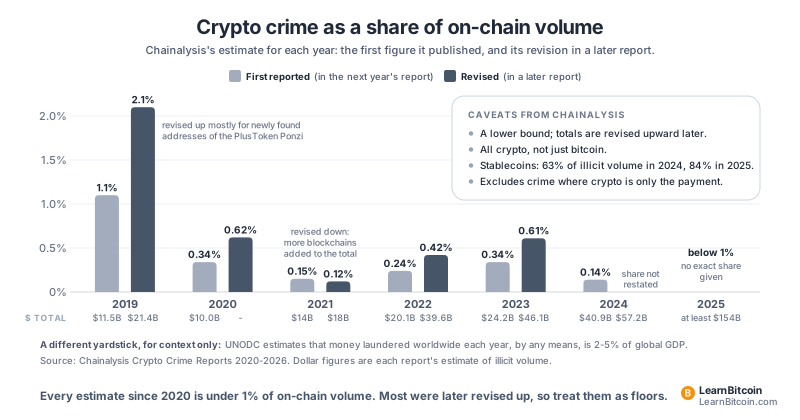
The usual measurement comes from Chainalysis, a company that sells blockchain tracing to police and compliance teams. Its first estimate of illicit activity has been under 1 percent of all the crypto moved on blockchains for every year since 2020. Those figures are minimums and get revised upward as more addresses are identified: 2023 went from 0.34 percent to 0.61 percent a year later, and 2024's first figure, $40.9 billion or 0.14 percent of volume, was later restated as $57.2 billion. They cover all crypto, not just bitcoin, and most of the illicit volume was in stablecoins, tokens built to hold a steady dollar value: 63 percent in 2024 and 84 percent in 2025. They also leave out ordinary crime, such as a drug deal, where crypto was only the means of payment. A second academic estimate, by Igor Makarov and Antoinette Schoar, put illegal transactions, scams and gambling together at less than 3 percent of bitcoin's volume at the end of 2020. Darknet markets, about $2 billion of business in 2024, ran mostly on bitcoin.
The label was close to the truth from 2011 to 2013, and the measures that cover 2020 onward all show it wrong. The Silk Road entry covers what the public ledger did to the people involved, and the privacy chapter covers the methods and their limits.
Money laundering
Larry Fink, head of BlackRock, said on 13 October 2017 that bitcoin just showed "how much demand for money laundering there is in the world." Christine Lagarde said in January 2021 that bitcoin had been used for "totally reprehensible money laundering activity." At her confirmation hearing for Treasury secretary on 19 January 2021, Janet Yellen told the Senate Finance Committee, "Cryptocurrencies are of particular concern. I think many are used, at least in the transactions sense, mainly for illicit finance." Less than three weeks later Nigeria's central bank, explaining its own crackdown, called cryptocurrencies "largely speculative, anonymous and untraceable."
Yellen's own department gave the scale in writing thirteen months later. The Treasury's 2022 National Money Laundering Risk Assessment says that "the use of virtual assets for money laundering remains far below that of fiat currency and more traditional methods," and its 2024 assessment repeats the point. The United Nations Office on Drugs and Crime puts the money laundered worldwide each year at 2 to 5 percent of global GDP, or $800 billion to $2 trillion. Chainalysis estimates crypto laundering in the tens of billions of dollars a year, $22.2 billion in 2023.
The public ledger also works against the launderer. In February 2022 the Justice Department recovered about 94,000 of the 119,754 BTC stolen from the exchange Bitfinex in 2016, after following the stolen coins for years and then finding the keys in an online account of the man who laundered them. Its announcement called it the department's largest financial seizure ever. In March 2024 Roman Sterlingov was convicted of running Bitcoin Fog, a mixing service that pooled users' coins to hide where they came from, from 2011 to 2021, and he was sentenced to 150 months, twelve and a half years. On 25 September 2026 the federal appeals court in Washington, D.C. upheld the conviction and sentence, including the evidence from Reactor, Chainalysis's tracing software, even though, as the court noted, "Both experts admitted that Reactor was not peer-reviewed and that they did not know the error rate for the software."
The laundering label is partly right. Crypto laundering is real and runs to billions of dollars a year, though it is small next to laundering through cash and banks, and Bitcoin's public ledger makes it a risky place to keep the proceeds.
Terrorist financing
The terrorism label had its biggest moment in October 2023. On 10 October, three days after Hamas attacked Israel, the Wall Street Journal reported that Palestinian Islamic Jihad had raised as much as $93 million in crypto between August 2021 and June 2023, citing the analytics firm Elliptic. A week later more than 100 members of Congress signed a letter saying the two groups had "raised over $130 million in crypto."
The data did not say that. Chainalysis replied on 18 October that such estimates appeared to count everything sent to service providers, such as money-transfer businesses, that had dealt with terror-linked wallets. In its example, one such address had received about $82 million, of which about $450,000 came from a known terror-affiliated wallet. Elliptic said that week that there was no evidence Hamas had received significant crypto donations, that the $93 million was everything sent to wallets Israel had seized, some of which probably belonged to brokers, and that the most prominent campaign since 7 October, run by the pro-Hamas outlet Gaza Now, had raised about $21,000. The Journal then corrected one passage, about money sent to Hezbollah, but kept the $93 million and the headline. In February 2024 the Treasury's terrorist financing risk assessment said "terrorists still prefer traditional financial products and services," and that "Public ledgers can support investigations in tracing the movement of illicit funds."
Hamas's armed wing had already stopped asking for bitcoin. In April 2023 it announced it would stop taking bitcoin donations, citing hostile efforts against its donors, and the Treasury later said US and Israeli disruptions had "likely contributed." Three years earlier, in August 2020, the Justice Department had seized more than 300 crypto accounts tied to al-Qassam, al-Qaeda and ISIS campaigns, noting that al-Qassam had told donors their bitcoin was untraceable. "However, such donations were not anonymous," the department said. Crypto fundraising for terrorist groups has not stopped. By late 2024, according to the Justice Department, the armed wing was raising crypto again through rotating addresses, and in September 2026 the department said it had seized more than $560,000 meant for the group. A letter from the group that the department filed in court that month told donors to send Tether's dollar token on the Tron network. Chainalysis reports that Iran-aligned groups are using crypto at a larger scale than before, and the Treasury says terrorist groups have been "increasingly turning to stablecoins." As a measurement, the October 2023 version of the label misread the data. Terrorist groups do raise money in crypto, more and more of it in stablecoins, but the Treasury's 2024 assessment found they still preferred banks and other traditional channels.
Illegal images in the blockchain
In March 2015 INTERPOL warned that blockchains could be used to store malware or illegal data, including child abuse images, with no way to remove it. In March 2018 a Guardian headline said child abuse imagery had been found in Bitcoin's blockchain. The story came from a paper by researchers at RWTH Aachen University and Goethe University Frankfurt, presented at the Financial Cryptography conference that year.
The paper is more careful than the headline. The researchers searched all 250.8 million transactions in the chain up to August 2017 and found about 1,600 files stored in it, mostly harmless text and images. The material they judged objectionable was two backed-up lists of links, 274 links in all, pointing to child-abuse websites, plus one image that an online forum claimed was abuse imagery and that the researchers said they could not verify. They also warned that laws in several countries could be read as making it illegal to possess the blockchain at all.
As of October 2026 we could find no report of anyone running a Bitcoin node, anywhere, being charged over data embedded in the chain, and lawyers quoted in 2025 pointed out that offenses of this kind generally require knowing possession. Bitcoin Core, the most widely used Bitcoin software, made practical changes instead. In 2015, and again in 2024, it began scrambling the data it stores on disk, so that antivirus programs and other software would stop misreading fragments of it. The argument came back in 2025 from inside Bitcoin, in the fight over Bitcoin Core's plan to raise its default limit on extra, non-payment data, such as text, that a transaction can carry and still be passed along to other computers, which shipped in version 30.0 that October. A group of Bitcoin Core developers said in a June 2025 statement that refusing to pass along transactions that miners will include anyway does not keep the data out of blocks, and that "Bitcoin can and will be used for use cases not everyone agrees on." The label overstated what the researchers found, and its legal prediction has not come true so far.
It boils the oceans
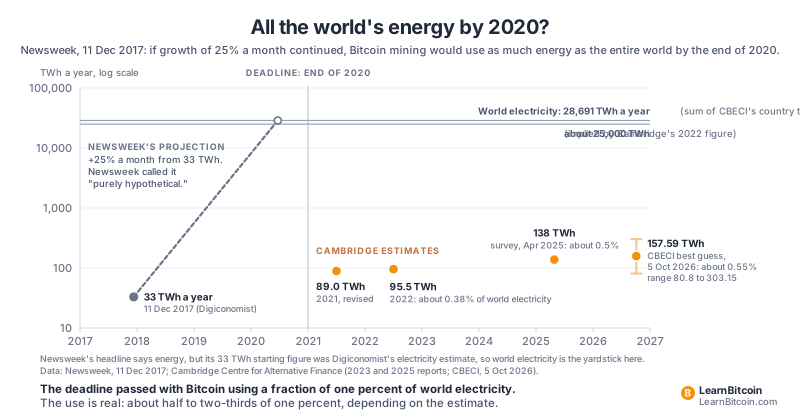
The energy argument's most famous version is a Newsweek headline from 11 December 2017, "Bitcoin Mining on Track to Consume All of the World's Energy by 2020." The projection came from extending one estimate's growth of about 25 percent a month, and the article itself called the projection hypothetical. CNBC answered ten days later that it was not likely to happen. In October 2018 a paper in Nature Climate Change argued that bitcoin "could alone produce enough CO2 emissions to push warming above 2 C" in less than three decades. Three rebuttals ran in the same journal in August 2019. One, by researchers including Eric Masanet and Jonathan Koomey, said the projections "should not be taken seriously," and another calculated that the scenario would require a tripling of global electricity generation within five years. The paper's middle scenario assumed about 11 billion Bitcoin transactions in 2020, and the chain processed about 113 million.
The dated predictions missed. In 2021, the year after Newsweek's deadline, Cambridge's revised estimate of Bitcoin's electricity use was 89 terawatt-hours. In its April 2025 report Cambridge put it at 138 terawatt-hours a year, about half of one percent of the world's electricity. Its live model stood at about 158 terawatt-hours in early October 2026, within a range of roughly 81 to 303.
Elon Musk suspended bitcoin payments at Tesla in May 2021 over the use of coal, and in June said they would return once miners showed "reasonable (~50%) clean energy usage." Cambridge's 2025 survey of mining companies put the sustainable share at 52.4 percent, and Tesla, which had said it would not sell any bitcoin, sold about three quarters of its holding in the second quarter of 2022. In November 2021 the heads of Sweden's financial regulator and environmental agency called on the EU to consider banning proof-of-work mining, the energy-hungry kind Bitcoin uses. The European Parliament's economics committee voted down a restriction in March 2022, an ECB bulletin that July floated measures for around 2025, and the EU's crypto law, MiCA, was adopted in 2023 with climate disclosure rules and no restriction on it. Greenpeace USA's 2022 campaign, "Change the code, not the climate," ran ads with headlines such as "If Only a Few Dozen People Agreed to Change Bitcoin, It Would Stop Polluting the Planet." Ethereum did switch that September to proof of stake, which does away with mining, and cut its energy use by more than 99.9 percent. Bitcoin's code did not change, and the block size war shows how hard it is to change even one rule.
The use itself is real, and the honest version of the label is a value judgment about whether the security that mining buys, by making the ledger expensive to rewrite, is worth the electricity. The fair concession, which d5000 made in our BitcoinTalk thread, is that a sustainable share of about half is not a high bar. The renewable share also depends on who measures it: a 2022 study by Alex de Vries and colleagues found renewables fell to about 25 percent after the China crackdown, while Cambridge's 2025 survey of miners puts renewables at 42.6 percent and nuclear at 9.8 percent. The energy chapter has the full numbers and the argument that miners help power grids by switching off at peak times.
They'll just ban it
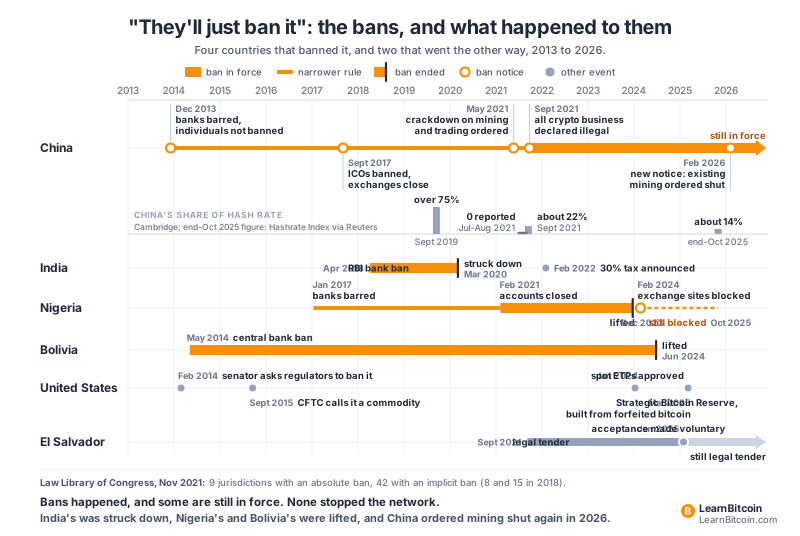
On 26 February 2014 Senator Manchin wrote to six US regulators urging them to "prohibit this dangerous currency from harming hard-working Americans." Joseph Stiglitz said on Bloomberg Television in November 2017, "So it seems to me it ought to be outlawed." A deputy governor of India's central bank said in February 2022 that "banning cryptocurrency is perhaps the most advisable choice open to India." Munger and Dimon, quoted above, wanted it banned or closed down. The investor Meltem Demirors joked in September 2021 that China was on roughly its twentieth bitcoin ban, and that if a ban had to be repeated, the first one had not worked.
China's central bank barred banks from handling bitcoin in December 2013, while still letting individuals trade it. China shut its exchanges and banned new token sales in September 2017. In May 2021 a State Council committee called for a crackdown on mining and trading, and that September ten government bodies, including the top court and prosecutor, declared all crypto business illegal. China's share of the world's mining fell to a reported zero in mid-2021, then crept back through underground operations to about 22 percent by that September and, by one industry estimate, about 14 percent by late 2025. In February 2026 eight agencies issued a new notice ordering existing mining shut. The mining death spiral section below covers what the 2021 crackdown did to the network.
India's central bank cut off banking for crypto businesses in April 2018. The Supreme Court of India set the order aside on 4 March 2020, and in February 2022 India's finance minister announced a 30 percent tax on crypto gains instead, thirteen days before the central bank's deputy governor recommended a ban.
Nigeria's story began with a protest. In October 2020, during the #EndSARS protests against police brutality, the Feminist Coalition, which was raising money for protesters, had its bank account shut, and it began accepting bitcoin, first through a payment service and then through its own BTCPay Server, free software for taking bitcoin without a middleman. In November a court froze the bank accounts of 20 people linked to the protests at the central bank's request. On 5 February 2021 the central bank told banks to close the accounts of anyone dealing in crypto. The price rose 2.5 percent that day and set a new high three days later. Trading moved to peer-to-peer platforms, and peer-to-peer volume rose by about a quarter in the following months. On 22 December 2023 new guidelines let banks open accounts for crypto businesses again. In February 2024 the telecom regulator had the big exchanges' websites blocked as the naira fell, and the blocks were still in place in October 2025. As a BitcoinTalk reader, Nheer, pointed out, bitcoin kept money moving while the banks were closed to the protesters, but it did not win the protest or lift the ban.
Bolivia banned bitcoin in 2014 and lifted the ban on 25 June 2024. The Law Library of Congress counted 9 jurisdictions with an absolute ban on crypto and 42 with an implicit ban, such as barring banks from serving crypto businesses, in November 2021, up from 8 and 15 in 2018. One BitcoinTalk reader, Jewan420, wrote that in his country, which he did not name, even talking about bitcoin is risky.
The United States went the other way from what Manchin asked for. Executive Order 14233 of 6 March 2025 created a Strategic Bitcoin Reserve from forfeited bitcoin that, in the order's words, "shall not be sold." El Salvador went further, making bitcoin legal tender in 2021 and then partly reversing course, as the coffee section describes, which cuts against bitcoin's boosters too.
So the bans were real, and China's was still in force in 2026, but none of them stopped the network. India's was struck down, Nigeria's banking ban and Bolivia's ban were lifted, and China's miners came back, so in 2026 China ordered existing mining shut again. Dimon's absolute version, that no government would put up with it, is the one that can be scored wrong.
Obsolete, too slow, flippened
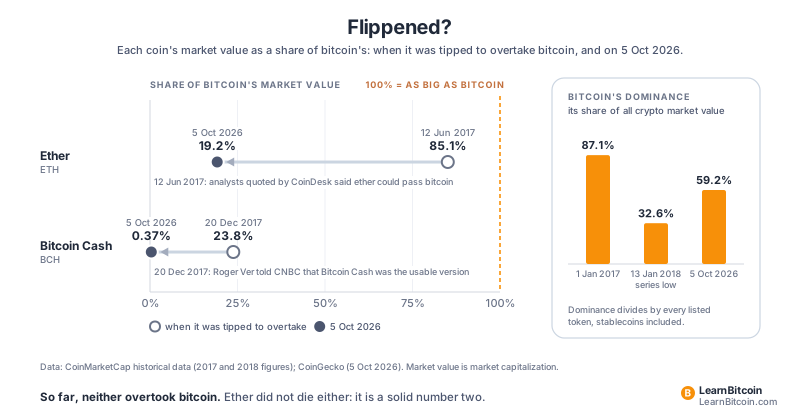
In June 2017 the market value of ether, the coin of the Ethereum network, reached 85 percent of bitcoin's, and CoinDesk quoted the head of CryptoCompare, Charles Hayter: "Ether has a strong chance of surpassing bitcoin." Bitcoin's share of the whole crypto market fell from 87 percent at the start of 2017 to a low of 32.6 percent on 13 January 2018. On 20 December 2017 Roger Ver told CNBC that bitcoin was "in danger of coming to a screeching halt altogether" if miners moved to his preferred fork, Bitcoin Cash, a breakaway version of Bitcoin with bigger blocks, which was then worth about 24 percent as much as bitcoin. In the same interview he suggested holders keep their bitcoin on an exchange so they could sell quickly. In October 2017 a small political site ran the headline "Blockchain Just Became Obsolete. The Future is Hashgraph," and in December Lobo's Der Spiegel column, quoted above, pointed readers to Hashgraph as a successor technology.
In early October 2026 ether was worth about 19 percent of bitcoin's market value, Bitcoin Cash about 0.4 percent, and Hedera, the Hashgraph network, about 0.3 percent. Bitcoin's share of the crypto market was about 59 percent. So "flippened" is wrong so far, and ether, which has not died either, was a solid second.
The other version of the label was "blockchain, not bitcoin." In 2015 a World Economic Forum survey found that most of the executives and experts it asked expected a tenth of global GDP to be stored on blockchains by 2025. In June 2018 Jack Ma said blockchain technology could change the world more than people imagine, while warning that bitcoin might be a bubble. The banks and shippers built consortium chains, private blockchains shared by a group of companies. Maersk and IBM announced in November 2022 that they would shut TradeLens by early 2023, because it "has not reached the level of commercial viability." The Australian stock exchange paused its blockchain settlement project the same month and wrote off up to A$255 million, and several trade-finance and insurance consortia, we.trade, B3i, Marco Polo and Contour, closed between 2022 and 2023. The survey's 2025 date has passed. It never said how "stored on blockchains" would be measured, but the market value of every cryptocurrency combined came to about 2.5 percent of world GDP in 2025, so on the closest available measure the forecast fell well short. Stablecoins and tokenization are a live story in 2026, so the score for the rest is narrower: the 2015 to 2018 consortium wave mostly shut down.
The "too slow" part was right about the base layer, the blockchain itself. Bitcoin confirmed about 154 million transactions in 2025, an average of under five a second. Scaling moved to layers built on top, which is the next section.
You can't buy a coffee with it
Satoshi Nakamoto conceded this one first, on BitcoinTalk in August 2010: "I don't think Bitcoin is practical for smaller micropayments right now." In December 2014 three researchers at ETH Zurich opened a paper with the problem: "the time to confirm a Bitcoin transaction is prohibitively slow," with a coffee as the worked example. The lead author, Christian Decker, went on to become the second-largest contributor to Core Lightning, one of the main versions of the software for the Lightning Network, which settles small payments away from the main chain. In January 2016 Mike Hearn predicted that rising fees would soon make bitcoin unusable in shops. The average fee that month was about 8 cents, and on 22 December 2017 it was about $56.
Merchants said the same thing as they dropped it, and so did central bankers. Steam dropped bitcoin on 6 December 2017, with fees "topping out at close to $20 a transaction last week." Stripe announced on 23 January 2018 that it would end support, and said bitcoin had become "better-suited to being an asset than being a means of exchange." Mark Carney, governor of the Bank of England, said in March 2018 that as a currency, "The short answer is they are failing." The Bank for International Settlements' 2018 annual report worked out that running a country's retail payments on the chain "could bring the internet to a halt."
Most of that was right about the base layer, and it is the argument the winning side of the block size war made for keeping the chain small and moving payments to other layers. The average fee was $128 on the day of the April 2024 halving, when the reward for mining a block was cut in half, and was under 50 cents on a typical day in the year to October 2026. The Lightning Network went live on the main Bitcoin network in March 2018. River, a Bitcoin company that runs Lightning services, estimated 5.22 million Lightning payments worth $1.17 billion in November 2025, much of it deposits to and withdrawals from exchanges. Square began letting its US sellers take bitcoin over Lightning on 10 November 2025, with no processing fee through 2026, and its launch announcement quoted the owner of a coffee shop.
El Salvador ran the largest test. Bitcoin became legal tender in September 2021, with a government wallet and a $30 bonus for signing up. A study for the US National Bureau of Economic Research found use "low, concentrated, and has been decreasing over time," and in a December 2024 survey 91.8 percent of Salvadorans said they had not used bitcoin that year. In January 2025, under its agreement with the IMF, accepting it became voluntary. The coffee label is partly right about the base layer, and Lightning is a partial answer to it.
Quantum computers will break it
In October 2017 a group of researchers wrote that the digital signatures that prove who owns which bitcoin "could be completely broken by a quantum computer as early as 2027," which they gave as the most optimistic estimate. MIT Technology Review's headline less than two weeks later was "Quantum Computers Pose Imminent Threat to Bitcoin Security." In May 2020 Decrypt reported the head of a post-quantum security company saying quantum computers could crack Bitcoin's cryptography by 2022.
No quantum computer able to do it existed in 2022, and none exists as of October 2026. The machines did improve, and estimates of what an attack would take came down: in 2025 a Google researcher put breaking RSA-2048, a widely used encryption standard, at under a million qubits, down from his 2019 estimate of 20 million. That is a different system from the one Bitcoin uses, but the direction is the same. About 35 percent of all bitcoin, more than one coin in three, sits at addresses that have already revealed the public key a quantum computer would need to attack, by ChainQuery's count. Two draft proposals, BIP-360 and BIP-361, sketch a migration, and neither has been activated. The "by 2022" call was wrong, and the 2027 date is not yet testable. The quantum chapter has the threat model and the fixes.
It can't recover from this
A reader on r/Bitcoin, greglogan84, suggested the idea for this section. The obituaries keep saying the same thing, that this time Bitcoin cannot recover, and only the reason changes.
August 2010, the overflow bug. On 15 August 2010 a bug in how the software added up amounts let block 74,638 create two payments of about 92 billion bitcoin each. A user on the forum, theymos, wrote, "This could be a serious problem." Satoshi released a fix that evening, and the corrected chain overtook the bad one about fifteen hours after the bad block. It is the only time the 21 million limit was broken on the live network. It drew no obituary, because the first one on the list was still three months away, and bitcoin was worth about six and a half cents. The inflation bug postmortem has the details.
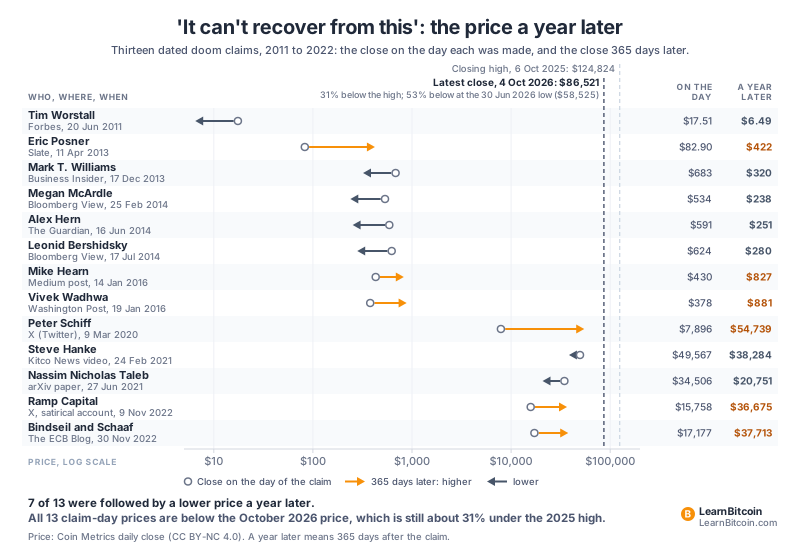
June 2011, the first Mt. Gox hack. A compromised account dumped coins on Mt. Gox on 19 June 2011, and the price on the exchange fell from about $17 to pennies in minutes before Mt. Gox halted trading and reversed the trades. Tim Worstall wrote in Forbes the next day, "this looks like it's the end of Bitcoin." A year later the price was $6.49, lower than before the hack. It made a new high in February 2013.
March 2013, the chain split. For seven hours and forty-one minutes the blockchain was split in two by a database bug. A wallet developer, Alan Reiner, predicted that many articles would turn it into "the end of Bitcoin," but 99Bitcoins has no entry between 24 December 2012 and 5 April 2013. The price dipped to $36.65 on Mt. Gox during the night and closed 8 percent lower, and six days later it made a new closing high. The 2013 chain fork chapter tells it from the chat log.
April 2013, the spring crash. On 10 April 2013 the price on Mt. Gox fell from $266 toward $50 over the following week. On 11 April the law professor Eric Posner wrote in Slate that bitcoin resembled a Ponzi scheme and that "Bitcoin will collapse" once people saw it could not survive as a currency. The price closed that day at $83, and a year later it was $422.
February 2014, Mt. Gox. The largest exchange halted withdrawals and then went offline. On 25 February 2014 Megan McArdle's column in Bloomberg View said the meltdown would "hasten the day when governments will regulate Bitcoin out of existence." A finance professor at Boston University, Mark T. Williams, had predicted in December 2013 that bitcoin would trade "for under $10 a share by the first half of 2014." It closed at $639 on 30 June 2014. A year after both pieces the price was lower, $238 against McArdle's $534.
June 2014, GHash.io. For a few hours on 13 June 2014 one mining pool, GHash.io, a group of miners working together, had 51 percent of the network's mining power, enough in principle to reverse recent payments. The Guardian wrote that bitcoin had "stared down an existential threat," and a month later Bloomberg View ran a column headlined "Trust Will Kill Bitcoin." Miners moved their machines away from the pool and the risk passed, without any rule changing. The Guardian's warning was fair, and the prediction in the Bloomberg View headline has not come true.
January 2016, Mike Hearn. Hearn, one of the best-known Bitcoin developers of the time, published "The resolution of the Bitcoin experiment" on 14 January 2016, at $430. He wrote that "the now inescapable conclusion that it has failed still saddens me greatly," said he had sold his coins, and expected the price to trend down over the long run. His reasons were the deadlock over the block size, the limit on how much each block can hold, and the control he said Chinese miners had over the chain. Five days later the Washington Post ran "R.I.P., Bitcoin. It's time to move on." A year after Hearn's post the price had roughly doubled. His points about rising fees and about Chinese miners' control both held, and the second is the one the next section tests.
September 2018, an inflation bug. A change released in 2017 had opened a hole, later logged as CVE-2018-17144, that could have let a miner create bitcoin out of nothing, in Bitcoin Core versions 0.15.0 to 0.16.2. It was reported on 17 September 2018, patched the next day and fully disclosed on 20 September, with no known attempt to exploit it. The developer who found it, awemany, called it "certainly one of the most catastrophic bugs in Bitcoin ever." No obituary on the list mentions it, and the price did not move: $6,497 before, $6,499 on disclosure day.
March 2020, the COVID crash. Schiff's "Put a fork in it," covered above, came three days before the price fell 38 percent in a single day.
November 2022, FTX. As the FTX exchange collapsed, on 9 November 2022, the day bitcoin closed at the lowest price of that cycle, $15,758, the satirical finance account Ramp Capital posted, "Crypto died today. I don't see how it recovers from this." Three weeks later came the ECB blog post titled "Bitcoin's last stand." A year later the price was more than twice as high.
October 2025 onward, the open one. No single event, just a 53 percent fall from October 2025 to June 2026, and no new high as of early October 2026. It is in this list because leaving it out would make the list look better than it is.
Thirteen claims in this section and the next are dated doom calls with a price on the day. All thirteen were made at prices below bitcoin's close on 4 October 2026, but seven were followed by a lower price a year later: Worstall, Williams, McArdle, the Guardian, Bershidsky, and Hanke and Taleb in the next section. Judged on the year that followed, the critics were right more often than not.
The mining death spiral
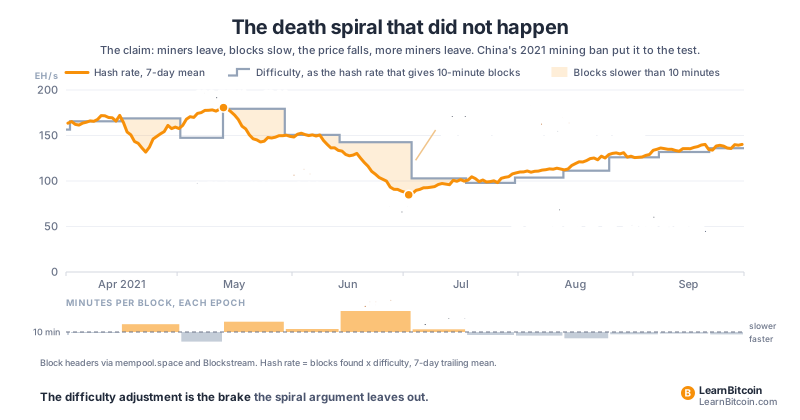
The most technical version of "it can't recover" is the mining death spiral. Miners pay their bills in dollars. If the price falls far enough, some miners switch off and blocks come more slowly. In the spiral story, the slowdown frightens holders, the price falls further, more miners switch off, and the chain grinds to a halt. The story leaves out the difficulty adjustment. Every 2,016 blocks, about two weeks, the network resets how hard blocks are to find, so they keep arriving about every ten minutes for whatever mining power is left. In December 2018, after the largest drop in difficulty since 2011, the idea was back in circulation, and a 2 January 2019 article in Finance Magnates asked whether the mining industry had entered a death spiral. Arjun Balaji published a rebuttal in the same weeks. In February 2021 the economist Steve Hanke said on Kitco that bitcoin would death-spiral to zero, though he meant the price rather than the mining mechanism. In June 2021 the writer Nassim Nicholas Taleb argued in a paper that bitcoin "depends on the existence of such miners for perpetuity," and that its expected value was no higher than zero. A year after each of those two calls the price was lower: $38,284 against Hanke's $49,567, and $20,751 against Taleb's $34,506.
Bitcoin's critics had pointed out for years that most mining sat in one country. Cambridge estimated China's share at 75.5 percent in September 2019 and 46 percent in April 2021. China put it to the test on 21 May 2021, when a State Council committee called for a crackdown on Bitcoin mining, the hydro-powered province of Sichuan ordered its known mining operations shut on 18 June, and the machines went dark or onto trucks. Taleb's paper came out on 27 June, in the middle of it.
The network lost about half its mining power in seven weeks. The seven-day average hash rate, the network's total mining power, fell 53 percent, from 180.7 EH/s (exahashes, or quintillions of guesses, a second) on 13 May 2021 to 84.8 EH/s on 2 July. Blocks slowed but never stopped. The difficulty period from 13 June to 3 July, the stretch between two adjustments, averaged 13.88 minutes a block, and even the slowest day, 27 June, produced 58 blocks against the usual 144. At block 689,472, on 3 July 2021, difficulty adjusted down by 27.94 percent, the largest cut on record, and the next period averaged 10.51 minutes.
The price fell by about half too, from $63,446 in April to $29,767 on 20 July, though it had started falling before the ban, and it set a new high on 19 October 2021, before the hash rate had fully recovered. The hash rate passed its May level in December 2021. By the following January the United States had about 38 percent of the world's mining, up from 17 percent in April 2021, and by early October 2026 the network's hash rate was about 950 EH/s, about five times the 2021 peak.
The critics were right that mining was concentrated in one country and that a single government could knock out half of it in weeks, as Hearn had warned in 2016. The network survived losing it anyway, because the difficulty adjustment did what it was designed to do. The mining chapter explains the adjustment.
Where the critics were right
Several of the critics were right about something.
- The crashes. The 2013 bubble calls from Greenspan and Schiff and Krugman's 2018 "grief" were all followed by crashes, and seven of the thirteen dated doom calls above were followed by a lower price a year later. Roubini posted on 9 March 2020 that bitcoin was "a shitty shitcoin hedge in risk-off cases," and three days later it fell 37 percent, more than stocks did. In November 2025 Schiff and Krugman both said bitcoin was falling, and it kept falling until June 2026. The bear market entry has the cycles.
- The custodians. People did lose fortunes, at Mt. Gox, QuadrigaCX, Celsius and FTX, and anyone who warned that ordinary buyers would get hurt was right, even if the losses came through companies rather than the protocol. That is the custody graveyard.
- Fees and scale. Hearn, Steam, Stripe and the BIS were right that fees would rise and that the base layer cannot carry a country's retail payments. Bitcoin's answer was to stop trying to, which is what the mempool and Lightning chapters cover.
- Mining concentration. Until 2021 most mining really did sit in one country, as the geographic mining distribution entry shows, and the decentralization chapter still treats concentration of mining as a live risk.
- Laundering and energy. Crypto laundering runs to billions a year, and Bitcoin mining uses about half a percent of the world's electricity, about half of it from sustainable sources by Cambridge's survey of miners.
- El Salvador and the central banks. Use of bitcoin in El Salvador was low and falling, and the law was rolled back. On 30 January 2025 Lagarde said that bitcoin "will not enter the reserves" of any central bank on the ECB's General Council. That holds so far, narrowly: in November 2025 the Czech National Bank bought bitcoin for a $1 million test portfolio, held outside its reserves.
- Quantum. The risk is real, and more than a third of all bitcoin is exposed to it.
Some critics described the time accurately without predicting anything. At her press conference on 13 December 2017, three days before the 2017 top, the Federal Reserve chair, Janet Yellen, said that bitcoin "at this time plays a very small role in the payment system" and was "a highly speculative asset."
Who changed their minds, or their policy
Some of the people quoted above changed their minds, or their firms changed course, and their own words are the clearest record.
| Who | Then | Later |
|---|---|---|
| Sean Lynch, author of the first obituary | "Why Bitcoin can't be a currency" (November 2010) | added an update walking it back (by June 2011) |
| Jamie Dimon, JPMorgan | "fraud" (September 2017) | regretted the word (January 2018), then called it "a hyped-up fraud" (January 2023); let clients buy bitcoin while saying his own view had not changed (May 2025) |
| Larry Fink, BlackRock | money laundering (October 2017) | "a big believer" (January 2024); BlackRock's bitcoin fund held about 803,000 BTC (October 2026) |
| Howard Marks, Oaktree | "unfounded fad" (July 2017) | "my skeptical view has not borne out to date" (January 2021) |
| Ray Dalio, Bridgewater | "Bitcoin is a bubble" (September 2017) | said he owns some (May 2021) |
| Kenneth Rogoff | $100 more likely than $100,000 by 2028 (March 2018) | said he had been "far too optimistic" that US regulators would rein it in (August 2025) |
| Donald Trump | "seems like a scam" (June 2021) | promised to keep every bitcoin the government held (July 2024); signed the order creating the Strategic Bitcoin Reserve (March 2025) |
| Vanguard | its founder: avoid it like the plague (November 2017) | opened its platform to crypto funds (December 2025) |
What our side got wrong
A reader on r/Bitcoin, abm2024, asked for the reverse list: things Bitcoiners said that turned out wrong. The same rules apply.
"Bitcoin is anonymous." The whitepaper never said so. It said to keep public keys anonymous, to use a new key for every payment, and that spending several coins together reveals they had one owner. Our side said it anyway, starting with WikiLeaks, which announced "anonymous Bitcoin donations" on 14 June 2011. Every one of the 26,416 payments into that address is public. In March 2013 bitcoin.org's page for newcomers was headed "Anonymous online payments" until the next morning, when the heading became "Pseudo-anonymous online payments." Careful voices had warned from the start, including the Bitcoin Wiki in December 2010 and the core developer Jeff Garzik in 2011. In October 2013 researchers at UC San Diego showed in "A Fistful of Bitcoins" how anyone with subpoena power could follow the money, and courts have been proving it since. bitcoin.org's privacy page calls Bitcoin "probably the most transparent payment network in the world." The privacy chapter explains why.
"It's free." Satoshi's announcement email in January 2009 said "there will probably always be nodes willing to process transactions for free." In March 2013 bitcoin.org promised payments "for free" under the heading "Almost 100% free to use," trimmed the next day to "Almost free to use," and that October its editor changed it to "Zero or low fees" in a commit titled "Fix a misleading title." The average fee was about $56 on 22 December 2017 and $128 on 20 April 2024. Fees are cheap on most days, but Bitcoin Core will not pass along a transaction that pays nothing unless a second transaction pays its fee for it, and on busy days fees are expensive. The mempool chapter has the mechanics.
"It can't be stolen." The ledger part is true, since nobody has rewritten it to take coins that were not theirs, but the companies around it are another matter. When Mt. Gox lost about 850,000 BTC in February 2014, six of the biggest Bitcoin companies issued a joint statement calling it "the result of one company's abhorrent actions" and assuring the public that hundreds of trustworthy companies remained. Bitfinex lost 119,754 BTC in 2016. Celsius, Voyager, FTX, BlockFi and Genesis failed within eight months of each other in 2022 and early 2023. Holding your own keys removes the company and leaves you as the risk: estimates from 2020 put 3 to 4 million BTC at addresses that had not moved in years, though nobody can say how much of that is lost and how much is just stored. The custody graveyard and seed backup chapters cover both halves.
"It will replace Visa." In April 2009 Satoshi wrote to Mike Hearn that Visa handled about 15 million online purchases a day and "Bitcoin can already scale much larger than that." In March 2018 the investor Tim Draper said on CNBC that within five years a barista would laugh at anyone paying in dollars. In the twelve months to October 2026 Bitcoin's base layer averaged about six transactions a second, while Visa's 329 billion transactions a year work out to about 10,400 a second. Satoshi's plan assumed much bigger blocks, which the network chose not to adopt, and Lightning is the partial answer.
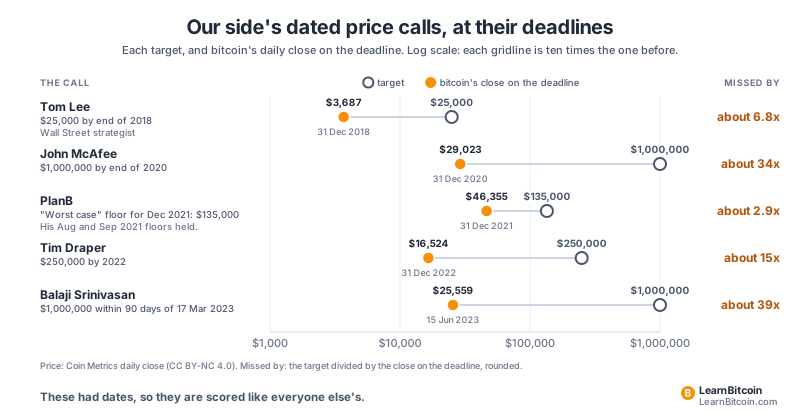
The price calls. These had dates, so they are scored like everyone else's, at the daily close on the deadline.
- John McAfee: $1 million by the end of 2020. It was $29,023. He later called the bet attached to it a ruse to bring in new users.
- PlanB: a "worst case" of $135,000 for December 2021. It closed the month at $46,355. His August and September floors held, and the later months missed.
- Tim Draper: $250,000 by 2022. It ended 2022 at $16,524, and he has since moved the date.
- Tom Lee, a Wall Street strategist rather than a Bitcoiner: $25,000 by the end of 2018. It was $3,687.
- Balaji Srinivasan: $1 million within 90 days of 17 March 2023, because of a coming dollar hyperinflation. It was $25,559 on the deadline, and US inflation that June was 3.0 percent. He had made the call as a $1 million bet and settled it early, on 2 May 2023, with $1.5 million in donations.
The inflation-hedge claim failed its first live test too. US inflation peaked at 9.1 percent in June 2022, the year bitcoin fell 64 percent. A reader, abm2024, also sent in a common Bitcoiner idea, that the price rises tenfold in the two years after each halving. It held twice and then stopped: about 31 times after 2012, 10 times after 2016, 3.4 times after 2020 and 1.2 times after 2024. This chapter does not add a prediction of its own.
What this buys us
Scored the same way, the labels from 2010 to 2026 leave you with four things to keep.
- You can sort a claim before you believe it. "Bitcoin is dead" tells you little until you know what kind of claim it is, so ask what would prove it wrong. If nothing could, it is an opinion, which anyone is entitled to hold.
- You know what the critics got right. The crashes, the custodial failures, the fees, the energy use and the laundering were real, and the chapters and entries linked above say so. Knowing which criticisms held up makes the next good one easier to spot.
- You know which crises mattered. The software failures that could have broken Bitcoin, in 2013 and 2018, drew almost no obituaries, and the events that drew the most were price falls. In October 2026 the price was in a fall that had not ended, and falling prices, which say little about whether the network works, have been the most common reason anyone declares Bitcoin dead.
- Our side gets the same test. Bitcoiners called it anonymous, free and impossible to steal, and set price targets that missed by up to 39 times. Dated claims are scored the same way whoever makes them.
Pro tip: When the next "Bitcoin is dead" headline arrives, write down the date and the price and keep them with the claim. If it names a deadline, put the deadline in your calendar. If it uses a word with a legal definition, like Ponzi or fraud, ask who would be charged. Then read it again a year later.
Credits
This chapter was built in public, in a thread on r/Bitcoin and one on BitcoinTalk. Readers shaped its structure. The "it can't recover from this" section was greglogan84's idea, robinsonrichard_3 suggested sorting each label by what would prove it wrong, and abm2024 asked for what our side got wrong. Others found sources and made points the chapter uses: aoluain (the Buffett, Dimon and Roubini quote archive), d5000 (obsolete and flippened, the Spiegel column, the death spiral and the energy concession), Darker45 (Gates, Medalla and Munger), Davidvictorson and Cookdata (Nigeria and #EndSARS), Nheer (the caution on #EndSARS), Jewan420 (bans), boyptc (fad), Cryptomultiplier (Golden Cyberfetters), pooya87 (Hearn), matrixx (GHash.io), Haunebu (Jack Ma) and Catenaccio (Trump). If something here is wrong, say so in either thread or use the edit link at the bottom of this page, and it gets fixed, with credit.
Sources
- 99Bitcoins - Bitcoin Obituaries
- 99Bitcoins - Bitcoin Obituaries as of May 2024, with the stated inclusion rules (Wayback Machine)
- Sean Lynch - Why Bitcoin can't be a currency, The Underground Economist, November 2010 (Wayback Machine, December 2010)
- Sean Lynch - the same post with his later update (Wayback Machine, June 2011)
- bitcoindeaths.com - Bitcoin death statistics
- Coin Metrics - Community data, BTC PriceUSD daily close (CC BY-NC 4.0)
- CNBC Buffett Archive - Of our 49 billion, we haven't moved any to bitcoin (4 May 2013)
- Quote Investigator - Rat Poison Squared (the 2013 and 2018 exchanges with Liz Claman)
- Bloomberg - Buffett Says Bitcoin Doesn't Meet the Test of a Currency (3 March 2014)
- CNBC - Buffett blasts bitcoin as mirage: Stay away! (14 March 2014)
- CNBC - Buffett says cryptocurrencies will almost certainly end badly (10 January 2018)
- Yahoo Finance - Warren Buffett: Buying bitcoin is not investing (28 April 2018)
- Becky Quick on X - Buffett on bitcoin: probably rat poison squared (5 May 2018)
- CNBC - Warren Buffett says bitcoin is probably rat poison squared (5 May 2018)
- CNBC - Warren Buffett says bitcoin is a delusion (25 February 2019)
- CNBC - Warren Buffett: cryptocurrency has no value (24 February 2020)
- CNBC - Warren Buffett gives his most expansive explanation for why he doesn't believe in bitcoin (30 April 2022)
- Bloomberg - Munger calls bitcoin a noxious poison (14 February 2018)
- CNBC - Charlie Munger calls bitcoin disgusting and contrary to the interests of civilization (1 May 2021)
- Fortune - Munger: bitcoin is stupid and evil (30 April 2022)
- CNBC - Charlie Munger says the US should ban cryptocurrencies (2 February 2023)
- Bill Miller - Miller Value Partners fourth-quarter 2020 market letter (GuruFocus copy)
- CoinDesk - Nubank launches bitcoin and ether trading (11 May 2022)
- CoinDesk - Berkshire Hathaway invests $500M in Nubank (8 June 2021)
- David Kass - Changes to Berkshire Hathaway portfolio during Q1 2025 (15 May 2025)
- Motley Fool - Buffett sold Citigroup and Nu Holdings in the first quarter of 2025 (19 May 2025)
- Fortune - Jamie Dimon on virtual currency (4 November 2015)
- CoinDesk - Jamie Dimon: bitcoin will not survive (5 November 2015)
- CNBC transcript - Jamie Dimon live from Davos on Squawk on the Street (20 January 2016)
- Bloomberg - JPMorgan's CEO says he'd fire traders who bet on fraud bitcoin (12 September 2017)
- CNBC - Jamie Dimon says bitcoin is a fraud that will eventually blow up (12 September 2017)
- CNBC - Jamie Dimon says people who buy bitcoin are stupid (13 October 2017)
- CNBC - Jamie Dimon says he regrets calling bitcoin a fraud (9 January 2018)
- CNBC - Jamie Dimon says bitcoin is worthless (11 October 2021)
- US House Financial Services Committee - Holding Megabanks Accountable, hearing record, 21 September 2022 (Serial No. 117-100)
- CNBC - Jamie Dimon says bitcoin itself is a hyped-up fraud (19 January 2023)
- CNBC - Jamie Dimon: if I was the government, I'd close it down (6 December 2023)
- CNBC - JPMorgan quietly unveils access to a half dozen crypto funds (5 August 2021)
- iShares Bitcoin Trust ETF - prospectus (authorized participants)
- CNBC - Jamie Dimon says the bank will let clients buy bitcoin (19 May 2025)
- CNBC - Peter Schiff calls bitcoin a bubble (12 November 2013)
- Peter Schiff on X - Put a fork in it (9 March 2020)
- Peter Schiff on X - When it ultimately goes to zero (2 January 2021)
- Peter Schiff on X - a permanent move down to zero is inevitable (16 February 2021)
- Peter Schiff on X - last chance to buy above $40,000 (4 February 2022)
- Peter Schiff on X - won't be around a decade from now (19 February 2022)
- Peter Schiff on X - will not recover (18 June 2022)
- CoinDesk - Peter Schiff says he wishes he'd bought bitcoin in 2010 (14 March 2024)
- Peter Schiff on X - the financial crisis of 2025 will kill it (10 April 2025)
- Peter Schiff on X - the race to get out of Bitcoin is on (19 November 2025)
- Peter Schiff on X - may have been the final ATH (9 February 2026)
- Paul Krugman - Golden Cyberfetters (7 September 2011)
- Paul Krugman - Adam Smith Hates Bitcoin (12 April 2013)
- Paul Krugman - Bitcoin Is Evil (28 December 2013)
- Paul Krugman - Bubble, Bubble, Fraud and Trouble (29 January 2018, Wayback Machine)
- Paul Krugman - Trump Is Planning the Biggest Heist in History (6 March 2025)
- Bank of England Quarterly Bulletin 2014 Q3 - The economics of digital currencies
- Satoshi Nakamoto - P2P Foundation post, 18 February 2009 (Satoshi Nakamoto Institute)
- Sascha Lobo - Bitcoin, Blockchain, Hashgraph: Die Blase, die bleibt (Der Spiegel, 6 December 2017)
- Bloomberg - Greenspan says bitcoin a bubble without intrinsic currency value (4 December 2013)
- Bloomberg - ECB's Constancio says bitcoin isn't a currency, it's a tulip (22 September 2017, Wayback Machine)
- CNBC - Ray Dalio says bitcoin is a bubble (19 September 2017)
- CNBC - Ray Dalio: I have some bitcoin (24 May 2021)
- Bloomberg - Roubini says bitcoin is the biggest bubble in human history (2 February 2018)
- Nouriel Roubini - written testimony to the Senate Banking Committee (11 October 2018)
- CNBC - Kenneth Rogoff: bitcoin more likely to be $100 than $100,000 in 10 years (March 2018)
- Kenneth Rogoff on X - far too optimistic about the US coming to its senses (August 2025)
- CoinDesk - Harvard professor who predicted bitcoin crash to $100 says regulators were too lax (21 August 2025)
- Howard Marks - There They Go Again ... Again (Oaktree memo, 26 July 2017)
- Howard Marks - Something of Value (Oaktree memo, 11 January 2021)
- CNBC - Robert Shiller says bitcoin is an interesting experiment (Davos, January 2018)
- CNBC - Shiller: the bitcoin bubble is an example of faddish human behavior (April 2018)
- CNBC - Jack Bogle says avoid bitcoin like the plague (29 November 2017)
- CoinDesk - Vanguard exec likens bitcoin to digital Labubu as the firm opens ETF trading access (13 December 2025)
- CNBC - Bill Gates: I would short bitcoin if I could (7 May 2018)
- CNBC - Bill Gates says crypto and NFTs are based on greater fool theory (15 June 2022)
- BusinessWorld - Incoming BSP governor not keen on cryptocurrency (20 June 2022)
- CNBC - Bank of England's Bailey: crypto investors risk losing all their money (7 May 2021)
- CNBC - ECB chief Christine Lagarde says crypto is worth nothing (23 May 2022)
- The ECB Blog - Bitcoin's last stand (Bindseil and Schaaf, 30 November 2022)
- The ECB Blog - ETF approval for bitcoin, the naked emperor's new clothes (Bindseil and Schaaf, 22 February 2024)
- Central Banking - Bitcoin is a rival to gold, not the dollar: Powell (December 2024)
- US SEC, Investor.gov - Ponzi schemes
- European Central Bank - Virtual currency schemes (October 2012)
- Kaushik Basu - Ponzis: The Science and Mystique of a Class of Financial Frauds (World Bank Policy Research Working Paper 6967, July 2014)
- Agustin Carstens - Money in the digital age: what role for central banks? (BIS, 6 February 2018)
- T Rabi Sankar - keynote, Indian Banks' Association (Reserve Bank of India, 14 February 2022)
- US SEC - SEC charges Texas man with running bitcoin-denominated Ponzi scheme (23 July 2013)
- US DOJ - BitConnect founder indicted in global $2.4 billion cryptocurrency scheme (25 February 2022)
- The Block - China seizes billions in cryptocurrency from the PlusToken scheme (27 November 2020)
- Ontario Securities Commission - QuadrigaCX: a review by staff (2020)
- Donald Trump on X - not a fan of Bitcoin (July 2019)
- Fox News - Trump: Bitcoin seems like a scam (Varney and Co., 7 June 2021)
- CNBC - Trump proposes strategic national crypto stockpile at Bitcoin Conference (27 July 2024)
- US DOJ - Statement of US Attorney Damian Williams on the conviction of Samuel Bankman-Fried (2 November 2023)
- US DOJ - Samuel Bankman-Fried sentenced to 25 years (28 March 2024)
- US DOJ - Founder of Celsius sentenced to 12 years (8 May 2025)
- CFTC - Bitcoin and other virtual currencies are a commodity (In re Coinflip, 17 September 2015)
- US SEC - Statement on the approval of spot bitcoin exchange-traded products (Gensler, 10 January 2024)
- NBC New York - Schumer calls on feds to shut down online drug marketplace (5 June 2011)
- US Senate - Beyond Silk Road: Potential Risks, Threats, and Promises of Virtual Currencies (hearing, 18 November 2013)
- US DOJ - Ross Ulbricht sentenced to life in prison (29 May 2015)
- CNBC - Bill Gates calls cryptocurrency super risky in Reddit AMA (27 February 2018)
- Foley, Karlsen and Putnins - Sex, Drugs, and Bitcoin (Review of Financial Studies, 2019)
- Makarov and Schoar - Blockchain Analysis of the Bitcoin Market (NBER Working Paper 29396, 2021)
- Chainalysis - 2024 Crypto Crime Report introduction (18 January 2024)
- Chainalysis - 2025 Crypto Crime Report introduction (15 January 2025)
- Chainalysis - 2026 Crypto Crime Report introduction (8 January 2026)
- CNBC - Larry Fink calls bitcoin an index of money laundering (13 October 2017)
- The Globe and Mail (Reuters) - ECB's Lagarde calls for global regulation of bitcoin (13 January 2021)
- US Senate Finance Committee - Yellen confirmation hearing, 19 January 2021 (S. Hrg. 117-165)
- US Treasury - 2022 National Money Laundering Risk Assessment
- UNODC - Money laundering overview
- US DOJ - Two arrested for alleged conspiracy to launder $4.5 billion in stolen cryptocurrency (8 February 2022)
- US DOJ - Operator of Bitcoin Fog sentenced to more than 12 years (8 November 2024)
- US Court of Appeals for the D.C. Circuit - United States v. Sterlingov, No. 24-3161 (25 September 2026)
- Sens. Warren and Marshall, Rep. Casten - letter to the White House and Treasury on Hamas crypto financing (17 October 2023)
- Chainalysis - Correcting the record: inaccurate methodologies for estimating cryptocurrency's role in terrorism financing (18 October 2023)
- Elliptic - Setting the record straight on crypto crowdfunding by Hamas (October 2023)
- Cointelegraph - Wall Street Journal corrects article misciting Hamas crypto terrorism funding data (28 October 2023)
- US Treasury - 2024 National Terrorist Financing Risk Assessment
- US DOJ - Global disruption of three terror finance cyber-enabled campaigns (13 August 2020)
- US DOJ - Justice Department continues to disrupt Hamas terrorist financing schemes through seizures (1 September 2026)
- CoinDesk - Hamas military wing told donors to avoid Binance (16 September 2026)
- INTERPOL - Cyber research identifies malware threat to virtual currencies (26 March 2015)
- The Guardian - Child abuse imagery found within bitcoin's blockchain (20 March 2018)
- Matzutt et al. - A Quantitative Analysis of the Impact of Arbitrary Blockchain Content on Bitcoin (Financial Cryptography 2018)
- Bitcoin Core PR #6650 - Obfuscate chainstate (2015)
- Bitcoin Core PR #28052 - XOR the block files (2024)
- Bitcoin Core - Bitcoin Core development and transaction relay policy (6 June 2025)
- Bitcoin Core 30.0 release notes (10 October 2025)
- Protos - Lawyers call Bitcoin Core v30 CSAM concerns overblown (1 October 2025)
- Newsweek - Bitcoin mining on track to consume all of the world's energy by 2020 (11 December 2017)
- CNBC - No, bitcoin isn't likely to consume all the world's electricity in 2020 (21 December 2017)
- Mora et al. - Bitcoin emissions alone could push global warming above 2 C (Nature Climate Change, 29 October 2018)
- Masanet et al. - Implausible projections overestimate near-term Bitcoin CO2 emissions (Nature Climate Change, 2019; author manuscript)
- Dittmar and Praktiknjo - Could Bitcoin emissions push global warming above 2 C? (Nature Climate Change, 2019)
- Houy - Rational mining limits Bitcoin emissions (Nature Climate Change, 2019)
- de Vries et al. - Revisiting Bitcoin's carbon footprint (Joule, 2022)
- CNBC - Elon Musk says Tesla will stop accepting bitcoin for car purchases (12 May 2021)
- CNBC - Musk: Tesla will accept bitcoin when miners use clean energy (13 June 2021)
- NPR - Tesla sold most of its bitcoin (21 July 2022)
- Finansinspektionen and the Swedish EPA - Energy-intensive mining should be banned (5 November 2021)
- CoinDesk - Proposal limiting proof-of-work is rejected in EU Parliament committee vote (14 March 2022)
- ECB Macroprudential Bulletin - Mining the environment: is climate risk priced into crypto-assets? (July 2022)
- Greenpeace USA, EWG and others - Change the code, not the climate campaign launch (29 March 2022)
- Greenpeace USA - Climate groups to Bitcoin: cut the pollution (15 September 2022)
- Cambridge Judge Business School - Cambridge study: sustainable energy rising in bitcoin mining (28 April 2025)
- Cambridge Judge Business School - Bitcoin electricity consumption: an improved assessment (31 August 2023)
- Cambridge Bitcoin Electricity Consumption Index
- US Senator Joe Manchin - Manchin demands federal regulators ban Bitcoin (26 February 2014, Wayback Machine)
- CoinDesk - Bitcoin ought to be outlawed, economist Joseph Stiglitz says (29 November 2017)
- CNBC - What investors should know about China's cryptocurrency crackdown (24 September 2021)
- People's Bank of China - Notice on further preventing and disposing of speculative risks in virtual currency trading (September 2021)
- People's Bank of China - Notice on further preventing and disposing of risks related to virtual currencies (6 February 2026)
- CoinDesk - China returns as third-largest bitcoin mining hub with a 14% share (24 November 2025)
- Reserve Bank of India - Prohibition on dealing in virtual currencies (6 April 2018)
- Supreme Court of India - Internet and Mobile Association of India v. Reserve Bank of India (4 March 2020)
- CoinDesk - Nigerian banks shut them out, so these activists are using bitcoin to battle police brutality (16 October 2020)
- Central Bank of Nigeria - Letter on crypto (5 February 2021, Wayback Machine)
- Central Bank of Nigeria - Response to regulatory directive on cryptocurrencies, press release (7 February 2021)
- Central Bank of Nigeria - Guidelines on operations of bank accounts for virtual asset service providers (22 December 2023, Wayback Machine)
- Decrypt - Bitcoin peer-to-peer trading up 27% in Nigeria since crypto ban (22 April 2021)
- TechCabal - Despite pro-crypto moves, major exchanges remain offline in Nigeria (30 October 2025)
- Banco Central de Bolivia - press release CP50/2024 on virtual assets (26 September 2024)
- Law Library of Congress - Regulation of Cryptocurrency Around the World: November 2021 Update
- Federal Register - Executive Order 14233, Establishment of the Strategic Bitcoin Reserve (6 March 2025)
- NBER - Alvarez, Argente and Van Patten, Are Cryptocurrencies Currencies? Bitcoin as Legal Tender in El Salvador (Working Paper 29968)
- IMF - El Salvador staff-level agreement on an EFF arrangement (18 December 2024, Wayback Machine)
- El Diario de Hoy - IUDOP survey on bitcoin use in El Salvador (16 January 2025)
- Reason - El Salvador walks back its bitcoin law (3 February 2025)
- CoinDesk - The Flippening: will ether pass bitcoin and what would it mean? (June 2017)
- CNBC transcript - Roger Ver talks Bitcoin Cash on Fast Money (20 December 2017)
- Squawker - Blockchain just became obsolete. The future is Hashgraph (25 October 2017, Wayback Machine)
- Financial Express (Bloomberg) - Jack Ma embraces blockchain but warns of bitcoin bubble (25 June 2018)
- World Economic Forum - Deep Shift: Technology Tipping Points and Societal Impact (September 2015)
- Maersk - Maersk and IBM to discontinue TradeLens (29 November 2022)
- Ledger Insights - we.trade starts insolvency procedure (June 2022)
- Insurance Post - B3i enters insolvency after failing to raise funding (28 July 2022)
- Ledger Insights - Marco Polo blockchain trade finance insolvency (24 February 2023)
- Ledger Insights - Contour blockchain trade finance network to shutter (1 November 2023)
- The Register - Project replacing stock exchange with blockchain paused (17 November 2022)
- Satoshi Nakamoto - on micropayments, BitcoinTalk, August 2010 (Satoshi Nakamoto Institute)
- Decker, Seidel and Wattenhofer - Bitcoin Meets Strong Consistency (arXiv, 26 December 2014)
- Mike Hearn - The resolution of the Bitcoin experiment (14 January 2016, Wayback Machine)
- Steam - Steam is no longer supporting Bitcoin (6 December 2017)
- Stripe - Ending Bitcoin support (23 January 2018)
- Mark Carney - The Future of Money (Bank of England, 2 March 2018)
- BIS Annual Economic Report 2018 - Cryptocurrencies: looking beyond the hype
- River - Bitcoin Adoption Report 2026 (Lightning payment estimates)
- Block - Block to roll out bitcoin payments on Square, over Lightning (27 May 2025)
- Square - Square launches bitcoin payments (8 October 2025)
- Aggarwal et al. - Quantum attacks on Bitcoin, and how to protect against them (arXiv, 28 October 2017)
- MIT Technology Review - Quantum computers pose imminent threat to Bitcoin security (8 November 2017)
- Decrypt - Quantum computers could crack Bitcoin by 2022 (12 May 2020)
- Craig Gidney - How to factor 2048 bit RSA integers with less than a million noisy qubits (arXiv, May 2025)
- ChainQuery - Quantum exposure report
- BIP-360 - Pay to Merkle Root (P2MR)
- BIP-361 - Post Quantum Migration and Legacy Signature Sunset
- BitcoinTalk - Strange block 74638 (15 August 2010)
- Tim Worstall - So, That's the End of Bitcoin Then (Forbes, 20 June 2011, Wayback Machine)
- Alan Reiner - bitcoin-development mailing list, 12 March 2013
- Eric Posner - Fool's Gold (Slate, 11 April 2013)
- Business Insider - Finance professor: Bitcoin will crash to $10 by mid-2014 (17 December 2013)
- Bloomberg View - Mt. Gox meltdown spells doom for Bitcoin (Megan McArdle, 25 February 2014)
- The Guardian - Bitcoin currency could have been destroyed by 51% attack (16 June 2014)
- Bloomberg View - Trust Will Kill Bitcoin (Leonid Bershidsky, 17 July 2014)
- The Washington Post - R.I.P., Bitcoin. It's time to move on. (19 January 2016, Wayback Machine)
- Bitcoin Core - CVE-2018-17144 full disclosure (20 September 2018)
- awemany - 600 Microseconds (21 September 2018, Wayback Machine)
- Ramp Capital on X - Crypto died today (9 November 2022)
- Finance Magnates - Has the Bitcoin mining industry entered into a death spiral? (2 January 2019)
- Arjun Balaji - The bitcoin mining death spiral debate, explained (December 2018)
- Nassim Nicholas Taleb - Bitcoin, Currencies, and Fragility (arXiv, 27 June 2021)
- Kitco NEWS - Steve Hanke: Why Bitcoin will death spiral to $0 (24 February 2021)
- Chinese government - State Council Financial Stability and Development Committee meeting (21 May 2021)
- CoinDesk - Sichuan becomes latest Chinese province to order bitcoin miner shutdown (18 June 2021)
- mempool.space - difficulty adjustments
- Cambridge Judge Business School - New data reveals timeline of China's bitcoin mining exodus (15 July 2021)
- Cambridge Judge Business School - Bitcoin mining: new data reveal a surprising resurgence (17 May 2022)
- Federal Reserve - FOMC press conference transcript (13 December 2017)
- Nouriel Roubini on X - a shitty shitcoin hedge in risk-off cases (9 March 2020)
- Yahoo Finance - Roubini says the bitcoin bubble will go bust (24 December 2020)
- Daily Hodl - Roubini says bitcoin may be a partial store of value (9 November 2020)
- ECB - Lagarde press conference transcript (30 January 2025)
- Czech National Bank - The CNB creates a test portfolio of digital assets (13 November 2025)
- CNBC transcript - Larry Fink on Squawk Box (12 January 2024)
- WikiLeaks on X - anonymous Bitcoin donations (14 June 2011)
- bitcoin.org git history - Anonymous online payments heading (18 March 2013)
- bitcoin.org git history - Fix a misleading title (14 October 2013)
- bitcoin.org - Protect your privacy
- Meiklejohn et al. - A Fistful of Bitcoins (IMC 2013)
- Satoshi Nakamoto - Bitcoin v0.1 released (Cryptography Mailing List, 8 January 2009)
- Satoshi Nakamoto - emails to Mike Hearn, April 2009
- NewsBTC - Joint statement regarding Mt. Gox (24 February 2014)
- Decrypt - 3.7 million lost bitcoin are probably gone forever (June 2020)
- Visa - fact sheet (FY2026 edition)
- CNBC - Tim Draper: in five years we'll only be using cryptocurrencies to pay (6 March 2018)
- CNBC - Tim Draper predicts bitcoin will reach $250,000 by 2022 (13 April 2018)
- John McAfee on X - $1 million by the end of 2020 (29 November 2017)
- PlanB on X - worst case scenario for 2021 (20 June 2021)
- CoinDesk - Balaji closes bitcoin bet with $1.5M in donations (2 May 2023)
- US Bureau of Labor Statistics - CPI for All Urban Consumers (CPI-U)