
what do you think about having a maximum fee rate?
3 messages, 22 to 24 Dec 2017. Started by oscar.
oscar (2), LORD HIS EXCELLENCY JAMES HRMH
Hello, I'm not a bitcoin developer, but I'd like to receive feedback on what I think is a serious problem. Hope I'm not wasting your time. I'm also sure this was already discussed, but google doesn't give me any good result.
Let me explain: I think that the current incentive system doesn't really align with the way miners are distributed (not very decentralized, due to pools and huge asic producers). I think big miners are incentivized to spam the network with low(ish) fee transactions, thereby forcing regular users into paying extremely high fees to be able to get their transactions confirmed.
Obviously this is the result of insufficient mining decentralization, but as I will try to show, such an attack could be profitable even if you are controlling just 5-10% of the hashing power, which could always be easy for a big player and with some collusion.
Let's look at some numbers: https://i.imgur.com/sCn4eDG.png

These are 10 blocks mined yesterday, and they all have rewards hugely exceeding the normal 12.5 mining output. Even taking the lowest value of 20, it's a nice 60% extra profit for the miner. Let's say you control 10% of the hashing power, and you spam enough transactions to fill 144 blocks (1 day's worth) at 50 satoshi/byte, losing just 72 BTC in fees.
(blocksize-in-bytes * fee-per-byte * Nblocks)/satoshis-in-btc => (1e6 * 50 * 144)/1e8 => 72
At the same time you will discover about 144*0.1=14.4 blocks per day. Assuming the situation we see in the previous screenshot is what happens when you have a mempool bigger than one day's worth of blocks, you would get 20-12.5=7.5 extra BTC per block, which is 14.4*7.5=108 BTC, given your investment of 72 to spam the mempool. 32 btc extra profit.
The big assumption here is that spamming 1 day of backlog in the 50satoshi/b range will get people to compete enough to push 7.5 btc of fees in each block, but:
* https://jochen-hoenicke.de/queue/#30d this seems to confirm that about half the mempool is in the 50satoshi/b range or less. * https://blockchain.info/pools there are miners that control more than 10% * if you get enough new real transactions, it's not necessary to spam a full 144 blocks worth each day, probably just ~50 would be enough, cutting the spam cost substantially * other miners could be playing the same game, helping you spam and further reduce the costs of the attack * you actually get 10% of the fees back by avoiding mining your spam transactions in your own blocks * most of the spam transactions won't actually end up in blocks if there is enough pressure coming from real usage
This seems to indicate that you would actually get much higher profit margins than my estimates. **PLEASE** correct me if my calculations or my assumptions are wrong.
You might also say that doing this would force users out of the system, decreasing the value of btc and disincentivizing miners from continuing. On the other hand, a backlogged mempool could create the impression of high(er) usage and increase scarcity by slowing down movements, which could actually push the price upwards.
Of course, it's impossible to prove that this is happening. But the fact that it is profitable makes me believe that it is happening.
I see some solutions to this, all with their own downsides:
- increasing block size every time there is sustained pressure this attack wouldn't work, but the downsides have already been discussed to death.
- change POW Not clear it would fix this, aside from stimulating terrible infighting. Controlling 5 to 10% of the hashing power seems too easy, and I don't think it would be practical to change pow every time that happens, as it would prevent the development of a solid POW support.
- protocol level MAX transaction fee I personally think this would totally invalidate the attack by making the spam more expensive than the fees you would recover. There already is a minimum fee accepted by the nodes, at 1 satoshi per byte. The maximum fee could be N times the minimum, maybe 100-200. Meaning a maximum of 1-2btc in total fee rewards when the block size is 1mb. Of course the actual values need more analysis, but 2btc - together with the deflationary structure - seems enough to continue motivating miners, without giving unfair advantage.
Yes, this would make it impossible to spend your way out of a congested mempool. But if the mempool stays congested after this change, you could have a bigger confidence that it's coming from real usage or from someone willfully burning money, making a block size increase much more justified.
Hope to hear your opinion, have a nice day.
oscar
If all transactions pay the proposed max then fee there are still going to be an awful lot of never confirming transactions once the transaction bandwidth limit is surpassed, as I suppose that it roughly is now:
https://bitinfocharts.com/comparison/bitcoin-transactions.html
This is what I have been working on as an alternative:
https://lists.linuxfoundation.org/pipermail/bitcoin-dev/2017-December/015371.html
There is a previous thread, linked later on in the linked thread.
Regards,
Damian Williamson
________________________________ From: bitcoin-dev-bounces@lists•linuxfoundation•org <bitcoin-dev-bounces@lists•linuxfoundation•org> on behalf of oscar via bitcoin-dev <bitcoin-dev@lists•linuxfoundation•org> Sent: Friday, 22 December 2017 7:26:12 PM To: bitcoin-dev@lists•linuxfoundation•org Subject: [bitcoin-dev] what do you think about having a maximum fee rate?
Hello, I'm not a bitcoin developer, but I'd like to receive feedback on what I think is a serious problem. Hope I'm not wasting your time. I'm also sure this was already discussed, but google doesn't give me any good result.
Let me explain: I think that the current incentive system doesn't really align with the way miners are distributed (not very decentralized, due to pools and huge asic producers). I think big miners are incentivized to spam the network with low(ish) fee transactions, thereby forcing regular users into paying extremely high fees to be able to get their transactions confirmed.
Obviously this is the result of insufficient mining decentralization, but as I will try to show, such an attack could be profitable even if you are controlling just 5-10% of the hashing power, which could always be easy for a big player and with some collusion.
Let's look at some numbers: https://i.imgur.com/sCn4eDG.png
[https://i.imgur.com/sCn4eDG.png]
These are 10 blocks mined yesterday, and they all have rewards hugely exceeding the normal 12.5 mining output. Even taking the lowest value of 20, it's a nice 60% extra profit for the miner. Let's say you control 10% of the hashing power, and you spam enough transactions to fill 144 blocks (1 day's worth) at 50 satoshi/byte, losing just 72 BTC in fees.
(blocksize-in-bytes * fee-per-byte * Nblocks)/satoshis-in-btc => (1e6 * 50 * 144)/1e8 => 72
At the same time you will discover about 144*0.1=14.4 blocks per day. Assuming the situation we see in the previous screenshot is what happens when you have a mempool bigger than one day's worth of blocks, you would get 20-12.5=7.5 extra BTC per block, which is 14.4*7.5=108 BTC, given your investment of 72 to spam the mempool. 32 btc extra profit.
The big assumption here is that spamming 1 day of backlog in the 50satoshi/b range will get people to compete enough to push 7.5 btc of fees in each block, but:
* https://jochen-hoenicke.de/queue/#30d this seems to confirm that [https://jochen-hoenicke.de/queue/mempool-20170608.png]<https://jochen-hoenicke.de/queue/#30d>
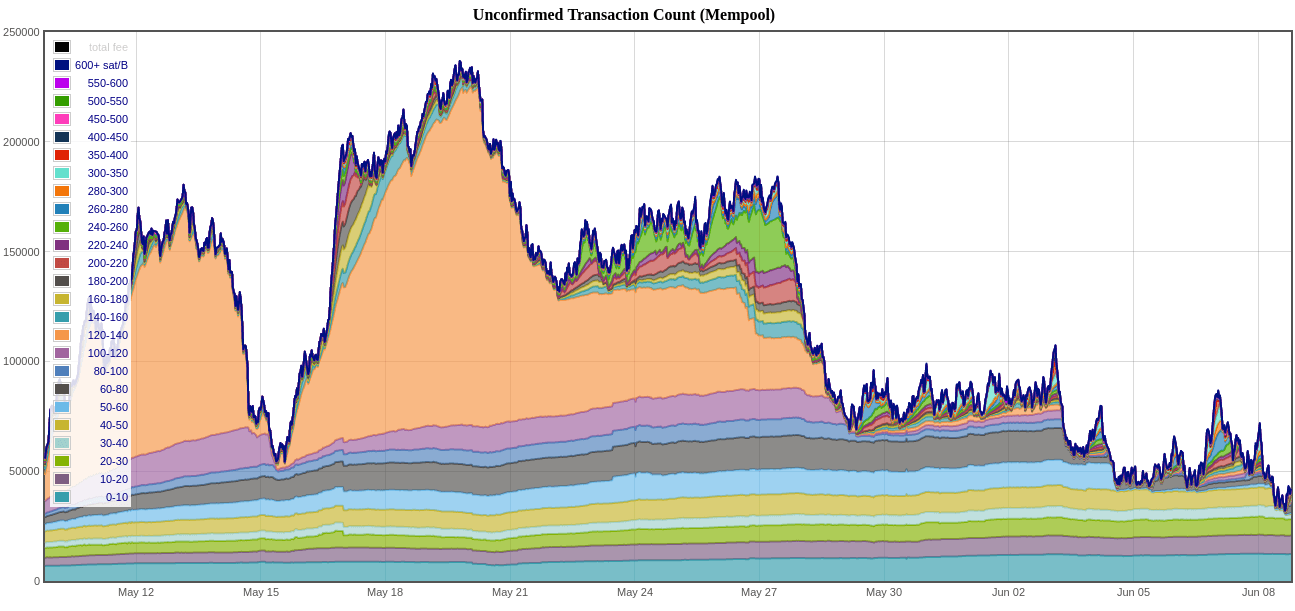
Johoe's Mempool Size Statistics - jochen-hoenicke.de/queue<https://jochen-hoenicke.de/queue/#30d> jochen-hoenicke.de This page displays the number and size of the unconfirmed bitcoin transactions, also known as the transactions in the mempool. It gives a real-time view and shows how ...
about half the mempool is in the 50satoshi/b range or less. * https://blockchain.info/pools there are miners that control more than 10% Bitcoin Hashrate Distribution - Blockchain.info<https://blockchain.info/pools> blockchain.info A pie chart showing the hashrate distribution between the major bitcoin mining pools - Blockchain
* if you get enough new real transactions, it's not necessary to spam a full 144 blocks worth each day, probably just ~50 would be enough, cutting the spam cost substantially * other miners could be playing the same game, helping you spam and further reduce the costs of the attack * you actually get 10% of the fees back by avoiding mining your spam transactions in your own blocks * most of the spam transactions won't actually end up in blocks if there is enough pressure coming from real usage
This seems to indicate that you would actually get much higher profit margins than my estimates. **PLEASE** correct me if my calculations or my assumptions are wrong.
You might also say that doing this would force users out of the system, decreasing the value of btc and disincentivizing miners from continuing. On the other hand, a backlogged mempool could create the impression of high(er) usage and increase scarcity by slowing down movements, which could actually push the price upwards.
Of course, it's impossible to prove that this is happening. But the fact that it is profitable makes me believe that it is happening.
I see some solutions to this, all with their own downsides:
- increasing block size every time there is sustained pressure this attack wouldn't work, but the downsides have already been discussed to death.
- change POW Not clear it would fix this, aside from stimulating terrible infighting. Controlling 5 to 10% of the hashing power seems too easy, and I don't think it would be practical to change pow every time that happens, as it would prevent the development of a solid POW support.
- protocol level MAX transaction fee I personally think this would totally invalidate the attack by making the spam more expensive than the fees you would recover. There already is a minimum fee accepted by the nodes, at 1 satoshi per byte. The maximum fee could be N times the minimum, maybe 100-200. Meaning a maximum of 1-2btc in total fee rewards when the block size is 1mb. Of course the actual values need more analysis, but 2btc - together with the deflationary structure - seems enough to continue motivating miners, without giving unfair advantage.
Yes, this would make it impossible to spend your way out of a congested mempool. But if the mempool stays congested after this change, you could have a bigger confidence that it's coming from real usage or from someone willfully burning money, making a block size increase much more justified.
Hope to hear your opinion, have a nice day.
oscar
On Sun, Dec 24, 2017 at 2:13 AM, Damian Williamson <willtech@live•com•au> wrote:
Quoted text (3 lines)
> If all transactions pay the proposed max then fee there are still going to
> be an awful lot of never confirming transactions once the transaction
> bandwidth limit is surpassed
Yes obviously. That would be the unequivocal sign that it's time to bump the block size.
Why not just bump now then? My main worry is that wasting space should not be profitable for anybody. If it is, it's an encouragement to waste space, and imho we have such an encouragement in place.
Fees should be allowed to get high enough as to discourage wasteful usage of blockchain space, but not high enough as to make it *profitable* to waste space, if you are a sufficiently big miner. The fact that it is now profitable, and that such big miners exist, makes me believe that a lot of blockchain space is wasted on purpose.
Quoted text (3 lines)
> This is what I have been working on as an alternative:
>
> https://lists.linuxfoundation.org/pipermail/bitcoin-dev/2017-December/015371.html
I read your proposal, but the value that I see in mine is that it is extremely simple. It would be trivial to have nodes stop propagating transactions with fees over the max, and miners can trivially reject blocks where coinbase > block reward + max fee rate * block size, if they are on board.
It would also be quite simple to adapt wallets, given that the fee range is fixed. If nodes had an rpc method giving you some mempool statistics, it would also be simple to correctly recommend fees according to the time expected to first confirmation.
Sure, at some point, if there is real congestion, it would just start always recommending the max fee. Again, this means that it's time to bump the block size. I think this is ultimately unavoidable, but I understand the reservations, and I agree that increasing the block size without incentivizing efficient usage would be counterproductive. I think the current fees are certainly incentivizing efficient usage to users, but not to miners. My (maybe naive) idea is that it would be possible to find an appropriate maximum fee value that would move things towards efficient usage by both users and big miners.
This would work very well if coupled with some proposals I've read to slowly increase the block size with a process similar to difficulty adjustment, like adding 100kb if 95% of the last 2016 blocks were full. Without max fees, a big miner could easily destroy this strategy by always applying just enough pressure as to always skyrocket fees and profit, while the blocksize slowly increases.
The way I see it, unbounded fees together with small blocks and big miners introduce a terrible flaw in the incentives equilibrium. I would really like an open discussion on this topic.