
ExploreRabbit Hole · History · Beginner · 21 min
The Bitcoin Faucet: Five Bitcoin for Anyone Who Asked
On June 11, 2010, Gavin Andresen put up a web page that gave five bitcoin to anyone who asked. This is the story of the Bitcoin Faucet for someone who has never heard of it: why giving coins away made sense, how people cheated it, how the gift shrank, who paid for it and how it ended. He wanted its payments public for anybody to audit, so we counted every one.
Where you're going: On June 11, 2010, a programmer named Gavin Andresen put up a web page that gave five bitcoin to anyone who asked. He called it the Bitcoin Faucet, and it ran for two years and four months. This chapter tells its story for someone who has never heard of it: why giving coins away made sense when a coin was worth half a cent, what using it was like, how people cheated it, how the gift shrank from five bitcoin to a thousandth of one, who kept refilling it, and how it ended. He wanted its payments public for anybody to audit, so we audited them, and the count is here with what it can and cannot say. Along the way there is a faucet you can use yourself, whose coins are worth nothing on purpose.
Credit: The Bitcoin Faucet was Gavin Andresen's. Most of the words quoted here are his and the forum members', as the Bitcoin forum and the Internet Archive kept them. The count is ours: every payment in and out was read from the Bitcoin Core node powering ChainQuery in November 2026.
A website that gave away money
On June 11, 2010, a new thread appeared on the Bitcoin forum, the message board where the people using Bitcoin then talked to one another. Its title was "Get 5 free bitcoins from freebitcoins.appspot.com", and it began like this: "For my first Bitcoin coding project, I decided to do something that sounds really dumb: I created a web site that gives away Bitcoins."
The writer was Gavin Andresen, a programmer who had made his first post on the forum thirteen days earlier. He would go on to lead Bitcoin's development. That June he was a newcomer teaching himself how the software worked, and a site that handed out coins was the simplest thing he could think of to build. It gave each visitor five bitcoin, "first come first served".
He said why in the same post:
"Because I want the Bitcoin project to succeed, and I think it is more likely to be a success if people can get a handful of coins to try it out. It can be frustrating to wait until your node generates some coins (and that will get more frustrating in the future), and buying Bitcoins is still a little bit clunky."
In 2010 there were two ways to get a bitcoin. One was to generate it. You left the Bitcoin program running, which made your computer a node, one of the machines that keep the network going, and with its generating option switched on it joined a contest that paid 50 new bitcoin to one winner about every ten minutes. That contest is mining. By the middle of 2010 an ordinary computer could run for days and win nothing. On June 3 Andresen wrote: "I've had zero luck generating any coins over the last week on my couple-year-old Macbook Pro".
The other way was to buy them from someone who had some, which he called clunky. So he would give them away.
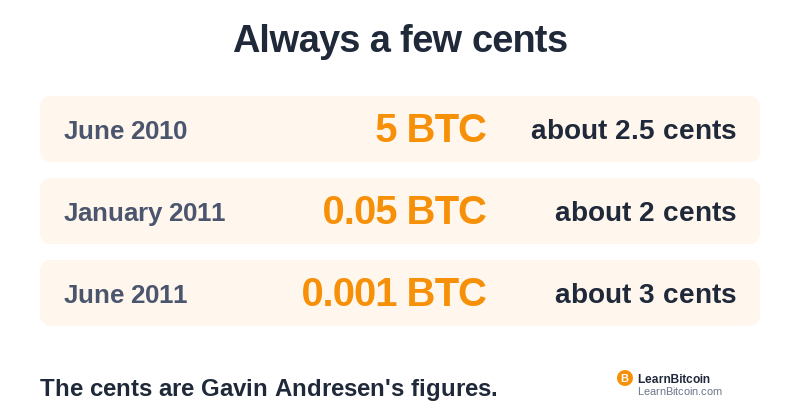
It was a small gift. A few months later he looked back on the faucet's own page: "When I started the Faucet, Bitcoins were worth about a half a US penny each, so five were worth about 2.5 US cents."
The first reply came eighteen minutes after the announcement. It was from laszlo, the forum member who three weeks earlier had paid 10,000 bitcoin for two pizzas, the trade now remembered as Bitcoin Pizza Day, and it was one word: "Awesome!"
A week later Bitcoin's creator, Satoshi Nakamoto, wrote in the thread: "Excellent choice of a first project, nice work. I had planned to do this exact thing if someone else didn't do it, so when it gets too hard for mortals to generate 50BTC, new users could get some coins to play with right away."
On his own blog that month Andresen explained what Bitcoin was and why he was excited about it, and ended with the faucet: "The Bitcoin Faucet will give you 5 Bitcoins to play with." Two more lines followed: "For free." and "Maybe I am crazy. What percentage of crazy people think they're sane?"
What using it was like
The page was a single screen. The Internet Archive is a library that keeps dated copies of web pages, and its earliest copy of this one, from July 3, 2010, shows a counter (750 bitcoin available), a box for an address, a puzzle to solve (it comes into the story below) and a button marked "Get Some!" Under them are a few plain questions and answers. One question was "What's the catch?" The answer: "No catch-- I want Bitcoin to be successful, so I created this little service to give you a few coins to start with."
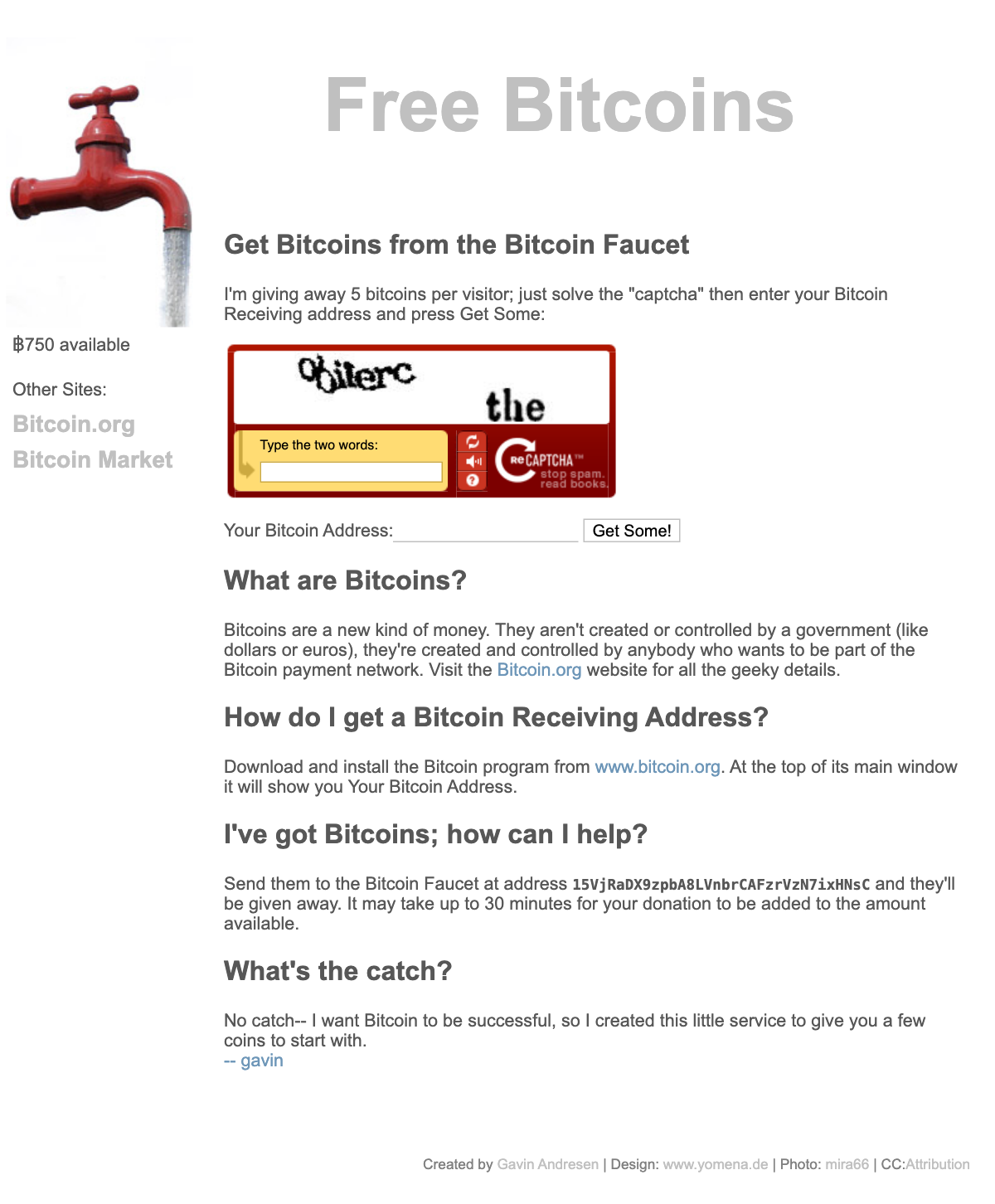
To use it you needed somewhere to receive the coins. In June 2010 that meant running the Bitcoin program, which was also your wallet: software that keeps your keys, the secret numbers that let you spend your coins. The page told newcomers where to look: "At the top of its main window it will show you Your Bitcoin Address." An address is a string of letters and digits that payments can be sent to, a little like an account number that is safe to hand to anyone. You pasted yours into the box and pressed the button.
Behind the page, a second computer held the faucet's own wallet and sent five bitcoin to the address you gave. A payment in Bitcoin is called a transaction, and it counts once it is written into a block. About every ten minutes the winner of that mining contest adds a batch of new transactions to the record. Each batch is a block, and the chain of all the blocks is the record of who has been paid what. If your copy of the program was up to date you would "get your bitcoins right away", Andresen told one newcomer, and the next block made the payment count.
The faucet's first payout is still on the chain. Twenty minutes after the announcement, by the time stamp on the block, the faucet paid five bitcoin to an address outside his own wallet. Whoever held it sent the same five bitcoin straight back, to the address the page gave for donations, in the same block, as the announcement had invited: "You can get some and then donate them right back". The faucet paid those same five bitcoin out again, to a third address, before the block was finished. Eleven payouts went out that first day.
For some people it did what he had hoped. That November somebody asked the forum whether the site was a scam, and a member called wumpus answered: "If it hadn't been for that very small help, I would have given up on bitcoin very soon." The following March, Andresen noted how many newcomers turned up in the developers' chat room mentioning the coins they had gotten from the faucet, and called it "still valuable as a nice introduction to using bitcoin."
Try it yourself: The 2010 faucet gave away real bitcoin. The faucet in our practice wallet gives 100,000 practice sats for each request. A sat, short for satoshi, is a hundred-millionth of a bitcoin, so that is a thousandth of one, the size of the 2010 faucet's smallest gift. Here it is play money on a private network that we run: it has no value, and nothing turns it into real bitcoin. The steps are the ones a visitor took in June 2010: get an address, ask, and watch a block take the payment in. There, a block comes about every 30 seconds, where Bitcoin's take about ten minutes.
The honor system
At first there was one rule: five bitcoin for each IP address, the number that identifies a computer's connection to the internet. There was no puzzle to solve and nothing to sign up for. Andresen wanted it, he explained, "to be as simple and non-threatening as possible", and he doubted that anyone with hundreds of connections to spare would bother writing a program to harvest the coins.
Two days in, a member called wobber showed how little it took: "I've been able to drawn 50 BTC in minutes using Tor." Tor is a tool that passes a connection through other people's computers, so that each request seems to come from somewhere new. The post ended: "PS: I've paid back those BTCs." To which laszlo answered: "He's giving it away, it's an honor system, so don't take more than you need".
Andresen would not shut Tor's users out. "I don't want to blacklist anybody coming from Tor, though-- I think a lot of people using Tor will also be interested in Bitcoin."
That evening a member called lachesis ran into an error page that the site should never have shown a visitor, and reported it in the thread: "I hit some kind of exception page and it gave me your secret and the URI of your JSON gateway." In plain words, the page had handed over the password and the location that the website used to give orders to the faucet's wallet. The post went on, with a grin: "I'll send your bitcoins back to you if you'd like."
The chain shows what the offer meant. In a block stamped a minute after the post, the faucet's whole balance left for a single address: 1,570 bitcoin, the figure Andresen had given the forum that afternoon. Less than three hours later, 1,565 of them came back. (The other five went to a different address in the same transaction, and the chain does not say whose.) Andresen's answer came within the hour, with thanks to lachesis and the promise of 50 bitcoin "for finding that bug!"
The chain names nobody. We take the address the coins went to for lachesis's because of the timing and the two posts.
Ten days after that, the site's logs showed somebody coming back again and again from a changing set of connections. Andresen tried a few quiet countermeasures and then, on June 24, added a captcha for everybody: the distorted-letters puzzle that is meant to tell a person from a program. He wrote: "I did throw in the towel today". It worked for a while: two days later he reported that the captcha had slowed the flow of coins from the faucet "to a very manageable trickle."
Satoshi's advice that week is what the faucet went on to do: "If you can't solve the problem, you can always keep lowering the amount of bitcoins given until it's manageable, and always require captcha."
The day the crowd came
On Sunday, July 11, 2010, Slashdot, a news site that programmers read, ran a story about a new version of Bitcoin. The story did not mention the faucet, but Slashdot's readers found it.
The faucet had made nine payouts on each of the two days before. On July 11 it made 113. On July 12 it made 1,189, which is 5,945 bitcoin in one day.
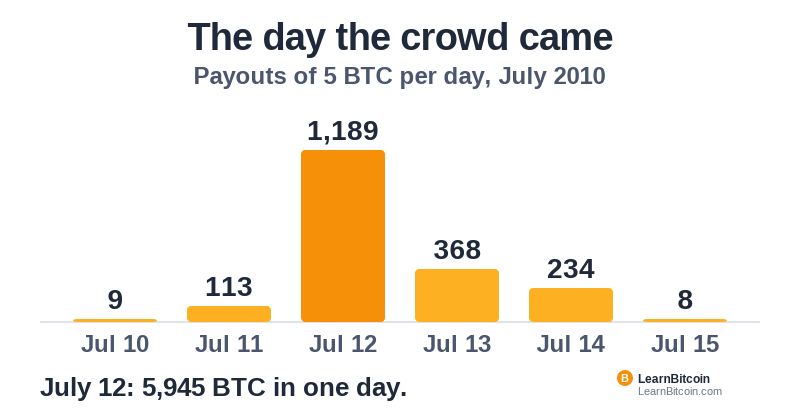
As the crowd arrived that night, Andresen's own wallet sent the faucet 6,000 bitcoin in two payments, and for 5,000 of it the wallet split a single piece of 10,000 bitcoin in two. By the next evening he was back on the forum: "The Bitcoin Faucet is handling the slashdotting really well... except that I'm running out of coins to give away. over 5,000 have flowed out of the Faucet since I refilled it last night."
He asked the people who had mined when it was easy to pass some of their coins on: "Any of you early adopters who generated tens of thousands of coins back in the early days, are you willing to send a few to the Faucet to be given away so more people can try out Bitcoin?" And he said what he expected to become of the coins: "I know that most of them are likely to be lost (I suspect there a lot of slashdot lookey-loos who won't stick around long enough to spend their 5 bitcoins)".
Others were giving already. Two donations of 500 bitcoin, each made of ten mining rewards of 50, had reached the faucet that day, the first of them before his own refill, and one of 1,000 is in a block stamped five minutes after his post.
He also changed the rule. When the faucet held less than 500 bitcoin it would pay 0.05, which he called a bit-nickel after the American five-cent coin, and it would go back to five when somebody refilled it. A day and a half later it was paying them.
Always a few cents
By August a bitcoin cost six cents, and five of them were worth some effort. On August 4, 2010, Andresen shut the site down, and by the blocks' stamps it paid nothing for an hour and fifty minutes that evening. It looked, he wrote, as if somebody in Spain was coming back over and over, each time with a new connection, a new address and a freshly solved captcha.
In the post that announced the shutdown he said what he would do next: "I'm going to drain the Faucet below 500 coins temporarily". Eleven minutes later, by the block's stamp, 122.43 bitcoin went from the faucet to an address of his own, which by our count left the page's counter at 499.00, one bitcoin under the line. The faucet went back to paying nickels, and he put all of it back over the next eleven weeks.
A few hours later he did the arithmetic in public. Somebody who needed two minutes for each visit would make 150 bitcoin an hour, "which is $9 USD an hour, which, if you're unemployed, bored, and/or 13 years old is easy money." The standard gift would become a tenth of what it had been: "I'm definitely going to drop from 5 BTC; I think I'll go all the way down to 0.50 BTC". Satoshi agreed: "Definitely time to lower it." The last payouts of five bitcoin went out on August 6, 2010.
From there the amount kept falling as the price rose. The faucet often had two rates at once, a larger one when it was well stocked and a smaller one when it was running low, so some rows overlap. (BTC is short for bitcoin.)
| Gift | From | Until | Payouts |
|---|---|---|---|
| 5 BTC | Jun 11, 2010 | Aug 6, 2010 | 2,448 |
| 0.05 BTC | Jul 13, 2010 | May 2, 2011 | 46,920 |
| 0.5 BTC | Aug 12, 2010 | Feb 10, 2011 | 4,634 |
| 0.02 BTC | May 2, 2011 | Jun 7, 2011 | 20,962 |
| 0.001 BTC | Jun 17, 2011 | Sep 26, 2012 | 34,186 |
| 0.005 BTC | Sep 12, 2011 | Sep 8, 2012 | 40,863 |
| 0.002 BTC | Sep 8, 2012 | Oct 28, 2012 | 8,099 |
From August 2010 it paid 0.5 while it held more than 500 bitcoin and 0.05 when it held less. From September 2011 to August 2012 the saved copies of the page show 0.005 when it was well stocked and 0.001 when it was running low. The last two, from September 2012, show 0.002.
A Bitcoin transaction can carry a fee, a small sum that goes to whoever mines the block it lands in, and a transaction that pays one gets written into a block sooner. From March 6, 2011, the faucet paid a fee of 0.01 bitcoin with every 0.05 it gave. Over its life it paid 225 bitcoin in fees, 164 of them in March and April 2011 alone.
Within a year the gift in bitcoin fell to a five-thousandth of what it had been, while its value in money hardly moved, by his own figures.
The part nobody solved
A smaller gift made each trick worth less, but the tricks went on, and the record of 2011 reads like a list of repairs.
On January 30, 2011, the faucet made 1,633 payouts, at a time when about 140 a day was normal. One address was paid 1,751 times in two days.
On March 1 it made 1,300, about twice what it had been making each day that week. Andresen explained that somebody had been "exploiting a weakness in my IPv6-handling code". IPv6 is a newer kind of internet address, and one person can have an enormous supply of them. He wrote: "I think I'm fighting a losing battle". A week later the faucet began asking for a Google account. The page gave the reason in its usual voice: "Some numbskulls were visiting the faucet over and over and over again", and went on: "So now I'm letting Google worry about the numbskulls."
On the morning of April 14 he wrote: "I've turned off the faucet; somebody is definitely stealing from it. There were 500 sends queued when I woke up this morning." The chain recorded the night: the faucet made 1,343 payouts that day, against 169 to 286 on each of the seven days before. Two days later, three transactions in a single block spent 1,163 of the payouts made that night and morning, 58 bitcoin in all, and sent them to one address. Only somebody with the keys to all of them could do that. By his account the thief had come with a different connection, a different Google account and a different browser each time.
A forum member suggested handing out test coins instead: coins from testnet, the separate test network Andresen had built the summer before, which are meant to be worthless. Andresen did not want to: "I worry about people starting to trade testnet coins, giving them real value."
The faucet was paying again four days later. On May 2 he launched a new version. It bundled many payouts into one transaction to save on fees, it had a page that listed its most recent payouts for anyone to inspect, and it asked for volunteers to watch it. He called them the Faucet Police, and they could shut the faucet off at any hour if they saw a suspicious pattern.
In August 2013, when the faucet had been closed for most of a year, a forum member asked whether the project was dead. Andresen answered four weeks later, and named the problem:
"The Faucet was the simplest possible project I could think of to get my feet wet with Bitcoin; the hard part is preventing cheaters who try to get more than their fair share, and I was never able to come up with a really good solution (that is tied into the whole identity-on-the-Internet thing, which nobody has solved)."
A faucet has to give once to each person. On the internet a person is whatever they can show: a connection, an email account, a bitcoin address. Anyone can get many of each. The chain gives a rough measure. A transaction that spends many payouts at once was made by one holder of all their keys, and by January 2013, 19,424 of the faucet's payouts had been spent ten or more at a time; 38 transactions spent a hundred or more. An online wallet that kept coins for many customers would gather payouts the same way, so this shows how little an address says about a person. It is not a count of cheats.
Who filled the faucet
The faucet could give away only what somebody had given it. Its donation address was on the page for anyone to pay: 15VjRaDX9zpbA8LVnbrCAFzrVzN7ixHNsC. (Do not send anything to it now: how it ended is below.)
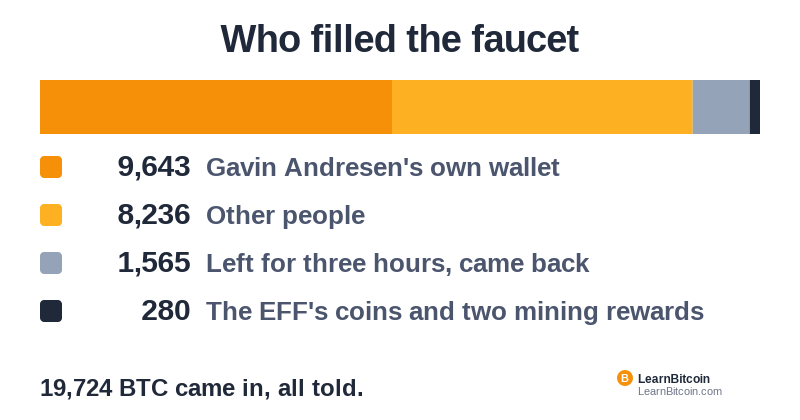
In all, 2,696 payments brought in 19,724 bitcoin. That includes the 1,565 that came back in the three-hour round trip of June 13, 2010, and 100 from two mining rewards that the faucet's own wallet had won. Of the rest, at least 9,643 came from Andresen's own wallet, which is more than from everybody else put together.
We can tell which coins were his because of a forum post. Eight days before the launch he used an address as an example and called it "my bitcoin address". The first payment into the faucet's donation address, 1,015 bitcoin, came from that address shortly before the announcement. The same wallet, followed along the chain (the method is in "The count"), also sent the 6,000 on the night of Slashdot, another 1,000 two days later, and smaller refills through February 2011.
In its first eight months the faucet paid his own addresses 317 bitcoin: the 122.43 of August 4, two payments of 1 bitcoin, and 52 payouts that look like his tests. The net from his wallet was 9,326.
He put a figure on it himself in May 2011, in passing, on the forum: "Just think of that guy who gave away 10,000 bitcoins through the Bitcoin Faucet..." In 2013 Princeton's alumni magazine told it this way: "he spent $50 on about 10,000 bitcoins and began handing them out, five at a time". The chain cannot see what he paid, but it shows the coins, and both had the size right.
Other people sent 8,236 bitcoin in about two thousand payments. The first donation came within the hour: 50 bitcoin. A member wrote in the thread, "I got 5 then felt bad so sent you 50 back". It was lachesis, who two days later would find the hole in the site. The largest donation was 1,300 bitcoin on September 29, 2010.
About half of those payments were made with coins the faucet itself had paid out, 447 bitcoin in all. A week after the launch Andresen had wondered about that: "I'd be really curious to see what percentage of bitcoins withdrawn from the Faucet end up donated right back into it..." The chain's answer, counting only payouts that were sent straight back, is at most 312 bitcoin: under 2 percent of the roughly 17,577 the faucet gave away.
One refill came from the Electronic Frontier Foundation, a digital-rights group in San Francisco. In June 2011 the EFF decided to stop accepting bitcoin donations, and rather than sell what it had been given it asked Andresen to pass the coins on through the faucet, "so that they can continue to circulate in the community". The EFF's account was with an online wallet company called MyBitcoin, which failed that summer and paid its customers about half. He told the forum: "I received 1,879 from the mybitcoin claims process". The chain agrees: on August 14, 2011, 1,879.89 bitcoin reached him at an address apart from the faucet's.
He did not pour them in, having written: "I would hate for them to get lost if somebody managed to hack the Faucet's web-facing code". He kept them in a separate wallet and fed them to the faucet a little at a time: 180 bitcoin over the next year, in 29 payments.
How it ended
On March 1, 2012, Andresen posted a short note in a thread about a break-in at Linode, the company that rented him the server where the faucet's wallet lived: "The 5 bitcoins in the main-net Faucet's wallet were stolen, also; I'll shutdown the Faucet website, do NOT donate any coins to the Faucet donation address, it is controlled by the thief."
"Main-net" is Bitcoin's real network. He had a second faucet, for test coins, running beside the first.
He gave the ID of the thief's transaction, the string of letters and digits that names it, so that anyone could watch where the coins went, and the chain has it: 4.988 bitcoin, in a block stamped that morning. Linode's notice to him, which he quoted on his blog, said the intruder had used the company's customer-support system. The thread had been started by the operator of a mining pool, a group of miners who share what they win, which lost 3,094 bitcoin the same day. Andresen lost five, and on his blog that evening he explained why so few: "I knew that using a shared hosting service was a risk, which is why I kept so few bitcoins in the Faucet's wallet." It is also why the EFF's coins had gone in a little at a time.
He made a new wallet with a new donation address, and the faucet was paying again on March 13.
The faucet made its last batch of payouts on October 5, 2012. A copy of the page saved that evening says: "The Bitcoin Faucet is closed for maintenance. Please come back later." One more payout went out on October 28, and 18.57 bitcoin were left in the faucet's wallet. By December the notice read: "The Faucet is being fixed; please come back in an hour or three." It still said so in January 2015. By October 2015 the page was gone.
He never did fix it. In 2013 he gave his reasons: the faucet had closed "due to lack of time for me to fight the scammers", and, later that year, "I don't have time to clean up the code". By then he was leading the development of Bitcoin itself.
Most of the EFF's coins had never gone through the faucet at all. In March 2013 a software accident split Bitcoin's chain in two for a few hours, the story told in the 2013 chain fork, and miners on the losing side saw their blocks thrown away. Andresen used 824 bitcoin of the EFF's coins to repay them, in two payments twelve minutes apart: he had not had time to fix the faucet, he wrote, and the coins were waiting to be given away. Not everyone on the forum thought that was his call to make. He answered that the donor was the EFF, "and their only request was that the Bitcoins be given back to the bitcoin community." Two months after the fork the EFF began accepting bitcoin again, and he sent back 726.34 bitcoin: all that was left but 100, which he had promised to another faucet and went on paying out ten at a time. With 50 that had gone out earlier, that is the 150 the EFF's note of thanks says were given to two other projects that handed out coins.
In its note of thanks, the EFF described what the faucet had been: "a way for new Bitcoin users to practice setting up a wallet and learn about this digital currency."
The count
A week into the project, Satoshi suggested that the faucet show a fresh donation address every time it received something. Andresen answered that he meant to keep one address on purpose:
"I WANT donations to, and payments from, the Bitcoin Faucet to be NON-anonymous, so anybody can audit that address and see the flow of bitcoins through the Faucet."
By our count the faucet paid out about 17,577 bitcoin in about 158,100 payouts, to 141,741 different addresses, between June 11, 2010, and October 28, 2012. Seventy percent of that bitcoin went out in the 2,448 payouts of five, in the first eight weeks. The rest of this section says how we counted and how far the count can be trusted. To skip it, go to The number in the press.
The address he meant is not the whole faucet, though. A Bitcoin wallet does not keep a balance the way a bank account does. It holds separate coins, each one the result of an earlier payment, and a coin is spent whole. For its first payout the faucet's wallet spent a coin of 35 bitcoin: it sent five to the visitor and the other 30 to a fresh address of its own. That second part is called change. So within days the faucet's coins sat at addresses that were never published, and by the end there were about 75,000 of them.
We read every transaction in the blocks from February 2010 to January 2013, about 11 million of them, from the Bitcoin Core node powering ChainQuery. (Bitcoin Core is the standard Bitcoin software, and ChainQuery is run by the same person as this site.) We started from the two donation addresses the faucet published, and from five more that we took to be its own: two that had won mining rewards and paid its first gifts, and three that held its change in June 2010. When one transaction spends coins from several addresses, a single wallet normally holds the keys to all of them (ways for several people to build one transaction together came later). So any address whose coins are spent alongside a known faucet address's is taken to be the faucet's too. And change can be told from a payout by its size, because the faucet said what it was paying at every stage: in a payment of 5 and 30, the five is the gift.
Three checks say the result can be trusted. The faucet's page printed its balance, and at 23 moments between 2010 and 2012 a saved copy of the page or a forum post records it: at 22 of them our count is within 8 bitcoin, and the other was read an hour after the faucet had been switched back on, in September 2011. From May 2011 a page of the site, "Recent Sends", listed its most recent payouts, and saved copies of it hold the IDs of 1,067 of its transactions; our count, made without that list, found all 1,067. And the books balance, down to the last satoshi. All 23 readings are in a file, with the gaps we could not explain.
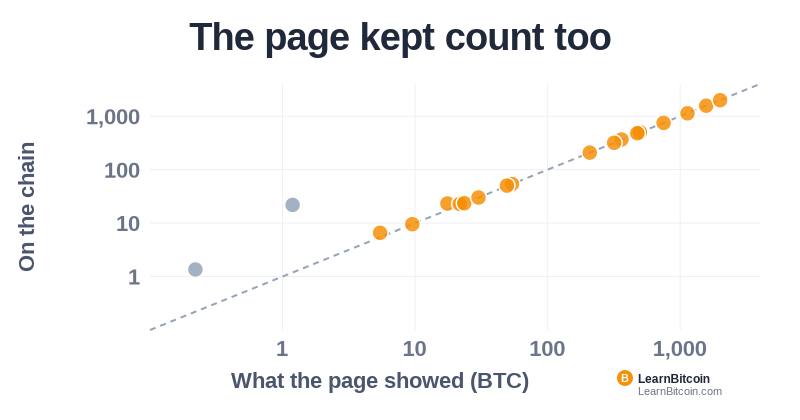
The books, in round numbers: 19,724 bitcoin came in. Of that, 17,577 went to visitors, 1,570 left in the round trip of June 13, 317 went to his own addresses and 225 to fees, and 35 were stolen, sent back to a sender or still in the wallet when our count ends in January 2013.
We say "about" because the count rests on judgment in two places. About sixty of the smallest payouts, 0.6 bitcoin in all, could instead be change that the wallet never used. And 168 times a payout and its change could be told apart only by what happened to each afterward; 651 payouts, 176 bitcoin, were made out of that change and are the faucet's only if we judged right. The files list every payment in and every payout of five bitcoin, and count the smaller payouts day by day and month by month.
Some things the count cannot say. It cannot say who received anything, or how many people there were: it counts addresses, and one address was paid 1,751 times. It cannot say whether some of the "other people" money was his too, which is why his share reads "at least". And it cannot rule out a payout made from coins we never tied to the faucet: the page's counter limits how much could be missing only at those 23 moments.
The number in the press
An article from 2021 said the faucet "gave away 19,700 BTC". The chain shows where a number like that comes from: everything that ever arrived at the faucet's first donation address, with its own change taken out, comes to 19,715.82 bitcoin as of November 2026, which is 19,700 in round figures. That is what came in at one address. It is not what went out, it leaves out the second address, and 56 bitcoin of it arrived in 2014, a year and a half after the faucet had closed.
Pro tip: Before you repeat a total for a Bitcoin address, ask what it counts. Look up the faucet's first address in a block explorer, a site that displays the chain's record, and you will find a "total received": 78,299 bitcoin when we looked, on November 20, 2026. That counts the faucet's own change every time the wallet sent it back there, thousands of times from August 2011. The press's 19,700 matches the same address with that change taken out.
The coins that never moved
Bitcoin's record shows whether a coin has ever been spent. On November 20, 2026, at block 976,691 (blocks are numbered in order from the first), we asked the same node about every payout the faucet made.
Of the 2,448 payouts of five bitcoin, 789 had never moved. That is 3,945 bitcoin sitting exactly where the faucet sent them. Of those 789, 730 were paid in July 2010, the month of the Slashdot crowd: about a third of that month's gifts of five. Andresen had doubted that those visitors would "stick around long enough to spend their 5 bitcoins". Across payouts of every size, 75,743 had never moved, nearly half of all the faucet made, and they hold 5,541 bitcoin.
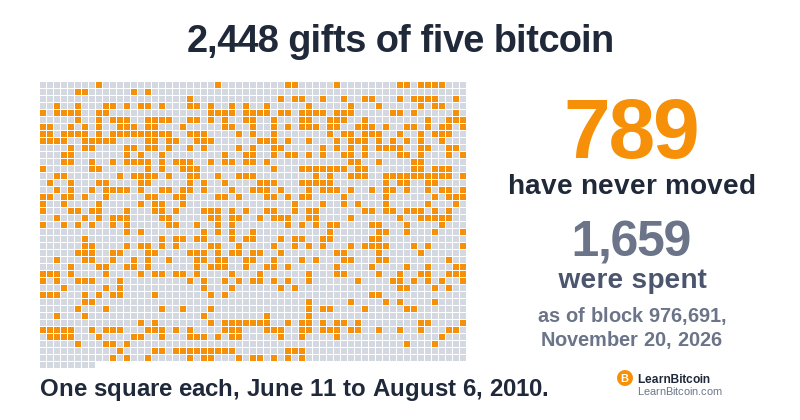
Never moved does not mean lost. The chain shows that a coin has not been spent. It cannot show whether somebody still holds the key that could spend it. Some of these coins probably belong to people who lost interest in 2010 and left the program on a computer that is long gone, and some may belong to people who know exactly where their keys are.
The list of all 2,448 is one of this chapter's files, with the transaction of each and whether it has moved.
What a faucet came to mean
The word has lasted longer than the site. A faucet came to mean any site that hands small amounts of coin to whoever asks. The kind that developers rely on hands out test coins: coins on separate practice networks, such as testnet, that are meant to have no value. Andresen built that kind too. Five weeks after his faucet opened he made a test network for people writing software, and the next day he gave it a faucet of its own: "Feel free to grab some play money any time". What he turned down in 2011 was handing newcomers test coins in place of real ones, because he feared the test coins would come to be traded. His first faucet gave real money on purpose, so that a newcomer held bitcoin of their own.
The faucet in our practice wallet is of the play-money kind, and it has a bot check for the reason his had a captcha: to keep programs from emptying it. If you have never held a coin, ask it for some and watch the block arrive.
What this buys us
- You know what the faucet was. A page that gave a few cents of real bitcoin to anyone who asked, so that a newcomer could hold a coin before deciding what to think of it.
- You know why it could not last. A gift for each person needs a way to tell people apart, and the internet does not have one. Every fix held for a while, and the one thing that always worked was to make the gift smaller.
- You know who paid for it. The man who built it gave more than everyone else put together. Other people gave most of the rest, early miners among them, and a little came from the EFF's supporters and from visitors sending their coins back.
- You know how a wallet can be audited from outside. Start from an address it published, follow the coins that are spent together, tell change from payment, and check the result against something the wallet itself said.
- You know to ask what a total counts. The 19,700 in the press is what arrived at one address; the faucet gave away about 17,577.
- You have somewhere to try it. A faucet that pays in practice coins, so you can do each step before real money is involved.
The thread, the saved pages and every payment are still there for anyone who wants to count again.
More in History
Sources
- BitcoinTalk, Gavin Andresen, June 11, 2010, 17:38:45 UTC - 'Get 5 free bitcoins from freebitcoins.appspot.com': the announcement, why he did it, and the donation address (this and every forum post below was read through the public archive api.ninjastic.space, which gives each post's time in UTC)
- BitcoinTalk, laszlo, June 11, 2010, 17:57:05 UTC - 'Awesome!', the first reply
- BitcoinTalk, laszlo, May 22, 2010 - 'I just want to report that I successfully traded 10,000 bitcoins for pizza.'
- BitcoinTalk, Gavin Andresen, May 29, 2010 - his first post on the forum
- BitcoinTalk, Gavin Andresen, June 3, 2010 - 'I've had zero luck generating any coins over the last week'
- BitcoinTalk, satoshi, June 18, 2010 - 'Excellent choice of a first project, nice work'; a new donation address for each gift
- BitcoinTalk, Gavin Andresen, June 19, 2010 - 'so anybody can audit that address and see the flow of bitcoins through the Faucet'; 'what percentage of bitcoins withdrawn from the Faucet end up donated right back into it'
- Gavin Andresen's blog (GavinThink), 'Money, Fixed', June 26, 2010 - 'The Bitcoin Faucet will give you 5 Bitcoins to play with.'
- freebitcoins.appspot.com as the Internet Archive saved it on July 3, 2010 (the earliest copy): 750 available, 5 per visitor, 'What's the catch? No catch'
- freebitcoins.appspot.com's style sheet as the Internet Archive first saved it, on May 23, 2011: the page design by www.yomena.de, 'distributed under the Creative Commons Attribution 3.0 license'
- Flickr, mira66 - 'Tap fountain, Santa Galdana, Menorca', the photograph on the faucet's page (CC BY 2.0)
- freebitcoins.appspot.com on August 5, 2010: 498.81 available, 0.05 per visitor
- freebitcoins.appspot.com on September 11, 2010: 'about a half a US penny each, so five were worth about 2.5 US cents'; 0.50 above 500, 0.05 below
- freebitcoins.appspot.com on March 19, 2011: a Google account required; 'numbskulls'
- freebitcoins.appspot.com on September 12, 2011: 1.190 available, 0.001 per visitor
- freebitcoins.appspot.com on September 24, 2011: 13.390 available, 0.005 per visitor
- freebitcoins.appspot.com on April 7, 2012: 4.064 available, 0.001 per visitor, and the second donation address
- freebitcoins.appspot.com on September 19, 2012: 30.080 available, 0.002 per visitor
- freebitcoins.appspot.com on October 5, 2012: 'closed for maintenance. Please come back later.'
- freebitcoins.appspot.com on December 7, 2012: 'The Faucet is being fixed; please come back in an hour or three.'
- freebitcoins.appspot.com on January 6, 2015: the same notice
- freebitcoins.appspot.com on October 11, 2015: the page is gone (404)
- BitcoinTalk, Gavin Andresen, June 12, 2010 - 'Running on the Google App Engine': the page, and the server behind it that held the wallet
- BitcoinTalk, Gavin Andresen, July 12, 2010 - with the program up to date, 'then you'll get your bitcoins right away'
- mempool.space - the first payout to an address outside his own wallet: 5 BTC in block 60,441, stamped June 11, 2010, 17:58:57 UTC
- mempool.space - the same 5 BTC paid to the faucet's donation address in the same block
- mempool.space - and paid out again by the faucet, to a third address, in the same block
- BitcoinTalk, wumpus, November 23, 2010 - 'If it hadn't been for that very small help, I would have given up on bitcoin very soon.'
- BitcoinTalk, Gavin Andresen, March 9, 2011 - newcomers who 'mention they got 0.05 BTC from the faucet'; 'still valuable as a nice introduction to using bitcoin'
- LearnBitcoin practice wallet - About (text): play money with no value, a private network with one operator, what the faucet gives and why it has a bot check
- BitcoinTalk, Gavin Andresen, June 11, 2010 - five per IP address; why no captcha yet; 'the balance is up to 1,135'
- BitcoinTalk, wobber, June 13, 2010 - 'I've been able to drawn 50 BTC in minutes using Tor'; 'PS: I've paid back those BTCs.'
- BitcoinTalk, laszlo, June 13, 2010 - 'it's an honor system, so don't take more than you need'
- BitcoinTalk, Gavin Andresen, June 13, 2010, 15:05:50 UTC - no blacklist for Tor; 'there are 1,570 bitcoins in the faucet right now!'
- BitcoinTalk, lachesis, June 13, 2010, 21:45:07 UTC - the error page; 'I'll send your bitcoins back to you if you'd like.'
- BitcoinTalk, Gavin Andresen, June 14, 2010, 01:23:20 UTC - thanks, and a reward 'for finding that bug!'
- mempool.space - block 60,770, stamped June 13, 2010, 21:46:28 UTC: 1,000 BTC leaves the faucet's wallet (570 BTC more leave in the same block)
- mempool.space - the other 570 BTC, same block, same destination
- mempool.space - block 60,793, stamped June 14, 2010, 00:37:20 UTC: 1,565 BTC comes back to the donation address
- BitcoinTalk, Gavin Andresen, June 23, 2010 - 'Bitcoin Faucet changes': what the request logs showed
- BitcoinTalk, Gavin Andresen, June 24, 2010 - 'I did throw in the towel today': a captcha for everybody
- BitcoinTalk, satoshi, June 26, 2010 - 'keep lowering the amount of bitcoins given until it's manageable'
- BitcoinTalk, Gavin Andresen, June 26, 2010 - the captcha 'has slowed the flow of coins from the faucet to a very manageable trickle'
- Slashdot, 'Bitcoin Releases Version 0.3', posted Sunday, July 11, 2010
- BitcoinTalk, Gavin Andresen, July 12, 2010, 19:15:46 UTC - 'Donations to freebitcoins.appspot.com needed!': 'over 5,000 have flowed out of the Faucet since I refilled it last night'; 'most of them are likely to be lost'
- mempool.space - 5,000 BTC from his wallet to the faucet, half of a 10,000 BTC coin: block 65,566, stamped July 12, 2010, 02:02:50 UTC (1,000 BTC had come 33 minutes earlier)
- BitcoinTalk, Gavin Andresen, July 13, 2010 - 'bit-nickels if the balance falls below 500'
- BitcoinTalk, Gavin Andresen, July 14, 2010 - 'the Faucet is now giving out bit-nickels; it just went under 500 BTC'
- BitcoinTalk, Gavin Andresen, July 15, 2010 - 'TEST network, for experimental development and hacking': he starts a separate test network
- BitcoinTalk, Gavin Andresen, July 16, 2010 - 'the TEST Faucet is open and giving out 50 TESTcoins per visit'; 'Feel free to grab some play money any time'
- BitcoinTalk, Gavin Andresen, August 4, 2010, 20:40:55 UTC - the shutdown (the thread's title is his); 'I'm going to drain the Faucet below 500 coins temporarily'
- BitcoinTalk, Gavin Andresen, August 5, 2010 - 'I'll go all the way down to 0.50 BTC'
- BitcoinTalk, Gavin Andresen, August 5, 2010 - 'from 0.005 USD each to 0.06 each'; '$9 USD an hour'
- BitcoinTalk, satoshi, August 5, 2010 - 'Definitely time to lower it.'
- mempool.space - 122.43 BTC from the faucet to an address of his own wallet: block 72,355, stamped August 4, 2010, 20:51:55 UTC
- BitcoinTalk, Gavin Andresen, January 17, 2011 - 'Making the Faucet sustainable....': 0.05 bitcoins is '2 cents at current prices'
- BitcoinTalk, Gavin Andresen, March 1, 2011 - 'a weakness in my IPv6-handling code'; 'I think I'm fighting a losing battle'
- BitcoinTalk, Gavin Andresen, March 8, 2011 - 'Changes to the Bitcoin Faucet...': a Google account required; a 0.01 fee with every send
- BitcoinTalk, Gavin Andresen, April 14, 2011, 12:31:09 UTC - 'I've turned off the faucet; somebody is definitely stealing from it.'
- BitcoinTalk, Gavin Andresen, April 14, 2011 - 'I worry about people starting to trade testnet coins, giving them real value.'
- BitcoinTalk, Gavin Andresen, June 4, 2011 - 'Testnet faucet': a second faucet, for test coins, 'is up and running'
- mempool.space - one of three transactions in block 118,597 (April 16, 2011) that together gathered 1,163 of the payouts of the night of April 13 to 14 into one address
- BitcoinTalk, Gavin Andresen, May 2, 2011 - 'Bitcoin Faucet Community Policing Project': 0.02 per visitor, a public Recent Sends page, payouts sent in batches
- BitcoinTalk, Gavin Andresen, June 9, 2011 - 'somewhere around 1 millibitcoin (which, at $30/BTC, is 3 cents)'
- BitcoinTalk, Gavin Andresen, September 15, 2013 - 'the whole identity-on-the-Internet thing, which nobody has solved' (answering a question of August 17, 2013)
- BitcoinTalk, Gavin Andresen, June 3, 2010 - an example in which he calls 19vcWM6EEbQHVdN2W8NXv9ySgsPjbZ6gU3 'my bitcoin address'
- mempool.space - the faucet's first funding: 1,015 BTC from that address to the donation address, block 60,433, stamped June 11, 2010, 17:19:01 UTC
- Princeton Alumni Weekly, 'Buying into Bitcoin', November 13, 2013 issue - 'he spent $50 on about 10,000 bitcoins and began handing them out, five at a time'
- BitcoinTalk, Gavin Andresen, May 18, 2011 - 'Just think of that guy who gave away 10,000 bitcoins through the Bitcoin Faucet...'
- BitcoinTalk, lachesis, June 11, 2010 - 'I got 5 then felt bad so sent you 50 back'
- Electronic Frontier Foundation, Cindy Cohn, 'EFF and Bitcoin', June 20, 2011 - the coins go to the faucet 'so that they can continue to circulate in the community'
- BitcoinTalk, Gavin Andresen, June 20, 2011 - 'EFF donations and the Bitcoin Faucet': why he would not put them all in the faucet's wallet at once
- BitcoinTalk, Gavin Andresen, August 15, 2011 - 'I received 1,879 from the mybitcoin claims process'; 3515.06 BTC had been donated to the EFF's address
- mempool.space - the EFF's coins arrive: 1,879.88935080 BTC, block 140,863, August 14, 2011
- BitcoinTalk, Gavin Andresen, March 1, 2012, 20:00:17 UTC - 'The 5 bitcoins in the main-net Faucet's wallet were stolen'; the transaction's ID (in a thread about the break-in at Linode, started by the operator of a mining pool that lost 3,094 BTC that day)
- Gavin Andresen's blog (GavinTech), 'Bitcoin Faucet Hacked', March 1, 2012 - 'which is why I kept so few bitcoins in the Faucet's wallet'; Linode's notice to him; a new wallet and a new donation address
- mempool.space - the theft: 4.988 BTC, block 169,178, stamped March 1, 2012, 06:33:47 UTC
- mempool.space - the last batch of payouts: block 201,942, stamped October 5, 2012, 14:16:19 UTC
- mempool.space - the last payout: 0.002 BTC, block 205,373, stamped October 28, 2012
- BitcoinTalk, Gavin Andresen, March 22, 2013 - 'Compensating miners on the wrong side of The Big Fork': 'a bunch of coins waiting to be given away'
- BitcoinTalk, Gavin Andresen, March 23, 2013 - the donor was the EFF, 'and their only request was that the Bitcoins be given back to the bitcoin community'; the faucet 'closed (due to lack of time for me to fight the scammers)'
- BitcoinTalk, BookLover, March 23, 2013 - an objection in the same thread: 'Return the coins.'
- Electronic Frontier Foundation, 'EFF Will Accept Bitcoins to Support Digital Liberty', May 17, 2013
- mempool.space - the larger of two payments to the miners of the discarded blocks: 798.28 BTC, block 227,266, stamped March 22, 2013, 01:42:23 UTC
- mempool.space - the second payment: 25.38 BTC to 179 addresses, block 227,267, stamped March 22, 2013, 01:54:20 UTC
- BitcoinTalk, Gavin Andresen, March 22, 2013, 01:55:04 UTC - 'to compensate the p2pool miners who's block was orphaned in the Big Chain Fork'; the second transaction's ID
- mempool.space - 726.3407 BTC back to the EFF, block 237,886, May 25, 2013 (60.38271963 BTC stayed behind as change, part of the 100 he kept for another faucet)
- Electronic Frontier Foundation, Rainey Reitman, 'Thank You, Bitcoin Community', May 31, 2013 - 'around 3,505 BTC'; 'about 150 BTC of Faucet funds were also given to the Minecraft Faucet' and one other project; the faucet as 'a way for new Bitcoin users to practice setting up a wallet'
- BitcoinTalk, Gavin Andresen, June 3, 2013 - 'I'm still giving away 10 BTC per month from those funds to the Minecraft Faucet'
- Cointelegraph, Sam Bourgi, April 11, 2021 - headline: Reddit reminisces defunct 'Bitcoin faucet' website that gave away 19,700 BTC for free
- bitcoin.org Developer Examples - Testing Applications: on testnet the satoshis spent have no real-world value; a community faucet gives free testnet satoshis
- mempool.space - the faucet's first donation address, with the explorer's own 'total received'
- mempool.space - block 976,691, November 20, 2026, the block at which the never-spent payouts were read
- LearnBitcoin - the faucet month by month: payments in by source, payouts by size, fees (CSV)
- LearnBitcoin - the faucet day by day: payouts on each of the 789 days it paid (CSV)
- LearnBitcoin - every payment into the faucet's wallets, with its source: 2,696 counted, and six more, marked, that arrived after the theft and are in no total (CSV)
- LearnBitcoin - every payout of 5 BTC, and whether it had been spent as of block 976,691 (CSV)
- LearnBitcoin - the 23 moments when the faucet's page or a forum post gave its balance, beside the balance counted on the chain (CSV)
- LearnBitcoin - what the five files hold, column by column (text)
Published . No corrections logged for this page.
Edit this page on GitHub