
ExploreRabbit Hole · History · Beginner · 18 min
The Crash Course: Andreas Antonopoulos's 2013 Bitcoin Lesson, Retold
On August 26, 2013, Andreas Antonopoulos explained Bitcoin to a dinner table in Cupertino, and the hosts filmed it. This is that lesson retold for someone hearing it for the first time: the problem Bitcoin solved, how its puzzle works, who really holds a coin, and what he thought it was for. The video does not say when the dinner was, so we found the evening on the chain.
Where you're going: On Monday, August 26, 2013, Andreas Antonopoulos explained Bitcoin to a dinner table in Cupertino, California. The hosts filmed it, and by November 12, 2026, the 72-minute video had been watched more than 205,000 times. It is the talk that brought the founder of this site to Bitcoin. This chapter retells the lesson in plain words, largely in his order, for someone hearing these ideas for the first time: what problem Bitcoin solved, how the puzzle at its center works, who really holds a coin, and what he thought it was for. The video does not say when the dinner was, so we start by finding the evening on the chain. The lesson itself starts at Why he cared, if you would rather begin there.
Credit: This chapter retells a talk by Andreas M. Antonopoulos, given to the Silicon Valley chapter of the Jefferson Club on August 26, 2013, and published by the club as "Bitcoin Cryptocurrency Crash Course with Andreas Antonopoulos" (September 25, 2013). The lesson is his, and so is the telling, the Sudoku and the coffee shop included. The words and the drawings here are ours, and so are the readings from the chain, taken in November 2026. It is the third in a set of credited recreations of early Bitcoin lessons; the first two, Quindecillions and Brain Wallets, come from James D'Angelo's Blackboard Series.
Dinner included
The evening was listed on Meetup as "Bitcoin: The Internet of Money": Monday, August 26, 2013, 6:30 in the evening, at Cafe Torre on Stevens Creek Boulevard in Cupertino, California. The listing was still up on November 12, 2026, and the Internet Archive kept a copy of it from four days after the event. The fee was 35 dollars and covered dinner. Fifteen places were offered, and the page records that seven people attended. The schedule gave the speaker half an hour to talk and half an hour for questions. A note one of the diners left on the page says a payment was sent from one phone to another at the table, which the video does not show.
The host was the Jefferson Club, a small free-market club that had first invited speakers to talk to Silicon Valley engineers in 1997. Its own list of past talks includes a lunch in September 1999 at which Peter Thiel, whose company launched PayPal the following month, spoke under the title "Strong Crypto, Smart Cell Phones, and the End of Monetary Sovereignty".
The speaker was Andreas M. Antonopoulos. He told the table that he had worked in computer security for more than twenty years, had dropped everything else for Bitcoin the September before, and had signed with a publisher a couple of months earlier to write a book about it. He had floated a Bitcoin book on a forum that April, and on July 17 he had started the manuscript of Mastering Bitcoin, which came out in December 2014. Eight days before the dinner his Twitter account, not yet three months old, had 355 followers.
The club had the evening filmed and put the video online a month later, on September 25, 2013. It runs 72 minutes: about 18 of talk and the rest questions, which ran well past the half hour set aside for them. The video has only automatic captions, so we paraphrase him and quote only short phrases that the captions give clearly. Where a number is not his, it comes from the chain or from a dated document, and the sources are listed at the end.
Finding the evening on the chain
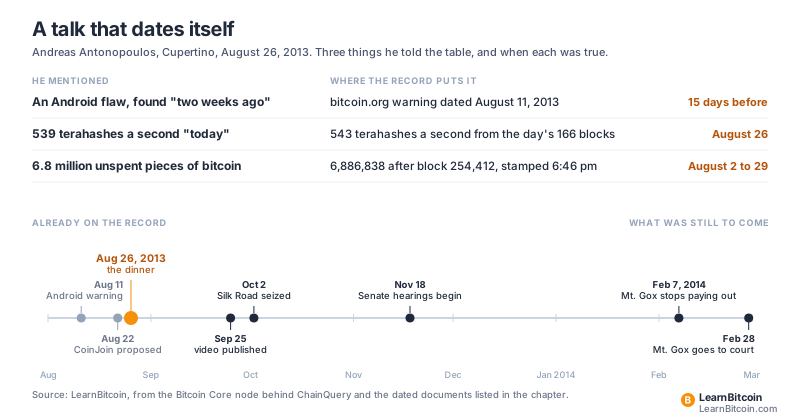
The video does not say when the dinner was, and its opening card calls the evening a "Bitcoin Lunch", though the listing says dinner and the club's own record gives the hours as 6:30 to 8:30 in the evening. The listing gives the date, and the talk itself confirms it. Bitcoin records payments in batches called blocks, about one every ten minutes. Each block has a number and a time stamp, written by the computer that produced it, and Bitcoin keeps every one. Together they are the chain, and three things he says that evening can be found on it or beside it.
Finding them takes the rest of this section and ends at block 254,412, stamped 14 minutes before he was due to start; the next section measures the network as it was that evening. To go straight to the lesson, skip to Why he cared.
The first is a flaw in Android phones that had put Bitcoin wallets at risk, which he says came to light two weeks earlier. The warning on bitcoin.org is dated August 11, 2013, fifteen days before the dinner.
The second is the network's computing power, called its hash rate, which he gives as 539 terahashes a second "today". Miners, the computers that add blocks to the chain, compete to solve a puzzle by guessing. Each guess is one run of a formula called a hash, and a terahash is a trillion of them. The chain records how hard the puzzle was and when each block was found, and the hash rate has to be worked out from those two. Block stamps are in UTC, the world's standard clock, and by that clock August 26, 2013, ended at 5:00 pm in Cupertino. The 166 blocks stamped on that day give 543 terahashes a second. Blocks arrive at random, so a figure for one day is good to about 8 percent either way: the days on either side give 494 and 552. With one block fewer, the same sum gives his 539.
The third is his count of the separate pieces of bitcoin on the ledger, 6.8 million, each one an amount that somebody has received and not yet spent. The technical name is unspent outputs, or UTXOs, and Bitcoin Core, the standard Bitcoin software, can report how many there were after any block. After block 254,412 there were 6,886,838, and the count stood between 6.8 and 6.9 million from August 2 to 29, 2013.
A fourth points the same way. He puts the value of all the bitcoin in existence at about 1.2 billion dollars, "1.3 as of this morning". By that block the schedule for new coins, which stops at 21 million, had issued 11,610,325 bitcoin, and at the day's reference price of 112.12 dollars, the daily close that Coin Metrics publishes, they come to 1.30 billion.
Block 254,412 is the last block stamped before he was due to start: 6:46 pm Pacific time, with the talk set for 7:00. We use it as the talk's place on the chain. A stamp is the miner's own reading of the clock, close to the real time and not exact.
The network he was describing
A node, a computer that keeps its own copy of the chain, can report how the network stood after any block. So the network of that evening can be set beside the network on the day we took our readings. We asked the Bitcoin Core node behind ChainQuery about block 254,412 and about block 975,500, stamped at 00:58 UTC on November 12, 2026.
After the first block Bitcoin Core counted 6,886,838 unspent outputs, and after the second 163,336,787. The schedule had issued 11,610,325 bitcoin by the first and 20,110,941 by the second, which is 95.8 percent of the 21 million.
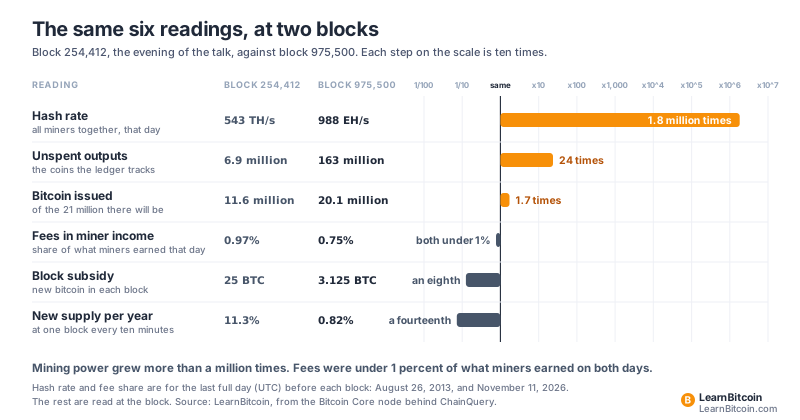
The hash rate is measured over the last full day before each block, August 26, 2013, and November 11, 2026, and so is the part of miners' income that came from fees, which the lesson reaches further on. An exahash is a million terahashes, so the network did about 1.8 million times as much work each second on the second of those days as on the first. Every reading, with the blocks and the days it covers, is in a file you can download. The rest of this chapter is the lesson he gave to the people in that room, when the network was that small.
Why he cared
Before any of the mechanics he says why Bitcoin matters to him. Banking as he means it, an account, credit and a way to send money abroad, reaches about a billion people, he says, and the other six and a half billion are shut out by politics and missing infrastructure and not for want of money. A cheap phone, he adds, is enough to reach them. He had been using the idea as a slogan since at least that May, when the captions of an earlier talk have it as "the other six billion". The World Bank's first worldwide survey, for 2011, asked a narrower question, whether a person had an account at a bank or a similar institution, and found that half of all adults, about 2.5 billion people, had none.
He tells the table he is not sure that Bitcoin is the system that wins, and that he is sure the invention is here to stay.
The problem Bitcoin solved
Antonopoulos starts the lesson with what was missing. Earlier digital money could prove who owned a coin but could not stop the owner from spending a copy of it twice, so each system needed a company in the middle to keep the books. Bitcoin lets strangers keep one set of books with nobody in the middle. It does that with a ledger everyone can check, and with a puzzle.
A puzzle kept ten minutes hard
His picture for the puzzle is a Sudoku, and this dinner is the earliest record we could find of him using it; it went into his book the following spring. Filling in the grid is hard, and checking a finished grid takes a glance along the rows and columns. Miners race to solve a puzzle of that kind, and everyone else can check the winner's answer at once. The solved puzzle is called proof of work. Each block, a batch of payments, is built on the one before, so every new block makes the older ones harder to redo.
The detail he stresses is that the puzzle is kept, in his words, "ten minutes hard". When computing power joins, the network makes the puzzle harder, and when power leaves it makes the puzzle easier, so that a block arrives about every ten minutes either way.
The adjustment comes in steps. The network resets the difficulty, its measure of how hard the puzzle is, once every 2,016 blocks, by looking at how long the last 2,016 took. Each such stretch is a difficulty period. When computing power is growing quickly, each new setting is out of date the day it takes effect, and in 2013 power was growing very quickly, a "shocking increase" as he puts it later in the evening: chips built for nothing but mining had first been shipped to customers that January. Across the difficulty period that includes the dinner, a block arrived every 7 minutes 34 seconds on average. Of the 31 difficulty periods that began in 2013, 30 ran faster than ten minutes, and the average over all of them was 8 minutes 16 seconds.
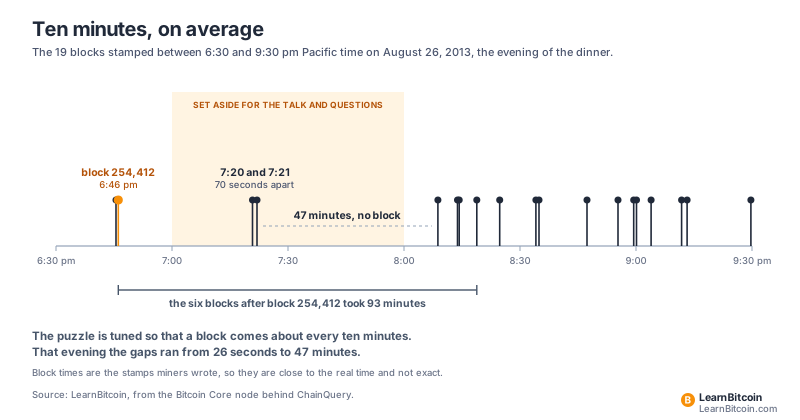
Ten minutes is also an average, and the evening itself shows it. By the stamps on the blocks, the hour set aside for his talk and the questions, 7:00 to 8:00 pm, produced two blocks, 70 seconds apart, at 7:20 and 7:21. The next one came 47 minutes later.
Twenty-one million, on a schedule
Miners are paid in new bitcoin, and that payment is the only way new bitcoin come into being. He gives the table the schedule: 50 bitcoin a block at the start, 25 since 2012, 12.5 from 2016, another cut in 2020, and so on until about 2140, when the last of 21 million will have been issued. The payment is cut in half every 210,000 blocks, which is four years at ten minutes a block, and each cut is called a halving. The first had come nine months before the dinner. The next two arrived in the years he gave: block 420,000 on July 9, 2016, and block 630,000 on May 11, 2020. Halvings has the full schedule.
New supply, he points out, shrinks on a timetable written into the software, and if demand keeps growing, each coin buys more as the years pass.
Nobody in charge
No government runs Bitcoin, he tells the table, and neither does any company or any group of programmers. More than a hundred other coins have appeared since Bitcoin, he says. The ones he describes each change one thing: one makes payments faster, one has a puzzle that searches for prime numbers, one loses value while it is held, and one sets aside a cut for its developers or for charity. He treats them as a pool for evolution to work on. His comparison is file sharing, where each network that was sued out of existence was followed by one that was harder to stop. If Bitcoin failed at something important, he says, a successor would take over. His stake, he tells the table, is in the invention more than in Bitcoin itself, the same point he made at the start.
What he would and would not promise
Antonopoulos is blunt with the table about risk. Bitcoin is "not a safe investment", he says. It is an experiment that could collapse in value, and anyone who calls it a sure bet is lying. He describes his own stake in it as hopelessly imprudent.
Then he says what he will guarantee: nobody can confiscate your bitcoin, seize it or inflate it away.
Someone at the table raises an objection. That May, American agents had seized about 5 million dollars from two accounts belonging to the US arm of Mt. Gox, the exchange in Tokyo that handled about half of all Bitcoin trading that August. Exchanges are the companies where bitcoin is traded for dollars. His answer draws a line he comes back to a few minutes later. The authorities took dollars, he says, because the dollars going in and out were what a currency regulator could reach. And a balance at an exchange is not bitcoin on the chain: trades inside Mt. Gox never touched the chain, and a customer's bitcoin was an entry in the company's own books until the day the customer withdrew it. He compares that to fractional reserve banking, in which a bank keeps on hand only part of what its customers have deposited.
The distinction mattered 165 days after the dinner, on February 7, 2014, when Mt. Gox stopped paying out bitcoin. On February 28 it asked a Tokyo court for protection from its creditors and said that about 750,000 of its customers' bitcoin and about 100,000 of its own were gone. Mt. Gox to FTX tells the rest.
Be your own bank
The guarantee, as the rest of his answer makes plain, is for bitcoin whose private keys nobody else holds. A private key is the secret number that lets its holder spend the coins. Trust someone else with your bitcoin, he tells the table, and the loss is yours. His advice was to be your own bank, and he described how he did it, with 5 percent of his bitcoin online and the rest on paper wallets, which are keys printed on paper by a computer started from a CD and never connected to a network, then locked in a safe. That was careful practice in 2013: the Bitcoin Wiki of the day called a paper wallet, properly made, "one of the safest ways possible to store Bitcoins". The advice changed later. Since October 2018 the same page has called the method obsolete and unsafe, and the paper wallet entry here explains why.
He said that ordinary computers were not safe enough for savings, and he told the table that an industry of purpose-built hardware wallets, small devices that hold keys and sign payments away from the computer, was on its way. One could already be ordered that summer, for one bitcoin, and its makers announced on July 28, 2014, that every one of those orders had shipped.
The line he drew holds for governments too. On October 1, 2013, American agents arrested the man who ran Silk Road, a market where drugs were sold for bitcoin. The next day they seized its servers and began moving the bitcoin held on them, about 29,655 in all, to an address of their own. An address is the string of letters and digits that a payment goes to. Three weeks later they took about 144,336 more from a wallet file found on his laptop. In both cases the state got hold of the keys.
The Android flaw he mentioned was a failure of keys too. A signature, the proof a key attaches to a payment, needs a fresh random number every time, and the faulty phones sometimes repeated one. Two signatures that share a random number are enough to work out the private key behind them, as he explains. The developers' mailing list had carried the warning on August 11, and the second message in that thread, under two hours later, is from Antonopoulos himself, asking who could explain the flaw on a podcast. The entry on nonce reuse has the mechanics.
The internet of money
The listing had promised "The Internet of Money", and during the questions he says what he means by it. Bitcoin is a platform as well as a coin. Payments are written in a small programming language that the network runs, so arrangements that used to need a bank or a lawyer in the middle, such as an escrow or a trust, can be written as rules the network enforces. Anyone can build on it without asking permission. The chain also works, he says, as a time stamp that nobody owns, which can do a notary's work. Run a document through a hash formula, put the short result into a block, and anyone can check afterwards that the document existed by then.
Bitcoin, he also tells the table, is not really very good at everyday payments, and he imagines a faster, lighter currency riding on top of it, with bitcoin as its reserve. Something of the kind arrived as the Lightning Network, which settles small payments without writing each one to the chain. The paper that proposed it appeared in February 2015, and in December 2017 its developers announced the first Lightning payments on Bitcoin's main network, the one that carries real bitcoin, to pass between all three programs then written for it.
How long a shop has to wait
One of the diners asks how a shop could take bitcoin if a payment needs ten minutes. His answer separates two things. A payment crosses the network in seconds, and the shop's own software can check at once that the coins exist and that the signature is good. What it cannot know yet is whether the payer has also signed the same coins over to somebody else, which is called a double spend. That is settled when a miner puts one of the two payments into a block, and every block added on top makes it harder to unsettle, because rewriting the record means redoing all of that work faster than the rest of the network. The block that holds a payment is its first confirmation, and each block after it adds one. He says a payment is fully confirmed after an hour, which is six blocks at ten minutes each, the usual standard. Ten minutes is an average, as that evening showed, and the six blocks after block 254,412 took 93 minutes.
His case for shops is that the fair comparison is with a card. A card payment looks instant, but the customer can dispute it afterwards, and the shop can lose the money. Visa's rules, in 2013 and in the edition we read in November 2026, allow 120 days for a charge to be disputed, and up to 540 days when goods or services never arrive. A bitcoin payment that is buried under blocks cannot be pulled back, which is why he calls it digital cash.
A ledger anyone can read
Asked whether Bitcoin is anonymous, Antonopoulos says it is nothing of the kind. Every payment since the first block is public and stays public. Addresses carry no names, but coins that are spent together link their addresses to each other, and an address is tied to a person the moment it touches an exchange that knows its customer. He calls the result a "privacy nightmare" and says it has to be fixed before Bitcoin goes worldwide. The mixing services of the day, which pooled users' coins to blur the trail, were in his view nowhere near good enough. He wanted strong mixing built in and switched on for every payment.
He was not alone in the worry that week. On August 22, 2013, the developer Gregory Maxwell had posted a proposal to the BitcoinTalk forum called "CoinJoin: Bitcoin privacy for the real world", a way for several people to combine their payments into one transaction so that an observer cannot tell whose coins went where. On October 24, two months after the dinner, researchers presented "A Fistful of Bitcoins", a paper that grouped addresses by owner from the public record, and put names to the groups by buying from them.
The concern has stayed with Bitcoin. CoinJoin exists as software a user has to go and find, no release of Bitcoin Core mixes coins by default, and following coins across the ledger became an industry of its own. Privacy on Bitcoin covers what works and what does not.
After the last coin
Someone asks the obvious question about a currency with a cap. When the last bitcoin has been issued, why would anyone go on mining? His answer is the standard one. A payment usually leaves a small amount unclaimed, the fee, and the miner who includes the payment in a block keeps it. A block that night paid its miner 25 new bitcoin plus the fees, and his example is a block that paid 25.125. As the new coins dwindle, fees have to carry more of the load, and if they fall short, he says, some miners leave and the puzzle gets easier for those who stay.
The chain shows how that had gone by November 2026. In the 166 blocks stamped on August 26, 2013, fees averaged 0.246 bitcoin a block, 0.97 percent of what miners earned that day. In the 134 blocks stamped on November 11, 2026, they averaged 0.024 bitcoin against 3.125 in new coins, which is 0.75 percent. One day is a small sample: over the seven days ending on each date the shares were 0.73 and 0.78 percent. The new coins in each block have been cut in half three times since that night, and on November 11, 2026, fees were under 1 percent of a miner's income, as they were on the day of the dinner. They have spiked from time to time, as in block 840,000, the block of the 2024 halving, which carried 37.6 bitcoin of them, but the spikes have not lasted. By November 11, 2026, the chain had not shown whether fees can carry the network by themselves.
One satoshi or a billion dollars
The price of a payment, he says, is small and even optional, and it is the same whether the payment carries one satoshi or a billion dollars. The fee depends on how much room a payment takes up in a block and not on how much money it moves. A satoshi, or sat, is the smallest unit of bitcoin: 100 million of them make one bitcoin. The blocks of that evening show the idea at work. Of the 6,089 transactions in the 19 blocks stamped between 6:30 and 9:30, 43 percent paid 0.0005 bitcoin, about 5.6 cents, 28 percent paid 0.0001, and 6.5 percent paid nothing at all. The largest transaction of the evening carried 2,780 bitcoin, about 312,000 dollars, and paid the same 5.6 cents.
The billion-dollar end of that range has since been seen at full size. On April 10, 2020, a single transaction spent 161,500 bitcoin, worth 1.1 billion dollars that day. It sent 15,000 of them on and the rest back to the sender, and its fee was 10,019 sats, or 69 cents.
A thousand cups of coffee
Antonopoulos uses a coffee shop to explain how money that gains value can still be spent. A customer holding bitcoin would rather keep it, hoping that the bitcoin that pays for one coffee will pay for a thousand in five years. The shop owner wants the bitcoin for the same reason. So the owner cuts the price in bitcoin until the customer gives in.
In his telling the thousand cups are the customer's hope. What the price did afterwards is on the record. The reference price on the day of the dinner was 112.12 dollars. Five years later, on August 26, 2018, it was 6,689.87 dollars, about 60 times as much. It first closed above a thousand times the dinner price on July 10, 2025. On August 26, 2025, twelve years to the day, it closed at 111,895.30 dollars, which is 998 times. On November 11, 2026, it was 73,805.52 dollars, or 658 times.
What he thought it was for
Late in the evening Antonopoulos lists what he expects Bitcoin to be used for, in order. First comes sending money home across borders, the remittance business, which he calls a broken market; the table agrees that the poorer the country, the worse the fee. Western Union, he says, will have to "adapt or die". After that come paying contractors and suppliers abroad, and last, transfers between banks.
For the quarter that included the dinner the World Bank put the average cost of sending 200 dollars home at 8.93 percent, and at 12.29 percent to Sub-Saharan Africa.
He pairs remittances with a second flow that runs the other way. Bitcoin sent home has to be sold for local money when it arrives, and the buyers he has in mind are the well-off trying to move savings out of failing currencies and past strict exchange controls, the rules that ration foreign currency. Argentina, he says, has both, along with the phones and the internet the idea needs, and is "right on the tipping point". The dollar, he expects, will be the last currency Bitcoin displaces, and the weakest will be the first. He does not expect a single winner either. The future he describes has five or six worldwide digital currencies alongside the national ones.
What worried him
Asked what worries him, Antonopoulos names nothing inside Bitcoin itself, apart from the chance of a serious bug nobody has found yet. He expects the regulatory climate to get, in his word, hairy, and he expects lawmakers to give drugs and terrorism as their reasons.
The Silk Road arrest came five weeks after the dinner, and that November the US Senate held two days of hearings on virtual currencies, the first of them under a title that began "Beyond Silk Road". The bug took longer: an inflation bug, one that could have let a miner create coins out of nothing, was reported to the developers on September 17, 2018, patched that evening and fixed in a release the next day; the developers knew of no attempt to use it.
After the dinner
Antonopoulos finished Mastering Bitcoin and wrote several more books, and in October 2014 he testified about Bitcoin to a committee of the Senate of Canada. His own site says he retired from public life in 2025, and that his Mastering books, his talks and his videos are released under a Creative Commons license, free for anyone to share and reuse.
One paragraph of the same page is in the spirit of the lesson. In January 2026 the Human Rights Foundation awarded him the third Finney Freedom Prize, which carries one bitcoin, and said he meant to give half of it to Creative Commons, the organization behind those licenses. His page says the prize was paid in a single transaction, half to him and half to Creative Commons, "as anyone can verify on the Bitcoin blockchain".
On March 2, 2026, the address the foundation publishes as the prize's treasury paid out 1.00005 bitcoin. Two blocks later, in block 939,062, the transaction his page links split that coin into two outputs of exactly half a bitcoin each, for a fee of 5,000 sats. The chain shows where the money came from and how it was divided. It does not say whose the two addresses are; that comes from his page.
Pro tip: When someone quotes a number about Bitcoin, ask which block it was read at. Most of the chain figures in this chapter came from asking a node two things about a block: how hard was the puzzle, and when was the block found. getblockheader answers both, and getblockstats adds the fees and the number of transactions.
What this buys us
- You know the problem Bitcoin solved. Digital money that cannot be spent twice, with no company in the middle keeping the books.
- You know how the puzzle works. It is hard to solve and quick to check, and it is reset every 2,016 blocks so that a block comes about every ten minutes on average.
- You know where the coins come from. New bitcoin pay the miners, the payment halves every 210,000 blocks, and it ends at 21 million. After that the fees have to do the work.
- You know whose bitcoin it is. It belongs to whoever holds the private key. A balance at an exchange is an entry in a company's books.
- You know the difference between seen and settled. A payment crosses the network in seconds and is settled by the block that holds it and the blocks that follow.
- You know how to find a moment on the chain. Block 254,412: 6:46 pm on August 26, 2013, 543 terahashes a second that day, 6.9 million unspent outputs.
The video is worth its 72 minutes, and every block from that evening is on the chain for anyone who wants to find it.
More in History
Sources
- Andreas M. Antonopoulos, filmed for the Jefferson Club - Bitcoin Cryptocurrency Crash Course with Andreas Antonopoulos - Jefferson Club Dinner Meetup (video, published September 25, 2013, 1:12:22; the page's own metadata gives uploadDate 2013-09-25T09:36:07-07:00; 205,625 views on November 12, 2026; automatic captions only)
- Meetup - Jefferson Club, Silicon Valley Chapter: 'Bitcoin: The Internet of Money', as the page stood on August 30, 2013 (Wayback Machine): '4 days ago' and '6:30 PM', Cafe Torre, 'Meeting fee ($35) includes dinner', the schedule, '7 attended', and members' notes on the evening, one of which records a live payment from one phone to another
- Meetup - the same event as the page stood on November 12, 2026: start 2013-08-26T18:30:00-07:00, end 21:30, Cafe Torre, 20343 Stevens Creek Boulevard, Cupertino, 15 places (the page sends visitors who are not logged in to a login screen)
- Jefferson Club - its own page for the event: 'Bitcoin: The Internet of Money', 'Date: August 26, 2013', with a link to this video (Wayback Machine copy of April 6, 2016)
- Jefferson Club - list of previous events, including Peter Thiel, 'Strong Crypto, Smart Cell Phones, and the End of Monetary Sovereignty', September 10, 1999; the page labels him CEO of PayPal (Wayback Machine copy of April 28, 2005)
- Jefferson Club - its own record of the lunch of September 10, 1999: 'Strong Crypto, Smart Cell Phones, and the End of Monetary Sovereignty', 'Noon to 2:00pm' (JSON)
- Jefferson Club - its own record of the first event on its list, November 13, 1997 (JSON)
- Jefferson Club - Purpose, as the page stood on October 3, 2001: 'Schedule presentations by free market thinkers to technology entrepreneurs and engineers' (Wayback Machine)
- Jefferson Club - its own record of this event: 'Bitcoin: The Internet of Money', August 26, 2013 (the record gives 8/26/13), '6:30pm to 8:30pm', with the Meetup number 132791502 and the video's YouTube id (JSON)
- PayPal, Inc. - prospectus (Form 424B4), filed with the SEC on February 15, 2002: Confinity, Inc. was incorporated in December 1998; Peter Thiel co-founded it and was its chief executive through March 2000; 'The PayPal product launched in October 1999'
- BitcoinTalk, aantonop, April 22, 2013 (edited May 6, 2013) - he opens a thread about a proposal for a Bitcoin book and looks for co-authors
- bitcoinbook/bitcoinbook - the first commit of the manuscript, July 17, 2013, 18:23:01 UTC; the next commit, three minutes later, heads the book file 'Mastering Bitcoin'
- O'Reilly Media - Mastering Bitcoin, by Andreas M. Antonopoulos, first edition, December 2014
- Twitter - @aantonop's profile on August 18, 2013: 355 followers; the page's own data give the account's creation date, May 30, 2013 (Wayback Machine; the capture is of Twitter's Arabic interface and shows the counts in Eastern Arabic digits)
- bitcoinbook/bitcoinbook - commit of April 2, 2014, that adds the Sudoku comparison to chapter 2 of Mastering Bitcoin
- Andreas M. Antonopoulos - Bitcoin Neutrality, Bitcoin 2013 conference, San Jose, May 18, 2013 (video published June 10, 2013): the captions already have 'the other six billion'
- LearnBitcoin - readings at block 254,412 and block 975,500 and for the day before each, from the Bitcoin Core node behind ChainQuery, read November 12, 2026 (CSV)
- LearnBitcoin - the 31 difficulty periods that began in 2013: difficulty, average time between blocks, hash rate (CSV)
- mempool.space - block 254,412, stamped August 27, 2013, 01:46:06 UTC (6:46 pm on August 26 in California), the last block stamped before the talk was due to start
- mempool.space - block 254,413, stamped 02:20:49 UTC, the first of the two blocks stamped in the hour set aside for the talk and the questions; block 254,414 follows 70 seconds later and block 254,415 not until 03:08:46
- mempool.space - block 975,500, stamped November 12, 2026, 00:58:35 UTC
- mempool.space - block 210,000, stamped November 28, 2012, the first halving
- mempool.space - block 420,000, stamped July 9, 2016, the second halving
- mempool.space - block 630,000, stamped May 11, 2020, the third halving
- mempool.space - block 840,000, stamped April 20, 2024 (UTC), the fourth halving: 37.62561499 BTC in fees
- Coin Metrics - community data, BTC PriceUSD daily close: 112.12 on August 26, 2013; 6,689.87 on August 26, 2018; 6,859.82 on April 10, 2020; 115,873.90 on July 10, 2025 (the first close above 112,120); 111,895.30 on August 26, 2025; 73,805.52 on November 11, 2026
- Bitcoin Magazine (Vitalik Buterin), January 23, 2013 - Avalon Ships Bitcoin's First Consumer ASICs
- Visa - Visa International Operating Regulations, the edition of April 15, 2013: chargeback time limits of 120 calendar days, and not more than 540 where goods or services were not received (Wayback Machine copy of May 18, 2013)
- Visa - Visa Core Rules and Visa Product and Service Rules (October 24, 2026), dispute time limits: 120 calendar days from the transaction, and not more than 540 where goods or services were not received
- BitcoinTalk, Gregory Maxwell, August 22, 2013 - CoinJoin: Bitcoin privacy for the real world
- ACM Internet Measurement Conference 2013, program: 'A Fistful of Bitcoins: Characterizing Payments Among Men with No Names' presented on October 24, 2013
- Meiklejohn, Pomarole, Jordan, Levchenko, McCoy, Voelker and Savage - A Fistful of Bitcoins: Characterizing Payments Among Men with No Names (IMC 2013)
- US District Court, District of Maryland, case 13-1085 SAG - return on the seizure warrant executed on May 9, 2013: 2,109,214.09 dollars from the Wells Fargo account of Mutum Sigillum LLC (RECAP copy)
- US District Court, District of Maryland, case 13-1162 SKG - return on the seizure warrant executed on May 14, 2013: 2,915,507.40 dollars from the Dwolla account of Mutum Sigillum LLC (RECAP copy)
- US District Court, District of Maryland, case 13-1162 SKG - seizure warrant of May 14, 2013, for the Dwolla account of Mutum Sigillum LLC, Mt. Gox's US subsidiary; the affidavit records a warrant of May 9, 2013, for its Wells Fargo account (scan hosted by Ars Technica)
- bitcoinwatch.com on August 24, 2013 - 24-hour volume by market: Mt. Gox's markets carry 21,936 of 43,356 BTC, 50.6 percent (Wayback Machine)
- Bitcoinity - monthly trading volume by exchange, in BTC: Mt. Gox 745,623 of 1,619,436 BTC in August 2013, 46.0 percent, down from 69.6 percent in April (CSV)
- MtGox Co. Ltd., February 7, 2014 - Statement Regarding BTC Withdrawal Delays: 'All bitcoin withdrawal requests will be on pause' (Wayback Machine)
- MtGox Co., Ltd., February 28, 2014 - Announcement regarding an application for commencement of a procedure of civil rehabilitation: 'approximately 750,000 bitcoins deposited by users and approximately 100,000 bitcoins belonging to us'
- bitcointrezor.com - the shop on June 18, 2013: a hardware wallet on pre-order for 1 BTC, 'Delivery est. November 2013' (Wayback Machine)
- SatoshiLabs news, July 28, 2014 - TREZOR on the Way: every pre-ordered unit of the one-bitcoin model has shipped (Wayback Machine)
- Bitcoin Wiki - Paper wallet, as it stood from April 2 to October 9, 2013 (Wayback Machine copy of August 19, 2013): 'When done properly, paper wallets are one of the safest ways possible to store Bitcoins.'
- Bitcoin Wiki - Paper wallet (read November 12, 2026; rewritten October 26, 2018): 'an obsolete and unsafe method of storing bitcoin which was popular between 2011 and 2016'
- bitcoin.org - Android Security Vulnerability, August 11, 2013: the flaw could 'render all Android wallets generated to date vulnerable to theft' (Wayback Machine copy of August 13, 2013)
- LearnBitcoin archive - bitcoin-dev, 'Android key rotation', August 11, 2013: Mike Hearn's warning at 16:28 UTC and, second in the thread at 18:21 UTC, Andreas M. Antonopoulos asking who could explain the issue in an interview
- Android Developers Blog (Alex Klyubin), August 14, 2013 - Some SecureRandom Thoughts: weak values 'due to improper initialization of the underlying PRNG'
- US Attorney, Southern District of New York, October 25, 2013 - the seizure of about 144,336 bitcoins found on Ross Ulbricht's computer, 'Along with a prior seizure of approximately 29,655 Bitcoins'; arrest on October 1, 2013
- US District Court, Southern District of New York, United States v. Ulbricht, 14 Cr. 68 - trial transcript of January 29, 2015 (Document 212): a former FBI agent describes moving the coins from Silk Road's servers to a government address from October 2, 2013, and the coins from a wallet file on the laptop to a second address (RECAP copy)
- mempool.space - the largest transaction in the dinner blocks: outputs of 2,780.32 BTC, fee 50,000 sats (block 254,413)
- mempool.space - block 625,332, April 10, 2020: one transaction spends 161,500.99966998 BTC, sends 15,000 BTC on and the rest back to the sender, for a fee of 10,019 sats
- Poon and Dryja - The Bitcoin Lightning Network, as first posted: the authors' site on February 28, 2015, lists 'Feb 28, 2015: Paper Version 0.5' (Wayback Machine)
- Blockstream (Christian Decker and Rusty Russell), December 6, 2017 - 'the world's first mainnet Lightning transactions using all three Lightning implementations'
- World Bank (Demirguc-Kunt and Klapper), April 2012 - Measuring Financial Inclusion: The Global Findex Database: '50 percent of adults worldwide have an account at a formal financial institution'; 'more than 2.5 billion adults do not have a formal account'
- World Bank - Remittance Prices Worldwide, Issue 7, September 2013: the global average cost of sending $200 'currently stands at 8.93 percent'; 12.29 percent to Sub-Saharan Africa
- US Senate Committee on Homeland Security and Governmental Affairs, November 18, 2013 - hearing 'Beyond Silk Road: Potential Risks, Threats, and Promises of Virtual Currencies' (S. Hrg. 113-516)
- US Senate Committee on Banking, Housing, and Urban Affairs, November 19, 2013 - hearing 'The Present and Future Impact of Virtual Currency' (S. Hrg. 113-210)
- Bitcoin Core, September 20, 2018 - CVE-2018-17144 full disclosure: reported on September 17, 2018, patched that evening, fixed releases out the next day; 'This could allow a miner to inflate the supply of Bitcoin'; 'We are unaware of any attempts to exploit this vulnerability'
- Senate of Canada, Standing Senate Committee on Banking, Trade and Commerce - evidence of October 8, 2014, with Andreas M. Antonopoulos as witness
- Andreas M. Antonopoulos - About (read November 12, 2026): 'In 2025, Andreas retired from public life'; 'his Mastering books, and all of his talks and videos, are released under the Creative Commons Attribution-ShareAlike license (CC BY-SA)'; the prize 'paid in a single transaction'; his testimony to the Senate of Canada in October 2014
- Human Rights Foundation - Finney Freedom Prize, about Andreas Antonopoulos (January 2026): the third Finney Freedom Prize; he intends to give half of the prize money to Creative Commons
- Human Rights Foundation - Finney Freedom Prize: one bitcoin for each prize, paid from a treasury whose address the page links
- mempool.space - block 939,060, March 2, 2026: the prize treasury's address pays out 1.00005 BTC
- mempool.space - block 939,062, March 2, 2026, 23:27:41 UTC: that coin is split into two outputs of 0.5 BTC each, fee 5,000 sats
Published . No corrections logged for this page.
Edit this page on GitHub